
Key Takeaways:
- Curtain wall systems in the UK range from £300–£500/m² for stick-built to £600–£900+/m² for structural glazing, with unitised systems at £500–£800/m².
- All curtain walling must comply with BS EN 13830 and carry UKCA marking, while buildings over 18 metres must meet post-Grenfell combustibility requirements under Approved Document B.
- High-performance aluminium curtain walls achieve U-values of 0.8–1.2 W/m²K, comfortably meeting Part L 2025 targets with polyamide thermal breaks and low-E glazing.
- Schuco, Kawneer, Reynaers, and Technal dominate the UK market, each offering distinct advantages for different project types and performance requirements.
- Choosing between stick-built, unitised, semi-unitised, and structural glazing depends on building height, programme speed, budget, and quality control demands.
Walk through any major UK city centre and you will see curtain walling everywhere — from the floor-to-ceiling glass facades of Canary Wharf to the sleek entrance screens of retail developments in Manchester and Birmingham. Aluminium curtain wall systems account for a significant share of the UK’s £3.13 billion facade market in 2026, growing at roughly 4.2% per year as net-zero targets and post-Grenfell regulations reshape how we build commercial exteriors.
Yet for many architects, developers, and building owners, specifying curtain walling remains full of technical jargon and cost variables that are difficult to pin down. What U-value do you need? Which system suits a six-storey office? How do you handle fire safety at the curtain wall junction?
This guide answers those questions. Written from the perspective of a commercial glazing installer with over 20 years of experience, it covers system types, materials, thermal and acoustic performance, UK standards, fire safety, costs, and the leading suppliers working in the UK today.

What Is an Aluminium Curtain Wall System?
A curtain wall is a non-loadbearing external wall system that hangs from the building’s primary structure. It carries no floor or roof loads — instead, it transfers wind loads and its own dead weight back to the structural frame through brackets fixed at each floor slab.
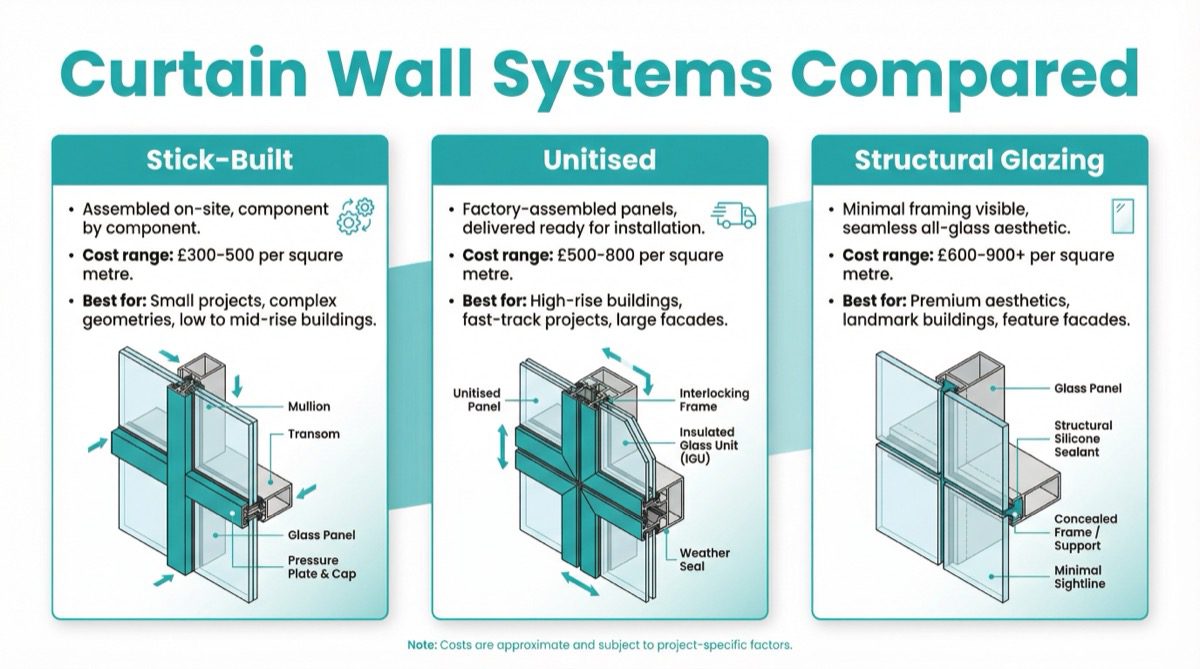
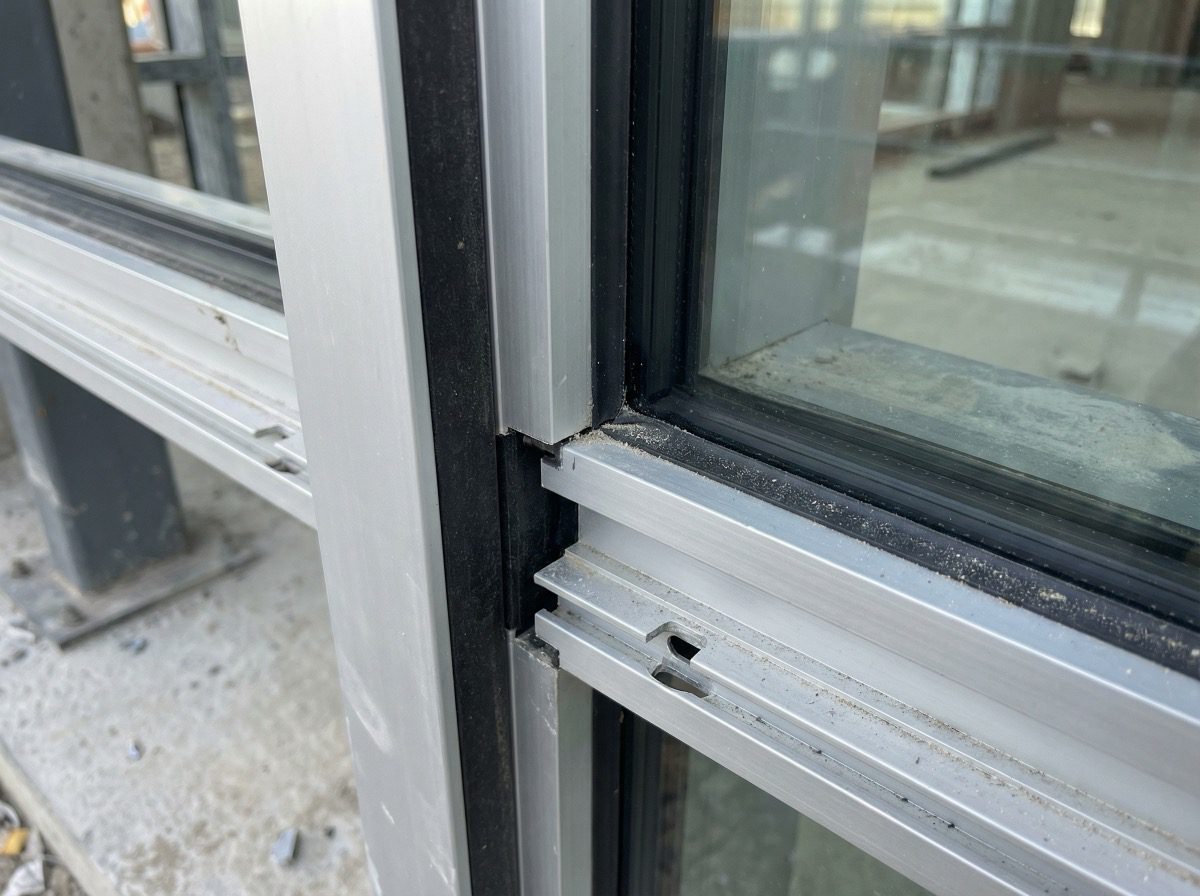
The typical aluminium curtain wall system consists of vertical mullions and horizontal transoms forming a grid. Into that grid sit infill panels — glass, insulated spandrel panels, louvres, or openable vents. Pressure plates and capping strips hold everything in place, compressing EPDM or silicone gaskets to create the weather seal.
What sets curtain walling apart from a standard window is scale and structural independence. A window sits within an opening in a loadbearing wall. A curtain wall spans entire elevations, floor to floor, and the structure behind serves only as a fire barrier and thermal line. This distinction affects structural design, fire compartmentation, and building control submissions. If you are comparing curtain walling against a conventional shop front or aluminium shop front, our guide on storefront vs curtain wall differences covers that comparison in detail.
Types of Curtain Wall Systems
Four main system types are used in UK construction, each suited to different building heights, budgets, and performance targets.
Stick-Built Systems
Stick-built curtain walling arrives on site as individual components — mullions, transoms, gaskets, pressure plates, and glazing units — and is assembled piece by piece. It is the most common choice for projects under 4,000 m² of facade area and for buildings with complex or irregular geometries.
The advantages are flexibility and lower upfront cost. If panel sizes change during construction, a stick system can usually accommodate the revision without re-engineering the facade. The trade-off is speed: assembly is slower, weather-dependent, and demands rigorous on-site quality control. Typical UK cost: £300–£500/m², rising to £450–£650 for high-performance variants.
Unitised Systems
Unitised systems take the opposite approach. Complete panels — pre-glazed, pre-sealed, and factory-tested — are craned into position and interlocked with their neighbours. For buildings of ten storeys or more, unitised is almost always preferred. Installation can be up to 50% faster than stick-built because panels are hung from inside the building, and quality control is far better under factory conditions.
The downside is cost and logistics. Pre-glazed panels are expensive to transport, and the structural frame must be built to tighter tolerances. Typical UK cost: £500–£800/m².
Semi-Unitised (Hybrid) Systems
Semi-unitised systems split the difference. Mullions are installed as a stick system, then pre-assembled transom-and-panel cassettes clip into place. This works well for mid-rise buildings of four to ten storeys where a full unitised system is overkill but the programme cannot afford a complete stick build. Costs sit closer to stick-built levels with some of the speed advantages of unitised fabrication.
Structural Glazing Systems
Structural silicone glazing (SSG) bonds glass directly to the frame using structural silicone, eliminating visible external pressure plates. The result is a seamless, frameless facade. SSG demands the highest manufacturing precision and careful movement design. Openable vent options are limited, and costs are the highest of any type. Typical UK cost: £600–£900+/m².
For a deeper look at the trade-offs of each system, our guide to curtain walling advantages and disadvantages covers the full picture.
Materials Used in Curtain Wall Construction
Aluminium: Why It Dominates
Aluminium accounts for the vast majority of curtain wall framing in the UK. It weighs roughly one-third as much as steel, does not rust, and can be extruded into almost any profile shape for slim sightlines and maximum glass area. Modern systems use 6060 or 6063 series alloys with surface finishes including polyester powder coating (PPC) in any RAL colour, anodising, and dual-colour options.
Aluminium is also 100% recyclable with no quality loss, and recycled aluminium requires just 5% of the energy of primary production. Suppliers like Technal and Hydro now offer low-carbon profiles with verified carbon footprints below 4 kg CO&sub2;/kg.
Steel and Timber Alternatives
Steel curtain walls suit heritage projects or long spans but are heavier, costlier to fabricate, and need corrosion protection. Timber curtain walling has a niche in low-rise, sustainability-focused projects — glulam mullions offer low embodied carbon, though durability in exposed conditions is limited compared with aluminium.
Glass and Glazing Options
Glazing specification has the single biggest impact on thermal performance, solar control, and acoustics:
- Double glazed units (DGUs) — the UK standard. A typical 6mm / 16–20mm argon / 6mm low-E spec achieves a centre-pane U-value of 1.1–1.4 W/m²K.
- Triple glazed units — centre-pane U-values of 0.6–0.8 W/m²K for projects targeting Part L compliance or BREEAM Excellent.
- Low-E coatings — metallic oxide layers that reflect radiant heat back into the building while transmitting visible light.
- Solar control coatings — reduce the g-value to prevent summer overheating on south and west elevations.
- Acoustic interlayers — laminated glass with PVB interlayers improves sound reduction by 3–8 dB for buildings near busy roads.
Curtain wall glazing is almost always toughened or laminated safety glass to meet BS EN 12600 impact requirements. For smaller installations, our guide on double vs single glazing covers that comparison separately.
Thermal Performance and Part L Compliance
Thermal performance is where poorly specified curtain walls fail. The frame, glazing, and every junction between them contribute to the overall U-value, and getting one element wrong can pull the entire facade out of compliance.
U-Value Requirements
Under Approved Document L, curtain walling in new non-domestic buildings should achieve 1.6 W/m²K or better. In practice, best-practice design targets 1.2 W/m²K or below. High-performance systems from Schuco (FWS 60+) and Reynaers (CW 50-HI) achieve 0.8–1.2 W/m²K with triple glazing and enhanced thermal breaks. SAP 10 assessments now demand figures approaching 1.0 W/m²K for residential projects.
Thermal Breaks
Polyamide thermal breaks (24–34mm deep) are inserted between inner and outer aluminium profiles to prevent thermal bridging. But the brackets connecting the curtain wall to the structure also penetrate the thermal break zone, creating point bridges. Advanced systems use stainless steel or composite brackets to address this.
The complete U-value calculation must account for frame, glazing, thermal breaks, brackets, and all junctions per BS EN ISO 10077. Quoting a centre-pane U-value alone is misleading — frame and junction losses can add 30–50% to the actual installed figure.
Part L 2025 and the Future Homes Standard
The 2025 Part L updates introduce tighter targets aligned with the net-zero trajectory. Systems designed to the minimum 1.6 W/m²K may no longer leave enough margin in the whole-building energy model, particularly on projects with high glazing ratios. The shift towards whole-building fabric performance means specifying a 1.0 W/m²K curtain wall may offset costs elsewhere in the building envelope.
UK Standards and Regulations
The regulatory framework involves several overlapping standards. Understanding which apply is essential for specification and building control submissions.
BS EN 13830: The Product Standard
BS EN 13830:2015+A1:2020 is the primary UK standard for curtain walling. It covers wind load resistance, dead load, impact resistance, air permeability, watertightness, thermal performance, sound insulation, and fire resistance. All curtain wall products must be assessed against it and carry UKCA (or CE) marking.
Performance Testing Standards
BS EN 12152 — Air Permeability: Classes A1–A4, with A4 (lowest leakage at 600 Pa) standard for energy-demanding buildings.
BS EN 12153 — Watertightness: Classes R4–R7, with R7 (600 Pa without leakage) the typical UK target for driving rain exposure.
BS EN 12179 — Wind Load Resistance: Full-scale testing under positive and negative wind loads. Systems must withstand 1.5 times the design wind pressure.
Our guide on curtain walling planning permission and building regulations covers the submission process step by step.
Fire Safety Requirements
Fire safety in curtain wall design has been under intense scrutiny since Grenfell. The regulatory changes that followed have fundamentally altered how curtain walls are specified on taller buildings.
Post-Grenfell Changes and Approved Document B
The Building Safety Act 2022 and amendments to Approved Document B ban combustible materials in external walls of buildings over 18 metres (Regulation 7). All curtain wall materials on these buildings must achieve A2-s1,d0 or better. Aluminium and glass inherently meet this. The areas needing careful specification are spandrel panel insulation, intumescent fire seals, and composite infill panels.
BS 8414: Large-Scale Fire Testing
Where a system cannot prove every component meets A2-s1,d0, it can be validated through BS 8414 large-scale fire testing — a full-scale rig of at least 9 metres, assessed against BR 135 criteria. Testing costs £50,000–£100,000 per test but is the only alternative compliance route for buildings over 18 metres.
Fire Stopping at Junctions
The perimeter fire barrier between floor slab and curtain wall is a critical detail. This 25–75mm gap must be sealed with an intumescent fire stop to prevent fire and smoke passing between floors. Poor fire stopping contributed to several high-profile facade fires. Building control inspectors now pay close attention, and third-party inspection is increasingly mandatory on higher-risk buildings.
For a fire safety comparison between facade types, see our guide to curtain wall vs cladding.
Acoustic Performance
A standard curtain wall with double glazing achieves a weighted sound reduction (Rw) of 30–35 dB — fine for quiet locations but insufficient near busy roads, railways, or flight paths. Reaching 38–50 dB Rw requires laminated acoustic glazing (adding 3–8 dB), asymmetric DGUs that break up resonance effects, and meticulous edge sealing — even a small air gap can cost several decibels.
Acoustic performance is tested to BS EN ISO 10140. The critical flanking paths are where the curtain wall meets floor slabs and partition walls, and sound transmission through these junctions can undermine even the best glazing specification.
How Much Does Curtain Walling Cost in the UK?
The following ranges reflect typical UK market rates for 2025–2026, covering supply and installation.
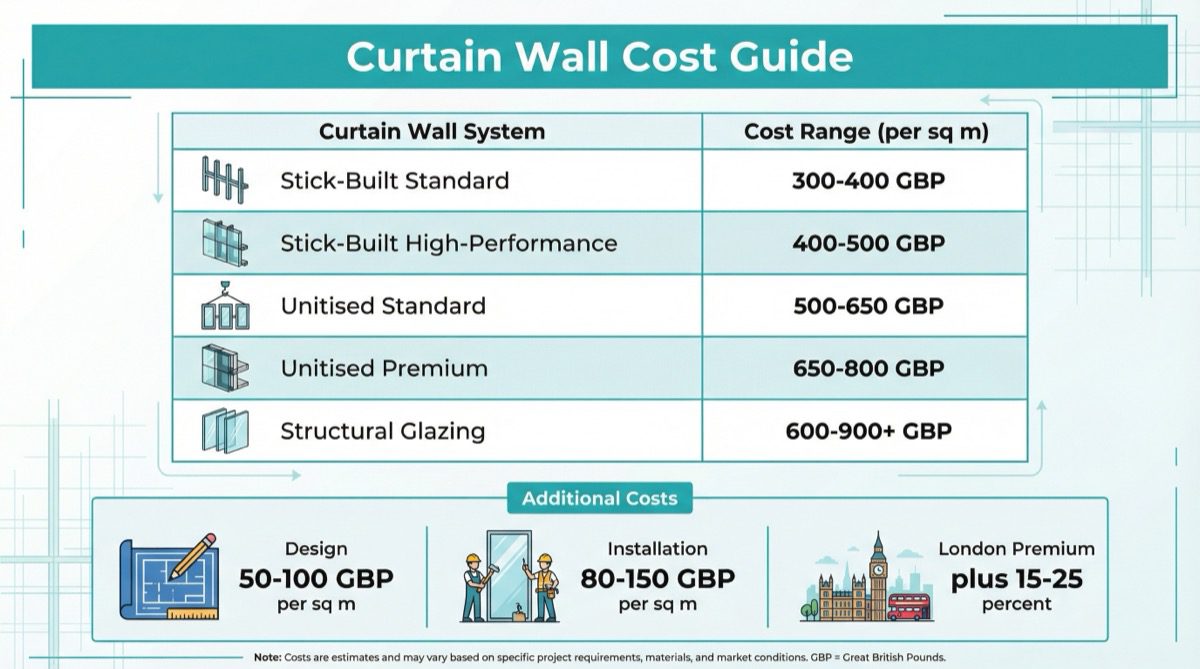
| System Type | Cost per m² (Supply + Install) | Best Suited For |
|---|---|---|
| Stick-built (standard) | £300–£500 | Low/mid-rise, smaller projects, complex geometries |
| Stick-built (high-performance) | £450–£650 | Enhanced thermal spec, Part L compliance |
| Unitised (standard) | £500–£700 | High-rise, large projects, fast programmes |
| Unitised (high-performance) | £650–£900 | Premium spec, complex geometry |
| Structural glazing (SSG) | £600–£900+ | Frameless appearance, flagship projects |
What Drives the Cost?
- Building height — scaffolding, mast climbers, and crane time add 15–30% above four storeys.
- Glazing specification — triple glazing costs 20–35% more than double; add solar control or acoustic interlayers and the glazing cost can double.
- Frame finish — anodised adds 10–15% over standard PPC; dual-colour adds 15–25%.
- Design complexity — curves, facets, and bespoke feature panels increase engineering and fabrication costs.
- Project size — economies of scale above 500 m² of facade area.
- Location — London carries a 15–25% premium over regional projects.
- Installation method — stick systems have lower material costs but higher labour; unitised costs more upfront but installs faster.
Whole-Life Costing
GreenSpec data shows an aluminium stick system has a capital cost of roughly £368/m² but a 60-year net present value of £592/m² once maintenance, gasket replacement, and eventual refurbishment are included. Unitised systems sit at £476/m² capital with a £714/m² 60-year NPV — higher in absolute terms, but reduced maintenance access costs can make unitised more economical on taller buildings over the full life cycle. Most systems need major refurbishment at 25–35 years.
For broader facade cost comparisons, see our guide to shop front costs in the UK.
Leading UK Curtain Wall System Suppliers
Schuco (18–20% UK market share) — the benchmark for thermal performance. Their FWS 50+ and FWS 60+ stick systems and UCC 65 SG unitised system appear on the highest-profile UK projects. If the brief demands Passive House certification or U-values below 1.0 W/m²K, Schuco is typically on the shortlist.
Kawneer (16–18%) — manufactured in Runcorn, Cheshire. The AA 100 and AA 110 ranges are among the most specified in UK education and healthcare. Strengths include expansion joint innovations accommodating ±15mm structural movement and strong architect technical support.
Reynaers Aluminium (12–14%) — the CW 50-HI and CW 50-SC ranges have a strong presence in education, healthcare, and residential. Their Part L compliance focus and CPD programme for architects drive high specification rates on public-sector projects.
Technal / Hydro (10–12%) — the MX curtain wall range. Hydro’s CIRCAL and REDUXA low-carbon aluminium options offer the lowest verified embodied carbon in the industry, making Technal the go-to for projects where BREEAM rating or whole-life carbon is a priority.
Senior Architectural Systems and Jack Aluminium — both UK-based, targeting mid-market and smaller projects. Senior’s SF52 and SF62 ranges integrate with their window and door systems. Jack Aluminium’s JCW system suits projects where the engineering overhead of larger system houses is not justified.
Choosing the Right System for Your Project
The decision framework comes down to four variables:
Building height: Stick-built suits buildings up to four storeys. Semi-unitised works well from four to ten. Above ten storeys, unitised is the standard — it is faster, safer, and less weather-dependent at height.
Programme: Unitised panels can recover weeks on a tight programme because factory fabrication runs in parallel with the structural frame. Installation rates of 20–30 panels per day are achievable on large projects.
Performance: Not all systems accommodate the thicker thermal breaks or triple glazing needed for U-values below 1.0 W/m²K. Schuco FWS 60+ and Reynaers CW 50-HI are engineered for this tier.
Aesthetics: Mullion face widths range from 50mm to 65mm+. The choice between capped, toggle-fixed, or structurally glazed framing has a major visual impact. Where curtain walling meets a ground-floor aluminium shop front, careful junction detailing is essential. Our guide to shop front design ideas covers creative ground-floor solutions.
Curtain walling is not always the right answer. For ground-floor retail, a conventional shop front system is more practical. For solid-dominant facades, rainscreen cladding with punched windows may be more cost-effective. Our guides to storefront vs curtain wall and curtain wall vs cladding cover these comparisons.
The Installation Process
Curtain wall installation follows four stages, and understanding them helps avoid common sources of delay.
Design and engineering (6–12 weeks): The contractor produces shop drawings and structural calculations, coordinated with the architect’s design intent and the structural engineer’s frame drawings. Bracket positions, movement allowances, and fire stop details are resolved before fabrication begins.
Fabrication (8–16 weeks): Profiles are cut, machined, and assembled. For unitised systems, panels are fully glazed and weather-tested in the factory. Lead times extend during busy periods.
Site installation: Stick systems progress at roughly 15–25 m² per day on a four-storey building. Unitised systems achieve 40–60 m² per day once the rhythm is established. Brackets go on first, followed by mullions, transoms, gaskets, glazing, and capping (stick) or complete panels lifted into position (unitised).
Commissioning and handover: Snagging, on-site water testing with a calibrated spray rack, and handover of test certificates, maintenance manuals, and as-built drawings. Exterior lighting design is worth considering at this stage for buildings where the facade doubles as a branding element after dark.
Frequently Asked Questions
What is the difference between a curtain wall and a window wall?
A curtain wall spans floor to floor and hangs in front of the slabs. A window wall sits between floors, resting on each slab. Curtain walls handle greater wind loads and suit taller buildings; window walls are lighter, cheaper, and work well on low to mid-rise projects.
How long does a curtain wall system last?
Design life is 40–60 years. The aluminium framing lasts indefinitely, but glazing units, gaskets, and sealants typically need replacement at 25–35 years. Regular maintenance extends the service life.
Can curtain walls be used on residential buildings?
Yes — they are common on residential towers and build-to-rent schemes. Buildings over 18 metres must meet the combustible materials ban under Regulation 7 and have fire stopping at every floor level.
What U-value should I specify?
Part L minimum is 1.6 W/m²K, but best practice in 2025–2026 is 1.0–1.2 W/m²K. Passive House projects need 0.8 W/m²K or below, typically requiring triple glazing and enhanced thermal breaks.
Do I need planning permission for curtain walling?
Usually covered by the building’s planning consent for new builds. Retrofitting, conservation areas, and listed buildings may need specific approval. Our planning permission guide covers the detail.
What is the difference between stick-built and unitised?
Stick systems are assembled on site (£300–£500/m², slower, flexible). Unitised systems are factory-assembled and craned in (£500–£800/m², up to 50% faster, better quality control). Unitised is preferred above ten storeys.
How do curtain walls perform in a fire?
Aluminium and glass are non-combustible. The critical detail is the perimeter fire barrier between curtain wall and floor slab. On buildings over 18 metres, all components must meet A2-s1,d0 and may require BS 8414 testing.
Can curtain walls be opened for ventilation?
Yes. Most systems accommodate top-hung, side-hung, parallel-opening, or louvre vents within the mullion and transom grid. Structural glazing systems have more limited vent options due to the frameless external appearance.
What maintenance does a curtain wall need?
Annual glass cleaning, gasket and sealant inspection, and drainage clearance. A more thorough survey of thermal breaks, fire stops, and glass units every 5–10 years. Proper maintenance ensures the system reaches its full 40–60 year design life.
How does curtain walling compare to cladding?
Curtain walling is a glazed, non-loadbearing facade system maximising transparency. Cladding is a broader term covering opaque finishes like rainscreen, brick slips, and composite panels. Curtain walling costs more but delivers superior daylighting and visual impact. Our full comparison goes into the detail.
Work With Huxley & Co on Your Curtain Walling Project
Huxley & Co has been designing, supplying, and installing commercial glazing and curtain wall systems across the UK for over 20 years. We hold FENSA, CHAS, and Constructionline accreditations and work with all the leading system suppliers including Schuco, Kawneer, Reynaers, and Technal.
Whether you need a stick-built system for a four-storey office or a unitised facade for a 20-storey residential tower, we handle the full process — from design consultation and system selection through fabrication, installation, and commissioning.
Call us on 020 7112 4849 or get in touch online to discuss your project.