

Key Takeaways:
- Most commercial curtain wall installations fall under permitted development and do not need planning permission — but Building Regulations approval is always required.
- Planning permission is needed if the property is in a conservation area, is a listed building, is subject to an Article 4 direction, or the work materially changes the building’s external appearance.
- Building Regulations Part L (energy), Part B (fire safety), and Part K (glazing safety) apply to every curtain wall project, even like-for-like replacements.
- Listed Building Consent is a separate requirement from planning permission — any works affecting a listed building’s character need it, including internal alterations.
- Huxley & Co manage the full regulatory process for curtain walling projects, from pre-application enquiries through to Building Control sign-off.
You have finalised the design for a curtain wall installation on a commercial property in central London. The contractor is booked — and then someone asks whether you need planning permission. Suddenly you are not sure whether a formal application is required, whether Building Regulations are the same thing, or whether the conservation area your building sits in changes everything.
This confusion comes up constantly at Huxley & Co. Planning permission and Building Regulations are two completely separate legal processes, and mixing them up can mean enforcement notices, costly delays, or having to strip out finished work. This guide explains when each one applies to curtain walling in the UK.
Planning Permission vs Building Regulations: Two Different Things
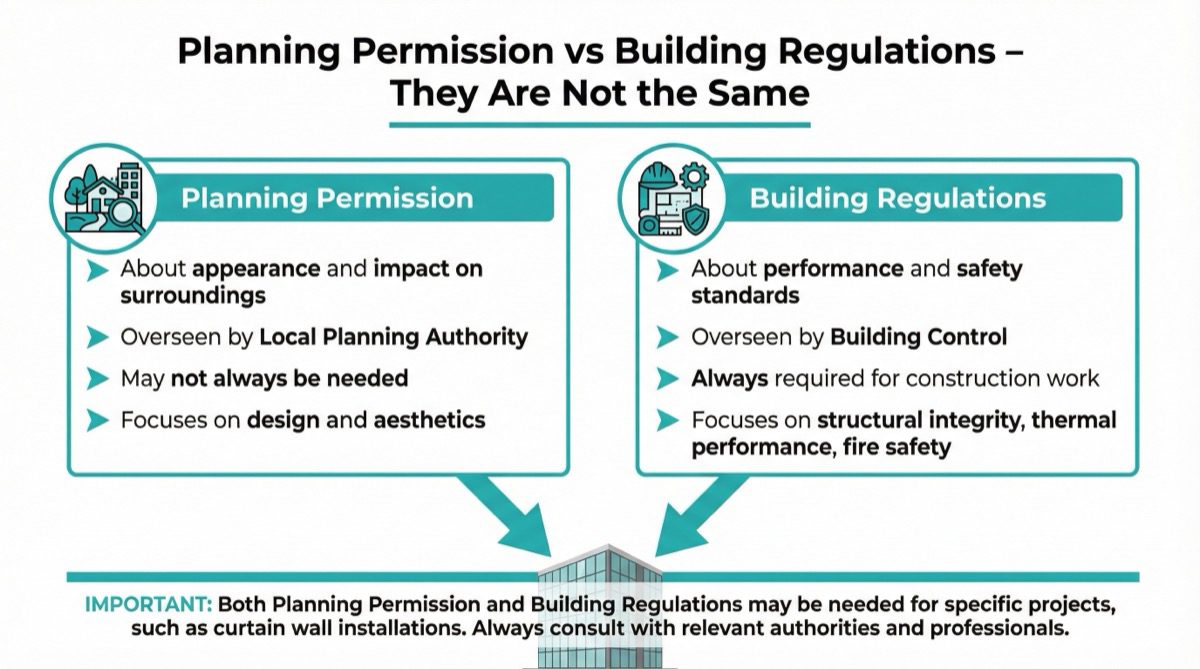
Planning permission is about external appearance, impact on neighbours, and land use. It is determined by your Local Planning Authority (LPA) — typically the council. For curtain walling, the question is whether the installation changes how the building looks from outside and whether it fits the surrounding area.
Building Regulations are about safety, structural integrity, energy efficiency, and fire performance. They are approved through Building Control — either the local authority team or a private Approved Inspector.
The critical point: Building Regulations apply to every curtain wall installation, without exception. Planning permission depends on the circumstances. You may need one, the other, or both — but Building Regulations approval is always required.
When You Need Planning Permission for Curtain Walling
Significant Change to External Appearance
Planning permission is triggered when the work materially changes the building’s external appearance. Replacing a solid brick facade with a full-height glazed curtain wall system is a material change. Swapping existing panels for similar-looking new ones generally is not.
Conservation Areas and Article 4 Directions
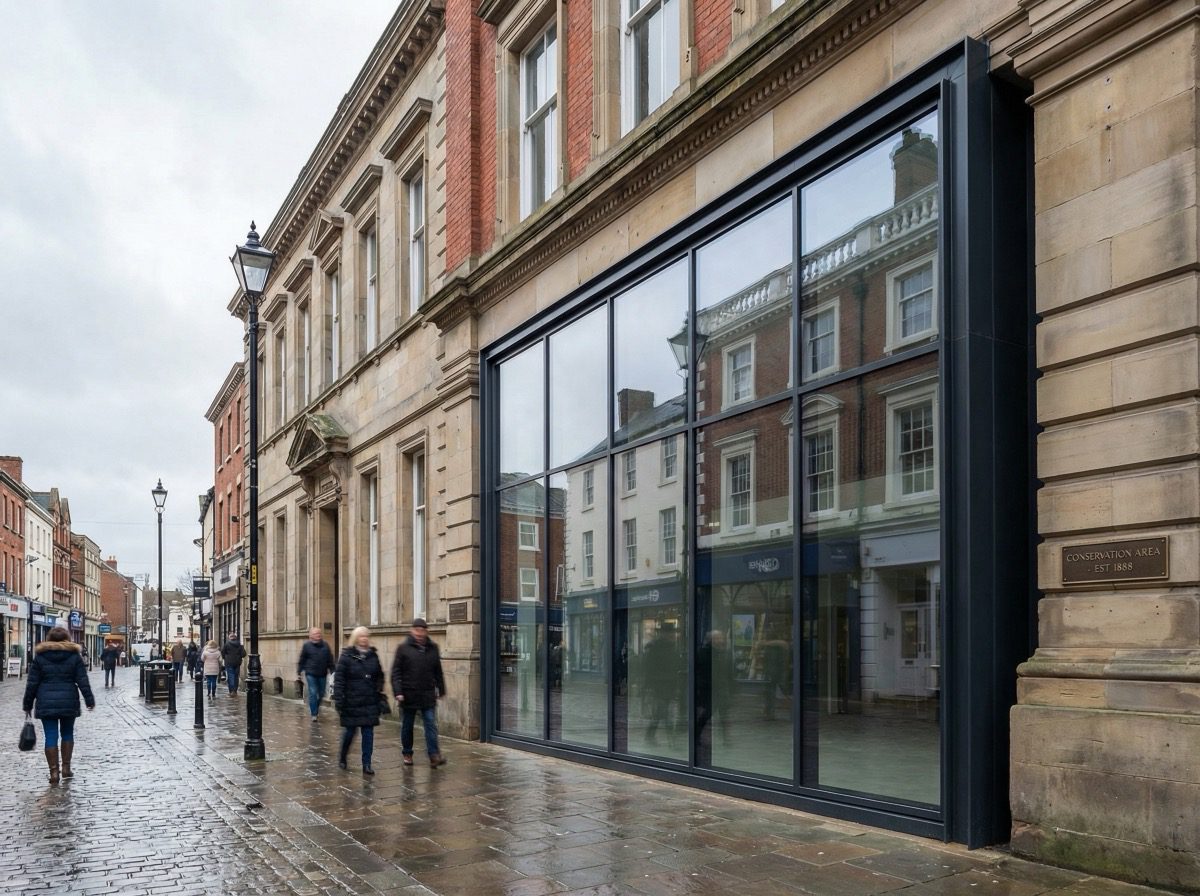
In a conservation area, the LPA can require planning permission for any change to external appearance, including changes that would otherwise be permitted development. The LPA will assess whether the design is sympathetic to the area’s character and whether glazing reflectivity causes visual disruption. Curtain walling is not impossible in these areas, but early engagement with the planning authority is essential.
Article 4 directions go further, removing permitted development rights entirely in a defined area. They are common in town centres and historic high streets. If one is in place, assume you need planning permission and check with the LPA before committing.
Listed Buildings
Listed Building Consent is required for any works affecting the character of a listed building — and it is separate from planning permission. You may need both. For Grade I and II* buildings, Historic England will be consulted. Curtain walling is not automatically refused, but expect to provide detailed design drawings and a heritage impact assessment.
Change of Use and Neighbour Impact
If the curtain wall is part of a change of use — converting a warehouse to residential flats, for instance — planning permission for the change of use is required and the curtain walling design will be assessed as part of that application. The LPA can also require a planning application if the installation causes significant issues for neighbours, including solar glare, light pollution, or overlooking of residential properties.
When Planning Permission Is NOT Required
Like-for-like replacement is the most common scenario we handle. Replacing existing curtain walling with new panels of a similar appearance does not normally require planning permission. The system changes, but the building looks the same from outside.
Permitted development under Class A, Part 7 of the GPDO allows certain changes to commercial and industrial buildings without a planning application, provided the external appearance is not materially affected. This does not apply in conservation areas or where Article 4 directions are in force.
Internal works — such as an internal glazed atrium wall that does not change the external appearance — do not need planning permission. Building Regulations still apply.
Building Regulations Requirements for Curtain Walling
Every curtain wall project in the UK must comply with these Approved Documents, regardless of whether planning permission is needed.
Part L — Energy Efficiency
Current requirements (updated June 2022) set a maximum U-value of 1.6 W/m²K for new commercial glazing. Modern aluminium curtain wall systems typically achieve 1.0–1.4 W/m²K with thermally broken profiles and argon-filled double glazed units. SBEM energy assessments are also required for commercial buildings.
Part B — Fire Safety
Post-Grenfell, fire safety scrutiny is intense. Part B requires fire stopping at floor and wall junctions, cavity barriers, and — for buildings over 18 metres — non-combustible materials classified as A1 or A2-s1,d0. Our article on the advantages and disadvantages of curtain walling covers fire performance in more detail.
Part K — Glazing Safety
Any glazed panel at low level that could be struck by a person must use toughened or laminated safety glass complying with BS EN 12600. Manifestation markings are required at certain heights to prevent people walking into full-height glazed panels.
Part E — Sound Insulation
For residential and mixed-use buildings, Part E sets acoustic performance standards. Curtain walling on residential facades may require laminated acoustic glass to demonstrate compliance.
The Application Process: A Practical Overview
- Pre-application enquiry — Submit to your LPA for informal feedback. Costs £200–£600 for commercial projects and takes four to six weeks.
- Planning application — If required, submit through the Planning Portal with design drawings, elevations, and a design and access statement. Heritage impact assessments are needed for listed buildings and conservation areas. The LPA has eight weeks to determine a standard application (13 weeks for major developments).
- Building Regulations application — Submit in parallel. A Full Plans application (where plans are checked before work starts) is almost always the better route for curtain walling because it confirms compliance before fabrication begins.
- Inspections and completion — Building Control inspects structural fixings, fire stopping, and thermal performance during installation, then issues a completion certificate once satisfied.
Allow three to four months from initial enquiry to having all approvals in place.
How Huxley & Co Handle Planning and Regulations
With over 20 years of experience in curtain wall installation across London and the UK, we manage the regulatory process alongside the technical work — pre-project assessments, Building Regulations documentation, and working with LPAs on conservation area and listed building applications.
We are registered with FENSA, CHAS, and Constructionline. If you are unsure whether your project needs planning permission, get in touch or call us on 020 7112 4849. We have installed curtain walling and shop front glazing in conservation areas across London and are happy to talk through your project.
Frequently Asked Questions
Do I need planning permission for curtain walling?
It depends on the building and location. Most commercial installations fall under permitted development. You will need planning permission if the building is in a conservation area, is listed, is subject to an Article 4 direction, or if the work materially changes external appearance.
What is the difference between planning permission and Building Regulations?
Planning permission controls appearance and land use. Building Regulations control safety, energy efficiency, and fire performance. They are separate processes — Building Regulations always apply to curtain walling.
Do Building Regulations apply to curtain wall replacement?
Yes. Even like-for-like replacements must meet current Building Regulations, particularly Part L energy requirements. The U-value standards in force at the time of installation apply, not those from when the original system was fitted.
Do I need Listed Building Consent for curtain walling on a listed building?
Yes. Listed Building Consent is required for any works affecting the building’s character, including internal alterations. This is separate from planning permission — you may need both.
Can I install curtain walling in a conservation area?
Yes, but you will almost certainly need planning permission. The LPA will assess whether the design suits the area’s character. A pre-application enquiry is strongly recommended.
What are the fire safety requirements for curtain walling?
Part B requires fire stopping at junctions, cavity barriers, and non-combustible materials for buildings over 18 metres. The complete curtain wall design guide covers fire safety standards in full.
How long does the planning process take?
Eight weeks for a standard application (13 for major developments). Building Regulations approval takes around five weeks. These run in parallel — allow three to four months total.
Do I need planning permission to change a shop front?
Similar rules apply. Like-for-like replacements are usually permitted development. Significant changes, or works in conservation areas and on listed buildings, require planning permission. Our guide on when to replace your shop front covers this in detail.