
Key Takeaways:
- Integrated LED shop front lighting built into aluminium frames during installation costs 30-40% less than retrofitting and produces a cleaner finish.
- A full LED shop front lighting scheme costs £500 to £5,000+ depending on type, with annual running costs as low as £30 to £80.
- Illuminated signs of any size require advertisement consent from your Local Planning Authority, with a 28-day consultation period.
- Choose 3000K warm white for hospitality, 4000K neutral white for retail, or 5000K+ cool white for clinics and pharmacies.
- All external shop front lighting must be IP65-rated minimum and installed by a qualified electrician to BS 7671 standards.
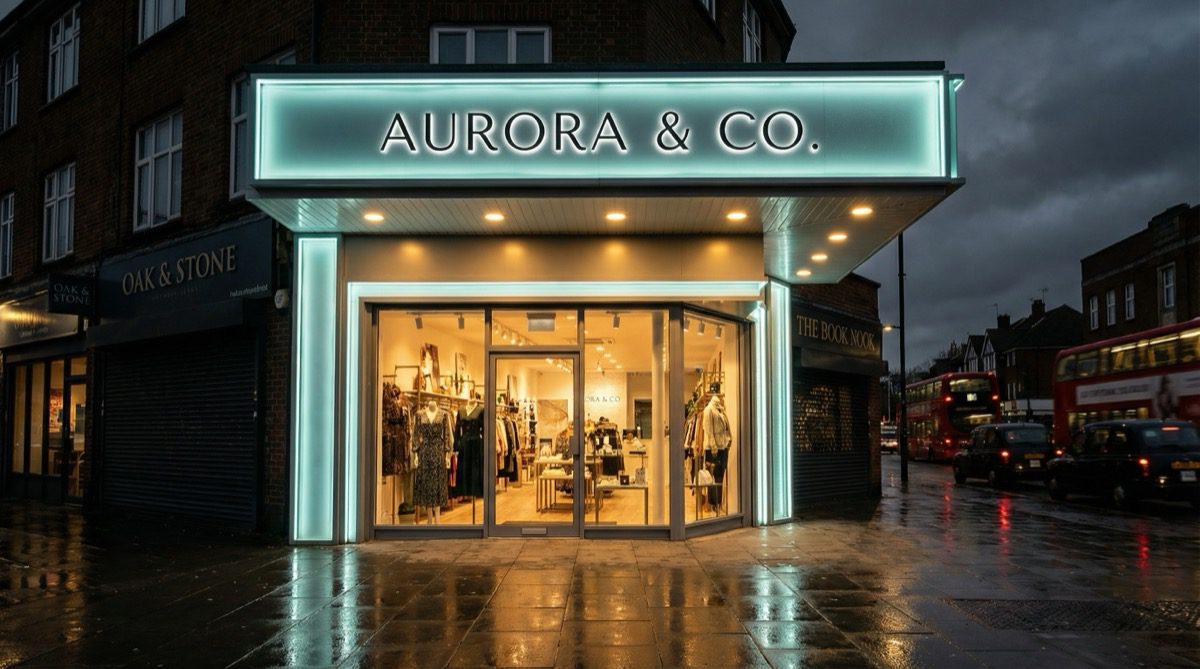
Walk down any UK high street after dark and the difference is stark. Some shop fronts disappear into shadow, their signage barely readable from across the road. Others practically pull you towards them — warm light spilling from illuminated fascias, crisp LED strips tracing clean aluminium frames, entrance downlights casting an inviting glow across the threshold.
That difference is not down to luck or a bigger electricity bill. It comes down to whether lighting was treated as an afterthought — a few spotlights bolted on after the shop front was already installed — or designed into the structure from day one.
As commercial shop front installers who work with business owners across the UK, we see this gap every week. The shop fronts that look best at night, attract the most attention, and cost the least to run are the ones where lighting was planned alongside the frame, the glazing, and the signage — not added as a last-minute extra. This guide covers everything you need to know about shop front lighting: the types available, how they integrate with different materials, what they cost, and the UK regulations you need to follow.
Why Shop Front Lighting Matters More Than You Think
First Impressions After Dark
Your shop front works a twelve-hour day shift when natural light does the heavy lifting. But for roughly half the year in the UK — from October through March — your premises sit in darkness for a significant portion of trading hours. A restaurant seating its last covers at 9pm, a convenience store open until 11pm, a gym running early-morning classes at 6am — these businesses rely on their shop front to attract attention when daylight is gone. Even a hair salon with a beautifully designed frontage loses its impact if the lighting fails to showcase it after dark.
Without effective lighting, even the best-designed aluminium shop front becomes invisible. Worse still, a dark storefront signals “closed” to passing foot traffic, even when you are very much open for business.
Lighting, Foot Traffic, and Security
Well-lit commercial frontages do three things simultaneously. They attract attention, making your business visible from further down the street and helping to maximise customer footfall. They communicate professionalism — a properly illuminated fascia tells potential customers you take your premises seriously. And they deter antisocial behaviour. A dark, unlit shop front is far more likely to attract graffiti, attempted break-ins, and rough sleeping than one with motion-activated entrance lighting and an illuminated sign. This is especially true for vacant properties, where security measures like lighting and roller shutters become even more critical.
For many business owners, the security benefit alone justifies the investment. Combined with the commercial advantage of nighttime visibility, shop front lighting is not a luxury — it is a practical necessity.
Types of Shop Front Lighting
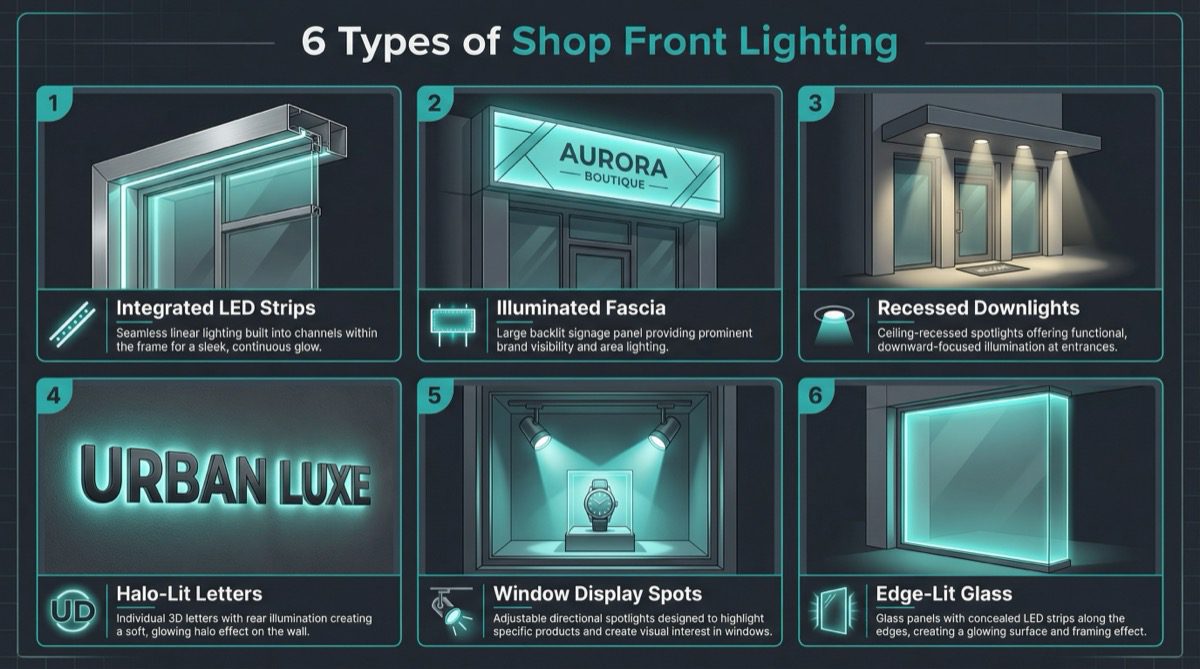
There is no single “best” shop front light. The right solution depends on your premises, your business type, your budget, and the planning restrictions in your area. Here is a breakdown of every type worth considering.
Fascia and Signage Lighting
Your fascia panel is the single most visible element of your shop front at night, which is why choosing the right signage and lighting it properly go hand in hand. There are several ways to light it.
Trough lights (sign lights) are external fittings mounted above or below the fascia, directing light across the sign face. They are one of the most common solutions for existing shop fronts because they can be retrofitted without major structural changes. Modern LED trough lights start from around £145 per unit, use minimal energy, and provide even illumination across fascia panels up to two metres wide.
Illuminated fascia panels and lightboxes take a different approach. Instead of lighting the sign externally, the entire fascia becomes a light source. An aluminium sign tray — typically starting from £325 — houses internal LED modules behind a translucent acrylic face, producing bright, even illumination that is visible from considerable distance. These work particularly well for businesses trading after dark, such as takeaways, pharmacies, and off-licences.
Halo-lit (backlit) channel letters produce a more subtle, premium effect. Individual letters are mounted slightly off the wall, with LEDs positioned behind them to cast a soft glow against the background. The letters themselves appear as silhouettes, surrounded by a halo of light. You will see this approach on high-end retailers, restaurants, and professional services — anywhere the brand wants to project sophistication rather than shout for attention.
Front-lit channel letters take the opposite approach. LEDs face forward inside each letter, illuminating the character face directly. The result is bold, bright signage that is easy to read from a distance, making it a good choice for businesses on busy roads where drivers need to spot the premises quickly.
For more on how signage works alongside your shop front design, see our guide to shop front signage ideas.
Entrance and Canopy Lighting
The entrance zone is where lighting shifts from “advertising” to “welcoming.” Recessed soffit downlights — installed into the underside of a canopy or the shop front’s header rail — cast a pool of light directly over the doorway. This serves a dual purpose: it makes the entrance inviting and meets the practical requirement of at least 25 lux on the floor outside the door.
Canopy lighting is particularly effective on toughened glass shop fronts where a glass or aluminium canopy provides a natural housing for recessed fittings. Soffit downlights can be wired into the shop front’s electrical supply during installation, keeping wiring concealed within the frame.
Architectural and Frame-Integrated Lighting
This is where modern shop front lighting gets genuinely interesting — and where the biggest gap exists between bolt-on solutions and proper integrated design.
Contemporary aluminium framing systems can be specified with dedicated channels that house LED strip lighting directly within the profile. The LED strip sits inside the extrusion, protected from the elements, with light emitting through a diffuser that sits flush with the frame surface. From the outside, there is no visible light fitting — the frame itself appears to glow.
This approach works beautifully on aluminium shop fronts because the profiles are manufactured to precise dimensions. Adding a lighting channel is a design decision made during specification, not a bodge applied afterwards. The wiring runs through the hollow sections of the frame, connecting to the main supply at a single point — clean, concealed, and compliant.
Frame-mounted spotlights offer another option, particularly for highlighting specific features — an entrance column, a decorative panel, or a branded element of the frontage.
Window Display Lighting
Your window display is a 24-hour advertisement. During business hours, daylight handles the illumination. After dark, you need artificial lighting to keep it working.
Track-mounted spotlights inside the window reveal are the traditional solution, allowing you to direct light precisely onto products or displays. LED strip lighting around the window perimeter provides ambient illumination without the bulk of individual fittings. Edge-lit glass panels — where LEDs feed light into the edge of a glass sheet, creating an even glow across the surface — offer a more contemporary option that works particularly well with the frameless aesthetic of toughened glass shop fronts. If you are also weighing up glazing performance, our guide to double glazing versus single glazing covers how glass choice affects both thermal performance and lighting transmission.
The key with commercial glazing and window display lighting is to avoid glare. Poorly positioned lights create reflections on the glass that make it harder to see the display, not easier. Recessed or concealed fittings positioned above the display, angled downward, eliminate this problem.
External Flood and Accent Lighting
Ground-recessed uplights, wall-mounted floodlights, and accent spotlights can dramatically transform the appearance of a building facade after dark. These are typically used on larger commercial premises — a hotel entrance, a restaurant with an impressive frontage, or a listed building where the architecture itself deserves highlighting.
For most standard retail shop fronts, flood lighting is unnecessary if the fascia, entrance, and frame lighting are doing their jobs properly. It is worth considering, though, if your premises has architectural features — stonework, decorative columns, or a striking timber shop front — that would benefit from uplighting after dark.
Why Integrated Lighting Beats Bolt-On Solutions
There is a fundamental difference between adding lights to a finished shop front and designing lighting into the shop front from the start. Understanding that difference can save you money, produce a better result, and avoid problems down the line.
Designed Into the Frame During Manufacture
When lighting is specified at the design stage, the aluminium frame profiles can be selected with built-in channels for LED strips. Wiring routes are planned through the hollow frame sections. Fascia panels are manufactured as integrated sign trays with internal LED modules already fitted. Downlight positions are cut into canopy soffits before the unit arrives on site.
The result is a shop front that arrives largely pre-wired and ready to connect. There are no surface-mounted cable runs, no exposed junction boxes, and no visible fixings for external light fittings. Everything looks intentional because it was.
Cost Advantage of Integration
Retrofitting lighting to an existing shop front typically costs 30-40% more than integrating it during a new installation. Why? Because retrofit work involves cutting into finished surfaces, routing cables externally or through conduit, hiring a separate electrician (often at a different time to the shop front fitter), and making good any damage to paintwork or powder coating.
When lighting is part of the original installation, the electrical work happens alongside the shop front fitting. One mobilisation, one scaffold, one programme of work. The shop front cost includes lighting from the outset, rather than it appearing as an expensive add-on three months later.
Pre-Wired Systems and Factory Assembly
Modern fabrication techniques allow illuminated fascia panels and LED frame lighting to be assembled and tested in the factory before delivery. LED modules are wired into sign trays, drivers are mounted inside the frame, and the entire assembly is tested before it leaves the workshop. On site, the electrician makes a single connection to the mains supply.
This factory-first approach reduces installation time, minimises the risk of wiring faults, and ensures consistent light output across the full width of the fascia. It is a far cry from the old approach of building a sign on site and hoping the lighting works once power is connected.
Material-Specific Lighting Options
Different shop front materials lend themselves to different lighting approaches. Here is how lighting works with each of the main framing materials.
Aluminium Frames With LED Channels
Aluminium is the most versatile material for integrated lighting. The extrusion process used to manufacture aluminium profiles allows bespoke channel shapes to be included in the cross-section, specifically designed to house LED strip with a clip-in diffuser. Standard profiles from major system suppliers now include lighting-ready options as part of their catalogue ranges.
The powder-coated finish of aluminium shop fronts means the frame colour can be matched or contrasted with the light colour — a dark grey frame with warm white LED strips creates a particularly striking effect at night.
Timber With Concealed Wiring
Lighting a timber shop front requires a slightly different approach. Timber sections can be routed (grooved) during manufacture to create channels for wiring, but the material does not lend itself to the same slim-profile LED integration that aluminium offers.
Instead, timber shop fronts typically use externally mounted trough lights for fascia illumination, recessed downlights within timber canopies, and concealed wiring routes through the frame sections to a central connection point. The warmth of natural timber pairs beautifully with warm white (3000K) lighting, making this combination a favourite for restaurants, pubs, bakeries, and boutique retail — particularly in conservation areas where timber frontages are often a planning requirement.
Glass With Edge-Lit Panels
Frameless and minimal-frame toughened glass shop fronts present a unique challenge: there is very little structure in which to conceal lighting. Edge-lit glass panels solve this by feeding LED light into the edge of the glass, which is then distributed across the panel surface by a pattern of micro-dots etched into the glass.
The effect is a gently glowing glass surface — often used for display panels, branded graphics, or wayfinding elements. Combined with commercial glazing that already maximises transparency, edge-lit panels add visual interest without compromising the clean, open aesthetic.
Choosing the Right LED Lighting for Your Shop Front
Colour Temperature: Warm, Neutral, or Cool White
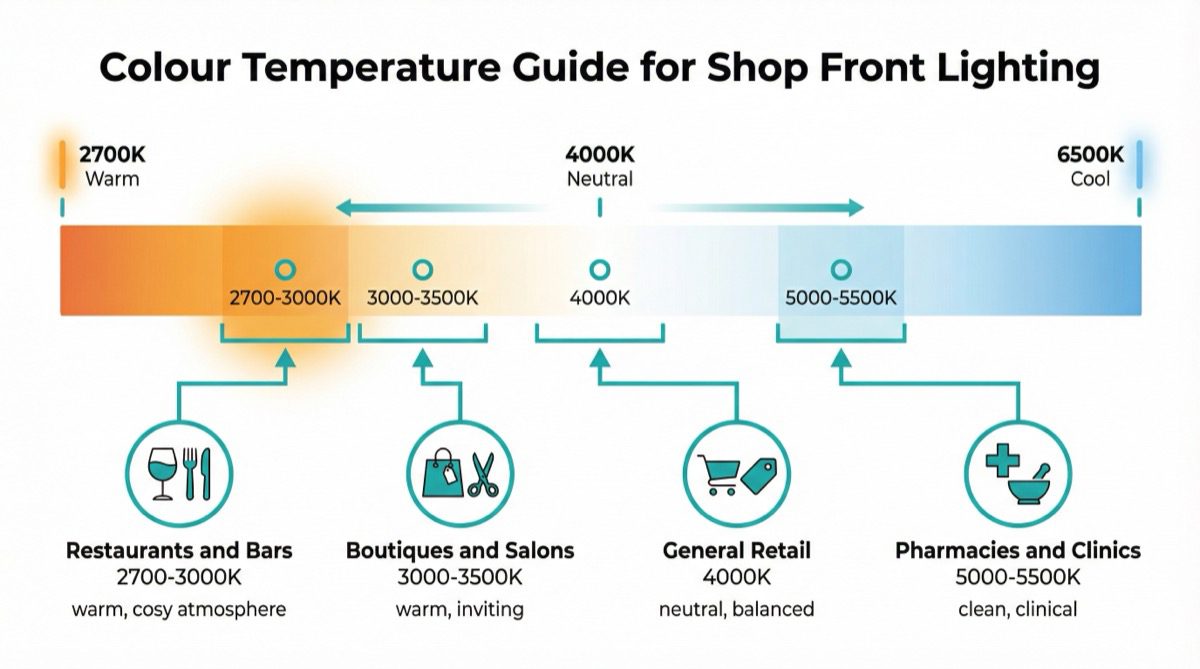
Colour temperature, measured in Kelvin (K), determines the “feel” of your lighting. Get it wrong and even expensive fittings will make your premises look cheap — or clinical, or gloomy.
| Colour Temperature | Appearance | Best For | Avoid For |
|---|---|---|---|
| 3000K (Warm White) | Soft, golden, inviting | Restaurants, cafes, boutiques, bars, bakeries, hotels | Pharmacies, dental clinics, tech stores |
| 4000K (Neutral White) | Clean, balanced, natural | General retail, supermarkets, estate agents, service businesses | Fine dining, luxury boutiques |
| 5000K+ (Cool White) | Bright, crisp, clinical | Pharmacies, dental clinics, gyms, tech stores, car showrooms | Restaurants, pubs, anything aiming for “cosy” |
A common mistake is mixing colour temperatures across the same shop front. The fascia at 5000K cool white while the entrance downlights are 3000K warm white creates a jarring, inconsistent appearance. Pick one temperature and use it consistently across all external fittings.
Brightness and Lux Levels
Brightness needs to be appropriate, not maximal. An overpowered LED sign on a quiet residential parade will draw complaints, not customers. Equally, a dimly lit fascia on a busy high street will disappear against the surrounding brightness.
As a practical benchmark, the floor area directly outside your entrance should receive at least 25 lux of illumination — enough to read a menu or see a step clearly. Fascia signage should be readable from across the road under typical street lighting conditions, which means balancing the sign’s luminance against ambient light levels.
CRI: Why Colour Accuracy Matters
The Colour Rendering Index (CRI) measures how accurately a light source renders colours compared with natural daylight. A CRI of 100 is perfect; cheap LEDs can score as low as 60-70, making reds look dull and skin tones appear grey.
For retail shop fronts, specify LEDs with a CRI of 80 or above. If your window display showcases clothing, food, flowers, or anything where colour accuracy drives purchasing decisions, push for CRI 90+. The price difference between CRI 80 and CRI 90 LEDs is modest, but the impact on how your products look from the street is substantial.
IP Ratings: Weatherproofing Your Lighting
Any lighting exposed to the outdoor environment needs an appropriate Ingress Protection (IP) rating. The first digit covers dust; the second covers water.
| IP Rating | Protection Level | Suitable For |
|---|---|---|
| IP44 | Splash-proof | Covered areas only — beneath deep canopies, inside recessed soffits |
| IP65 | Dust-tight, water jet protected | Standard external shop front lighting — the minimum for any exposed fitting |
| IP66 | Dust-tight, powerful water jet protected | Exposed locations, coastal areas, frontages subject to pressure washing |
| IP67 | Submersible to 1 metre | Ground-recessed uplights, areas prone to standing water |
For most UK shop fronts, IP65 is the correct specification for any fitting not fully sheltered by a canopy. It is dust-tight and withstands water jets from any direction — more than adequate for British weather. Cutting corners with IP44 fittings in exposed positions is a false economy. Moisture ingress causes LED failure — much like how unchecked rust and corrosion can undermine an entire shop front — and replacing a failed fitting that is integrated into your fascia is far more expensive than specifying the correct IP rating from the start.
Energy Efficiency and Running Costs
LED vs. Traditional Lighting: The Numbers
If your shop front still runs fluorescent tubes or halogen spotlights, the numbers make a compelling case for switching to LED — or considering whether it is time to replace the entire shop front with a modern system that has lighting built in.
| Factor | LED | Fluorescent | Halogen |
|---|---|---|---|
| Typical Wattage | 5-15W | 18-36W | 50-100W |
| Lifespan (Hours) | 50,000-100,000 | 10,000-15,000 | 1,000-2,000 |
| Annual Running Cost (per fitting) | £2-£3 | £5-£10 | £14-£18 |
| Replacement Frequency | 14-27 years | 3-4 years | Under 6 months |
| Warm-Up Time | Instant | 1-3 minutes | Instant |
| Dimmable | Yes (with compatible driver) | Limited | Yes |
| Mercury Content | None | Contains mercury | None |
The comparison is not close. A single 6W LED fitting running 10 hours per day at current UK business electricity rates (25p-35p per kWh) costs roughly £2-£3 per year to operate. The equivalent 50W halogen runs £14-£18 per year. Multiply that across six to ten fittings on a typical shop front, and the annual saving is significant — typically 60-90% lower energy costs after switching to LED.
Annual Running Costs for a Typical UK Shop Front
A complete LED lighting scheme for a standard retail shop front — including fascia illumination, entrance downlights, and frame-integrated strip lighting — might consume 100-200 watts in total. Running that system 10 hours per day, 365 days per year, at 30p per kWh:
- 100W system: 365 kWh/year = approximately £110/year
- 150W system: 548 kWh/year = approximately £164/year
- With smart controls (reducing to 6 hours effective daily use): approximately £66-£99/year
Compare that with an older halogen/fluorescent system drawing 500-800W: £548-£876 per year. The LED investment typically pays for itself within two to three years through energy savings alone — before you even factor in reduced maintenance and lamp replacement costs.
Part L Building Regulations
Part L of the Building Regulations covers the conservation of fuel and power in buildings. For commercial premises, the lighting requirements specify that general lighting must achieve an average of 95 luminaire lumens per circuit watt, and display lighting must deliver 80 light source lumens per circuit-watt or consume no more than 0.3W per square metre.
Modern LED shop front lighting comfortably exceeds these thresholds. However, if your premises is undergoing a change of use, a major renovation, or a new build, compliance with Part L will be assessed as part of the building control process. It is worth noting that integrated, energy-efficient LED lighting contributes positively to your building’s overall energy performance rating.
Smart Controls: Timers, Dimmers, and Sensors
The cheapest energy is the energy you do not use. Smart lighting controls can cut your running costs further without reducing the effectiveness of your shop front lighting.
Timers and astronomical clocks switch lighting on at dusk and off at a set time — say, midnight for fascia lighting on a retail parade that sees no foot traffic after closing. More sophisticated astronomical time clocks adjust automatically for seasonal changes in daylight hours, so you never forget to update the schedule in spring or autumn.
Dusk-to-dawn photocells use a light sensor to activate fittings when ambient light drops below a threshold. Simple, reliable, and maintenance-free — these are the most popular control option for basic shop front lighting.
Motion-activated lighting is particularly useful for entrance zones. A PIR sensor activates brighter entrance lighting when someone approaches, then dims back to a lower level after they pass. This provides security benefits (deterring loitering) while reducing energy consumption during quiet periods.
Dimmable LED systems allow you to adjust brightness throughout the evening — full brightness during peak hours, reduced output after closing. Combined with a timer, this can reduce overnight energy consumption by 50% or more while still maintaining a lit presence on the street.
UK Regulations for Illuminated Shop Fronts
Getting your shop front lighting right is not just a design decision. There are several UK regulations that govern what you can and cannot do with illuminated signage and external lighting.
Advertisement Consent for Illuminated Signs
This catches many business owners off guard. In the UK, illuminated signs of any size require advertisement consent from your Local Planning Authority (LPA). While certain non-illuminated signs benefit from “deemed consent” (meaning no formal application is needed), the moment you add any form of illumination — whether internal LEDs, external trough lights, or even a simple spotlight — you need to apply for consent.
The process involves submitting an application to your local council, a 28-day public consultation period, and a decision typically within 8 weeks. Consent, once granted, is normally valid for five years and can be renewed.
The application requires details of the sign’s dimensions, position, illumination method, and luminance. Your shop front installer should be able to provide the technical details needed for the application.
Conservation Areas and Listed Buildings
If your premises is within a conservation area or involves a listed building, the rules are stricter. Councils will scrutinise the size, design, and brightness of any illuminated signage far more closely. Internally illuminated lightbox signs are often refused in conservation areas in favour of externally lit traditional signage or individually mounted halo-lit letters.
Timber shop fronts with externally lit painted signage are frequently specified in these sensitive locations precisely because they comply with conservation requirements while still providing effective nighttime visibility.
Light Pollution and Neighbour Considerations
BS 5489 provides guidance on exterior lighting, including the limitation of obtrusive light. If your shop front is near residential properties, you need to consider light spill — particularly upward light and light trespass into neighbouring windows.
Practical steps to minimise light pollution include using shielded or recessed fittings that direct light downward, selecting the lowest effective brightness for your signage, fitting timers that switch off illumination during late-night hours, and avoiding cool white lighting (5000K+) in residential areas, as higher colour temperatures scatter more and appear harsher at night.
Some councils include conditions on advertisement consent specifying maximum luminance levels and operating hours. It is worth checking local policies before committing to a lighting design.
Electrical Safety and Certification
All external electrical work, including shop front lighting installation, must comply with BS 7671 (the IET Wiring Regulations). Work must be carried out by a qualified electrician, and for commercial premises, an Electrical Installation Certificate (EIC) must be issued on completion.
When lighting is integrated into a new shop front installation, the electrical work is coordinated with the shop front fitting. This means one set of scaffolding, one disruption to your business, and a single point of responsibility for the completed installation.
Shop Front Lighting Costs in the UK
Understanding what shop front lighting costs helps you budget realistically and avoid surprises. Here is what you can expect to pay for different lighting types in 2026.
Typical Price Ranges by Lighting Type
| Lighting Type | Typical Cost (Supply) | Notes |
|---|---|---|
| LED trough lights (per unit) | From £145 | Most cost-effective option for fascia illumination |
| Illuminated fascia sign tray | From £325 | Complete unit with internal LED modules |
| Lightbox fascia sign | £500 – £1,500 | Depends on size and face material |
| Illuminated channel letters | £700 – £3,000 | Front-lit or halo-lit; price varies with size and letter count |
| Premium illuminated signage | £800 – £5,000+ | Bespoke designs, large formats, London premium |
| Frame-integrated LED strips (per linear metre) | £15 – £40 | Including diffuser channel and driver |
| Recessed soffit downlights (per unit) | £25 – £80 | IP65 rated for external use |
Installation Costs
Professional electrical installation for shop front lighting typically runs £200 to £800, depending on the scope of work, access requirements, and whether the lighting is being integrated into a new shop front or retrofitted to an existing one.
When lighting is part of a new shop front installation, the electrical work is included in the project programme and the cost is significantly lower than commissioning it as a separate job afterwards. The overall shop front cost reflects the lighting as an integrated element rather than an expensive add-on.
Return on Investment
The ROI on shop front lighting comes from three sources: increased visibility driving more foot traffic and sales, energy savings versus older lighting systems, and reduced maintenance thanks to LED longevity.
For a business replacing a halogen/fluorescent lighting scheme with a modern LED system, the energy savings alone (typically £300-£600 per year) deliver payback within two to three years. The increased nighttime visibility and improved brand presentation are harder to quantify, but any business owner who has invested in proper shop front lighting will tell you the difference in passing trade is noticeable from the first evening.
How Huxley & Co Designs Lighting Into Every Shop Front
Our Integrated Approach
At Huxley & Co, lighting is part of the conversation from the very first site survey. When we assess your premises, we consider the orientation of the frontage (north-facing shops need brighter lighting to compensate for lower ambient light), the surrounding environment (a busy high street versus a quiet parade), the type of business you operate, and any planning constraints that might affect your options.
We work with our fabrication team to specify aluminium profiles with built-in LED channels, illuminated fascia panels manufactured as complete assemblies, and pre-wired canopy systems that minimise on-site electrical work. The goal is always a seamless finish where lighting looks like it belongs — because it does.
From Design to Installation
Our process follows a clear sequence: initial consultation and site survey to assess your lighting requirements, design development with technical drawings showing lighting positions and specifications, fabrication with lighting components integrated during manufacture, on-site installation where the shop front and lighting are fitted as a single coordinated programme, and electrical connection and testing by a qualified electrician with full certification.
This integrated approach means you deal with one company, one project timeline, and one point of accountability. No chasing separate contractors. No discovering that the electrician and the shop fitter have different ideas about where the wiring should go.
For unique shop front design ideas that incorporate creative lighting solutions, or to discuss your specific requirements, get in touch with our team for a free consultation.
Frequently Asked Questions
What is the best lighting for a shop front?
LED lighting is the clear winner for modern shop fronts. The most effective approach combines illuminated fascia signage for street-level visibility, recessed entrance downlights for a welcoming threshold, and frame-integrated LED strips for architectural definition. The specific fittings depend on your business type, building style, and budget, but LEDs are now the standard choice for efficiency, longevity, and versatility.
How much does shop front lighting cost in the UK?
Costs range from around £500 for basic trough lighting and LED strips to £5,000+ for premium illuminated fascia signs with halo-lit channel letters. A mid-range scheme for a standard retail unit — including a lightbox fascia, entrance downlights, and frame lighting — typically falls in the £1,500 to £3,500 range including installation. Integrating lighting into a new shop front is 30-40% cheaper than retrofitting.
Do I need planning permission for illuminated shop front signs?
Yes. Illuminated signs of any size require advertisement consent from your Local Planning Authority. The process involves a formal application, a 28-day public consultation, and a decision within approximately 8 weeks. Conservation areas have stricter requirements, and listed buildings need additional consents. Your shop front installer can provide the technical specifications needed for the application.
What colour temperature is best for shop front lighting?
It depends on your business. Warm white (3000K) creates an inviting atmosphere for restaurants, cafes, and boutiques. Neutral white (4000K) provides clean, balanced lighting for general retail and service businesses. Cool white (5000K+) suits pharmacies, clinics, gyms, and tech stores where a bright, modern appearance is appropriate. Consistency across all fittings is more important than the specific temperature you choose.
What IP rating do shop front lights need?
Any lighting directly exposed to the weather needs IP65 as a minimum — dust-tight and protected against water jets from any direction. Fittings beneath deep canopies can use IP44. For coastal locations or areas subject to pressure washing, specify IP66. Using fittings below the recommended IP rating is a false economy, as moisture ingress is the most common cause of premature LED failure.
How much does it cost to run LED shop front lights?
Very little. A 6W LED fitting costs approximately £2-£3 per year. A complete shop front LED lighting scheme drawing 100-200W and running 10 hours daily costs roughly £110-£164 per year at current UK rates. With smart controls reducing effective run-time, that drops to £66-£99. Compare this with £548-£876 for an equivalent halogen system and the savings are substantial.
Can you integrate LED lighting into aluminium shop fronts?
Yes, and this is the approach we recommend. Modern aluminium framing profiles include dedicated channels for LED strip lighting, with diffusers that sit flush with the frame surface. The wiring runs through the hollow frame sections, completely concealed. This gives a seamless appearance impossible to achieve with bolt-on fittings. It requires planning at the design stage — you cannot add frame-integrated lighting to an existing aluminium shop front without replacing the profiles.
What is the difference between front-lit and back-lit shop signs?
Front-lit signs have LEDs illuminating the face of each letter, producing bright, bold signage that is easy to read from a distance. Back-lit (halo-lit) signs position LEDs behind the letters, casting a glow onto the wall behind them. The letters appear as dark silhouettes surrounded by a soft halo of light. Front-lit is better for maximum visibility; halo-lit is better for a premium, sophisticated brand image.
How long do LED shop front lights last?
Quality LEDs have a rated lifespan of 50,000 to 100,000 hours — roughly 14 to 27 years at 10 hours of daily use. Halogen bulbs last under 6 months at the same usage; fluorescent tubes last 3 to 4 years. LEDs also maintain consistent brightness throughout their lifespan, so your shop front looks as good in year ten as it did on day one.
Is shop front lighting tax deductible for UK businesses?
Yes. Shop front lighting is a business expense and can be claimed as a tax-deductible cost. For incorporated businesses, lighting installed as part of a shop fit-out qualifies for capital allowances. The Annual Investment Allowance (AIA) allows businesses to deduct the full cost of qualifying plant and machinery — including commercial lighting — from their taxable profits in the year of purchase. Consult your accountant for specific advice on your situation.
Transform Your Shop Front With Integrated Lighting
Whether you are planning a new shop front installation or considering upgrading the lighting on your existing premises, the right lighting makes a measurable difference to how your business looks, how it performs after dark, and how much you spend on energy.
At Huxley & Co, we design and install commercial shop fronts with integrated lighting as standard — not as an afterthought. From aluminium shop fronts with built-in LED channels to illuminated fascia signage and smart lighting controls, we handle everything from design through to installation and certification.
Contact us today for a free site survey and lighting consultation. We will assess your premises, recommend the best lighting solution for your business, and provide a detailed, no-obligation quotation.