
Key Takeaways:
- Steel shop fronts rust because iron oxide is porous and self-perpetuating — unlike aluminium, which forms a hard, self-healing oxide layer that blocks further corrosion.
- Most UK high streets fall into corrosion category C3 (medium), while coastal locations within 2 km of the sea are C4-C5 — accelerating steel degradation by up to 400%.
- Surface rust affecting less than 10-15% of a shop front can be treated for £300-£3,500, but once 25% or more is corroded, replacement is the more cost-effective option.
- Over 10 years, repeatedly treating a rusted steel shop front costs roughly £6,500, while a one-time aluminium replacement totals around £5,100 with virtually zero ongoing maintenance.
- Galvanic corrosion — caused by incompatible metals in contact (e.g. steel fixings in aluminium frames) — is one of the most common and least understood causes of premature shop front failure.
- Under FRI leases, tenants are typically responsible for shop front condition; a corroded frontage can trigger dilapidations claims and may invalidate building insurance.
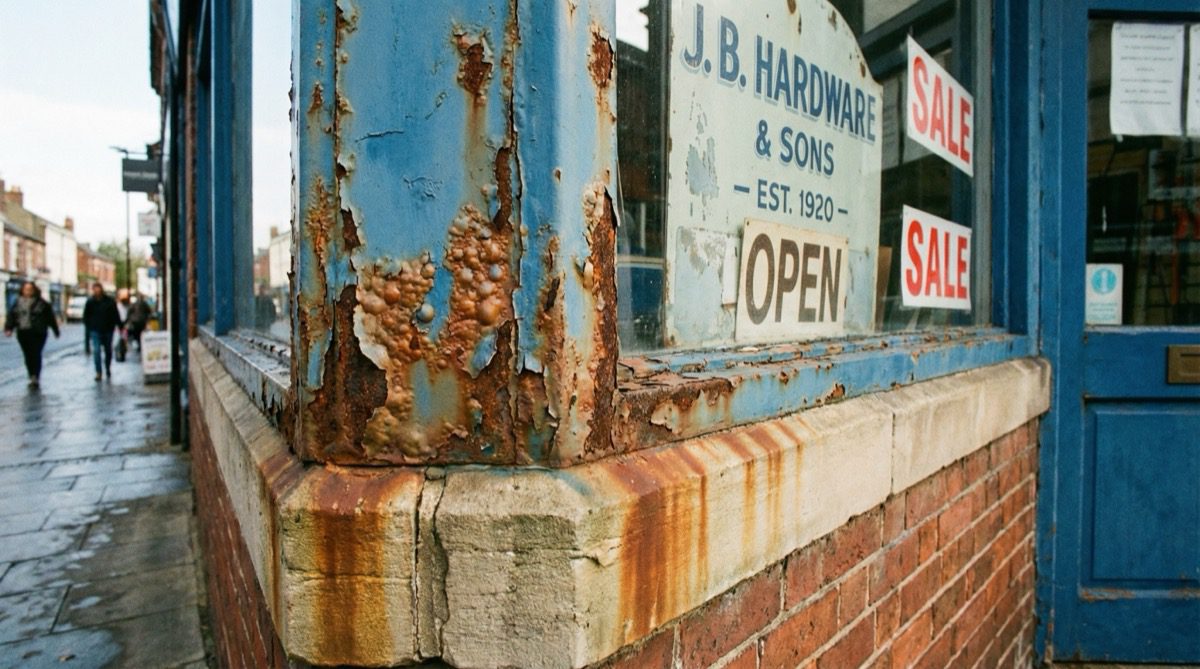
There is a steel shop front on a high street in Manchester that was installed in 2011. By 2019 the paint had started bubbling around the bottom rail. By 2022 the rust had spread to both mullions and the transom bar. The business owner spent £2,200 on professional treatment. Eighteen months later, the rust came back worse. The final bill for a full aluminium shop front replacement was £4,800 — meaning the combined cost of trying to salvage the old frame then replacing it anyway came to over £7,000.
That story plays out across the UK every week. Shop front corrosion is not just a cosmetic problem. Left unchecked, it compromises structural integrity, creates health and safety liabilities, damages your insurance position, and costs far more to fix later than it would have cost to prevent or address early.
This guide covers everything a UK business owner or property manager needs to know about shop front rust and corrosion: the science behind it, why some materials fail faster than others, how to assess damage, when treatment is viable, when replacement is the only sensible answer, and what it all costs. Every recommendation is grounded in British Standards, real UK pricing, and over 20 years of shop front installation experience.
What Causes Shop Front Rust and Corrosion
Before you can fix or prevent corrosion, you need to understand what drives it. The word “rust” gets used loosely, but it describes a specific chemical process that only affects iron and steel. Aluminium corrodes too — just through a completely different mechanism with very different consequences.
How Steel Rusts: The Electrochemical Process
Rust is not just surface discolouration. It is an electrochemical reaction that requires three things: iron (present in all steel), oxygen, and moisture. Remove any one of those three and rusting stops.
Here is what happens at the molecular level. Iron atoms on the steel surface lose electrons and dissolve into the surrounding moisture as iron ions. Simultaneously, oxygen from the air combines with water and those freed electrons to form hydroxide ions. The iron ions then react with the hydroxide ions to produce iron hydroxide, which oxidises further into hydrated iron oxide — the reddish-brown flaking substance we call rust.
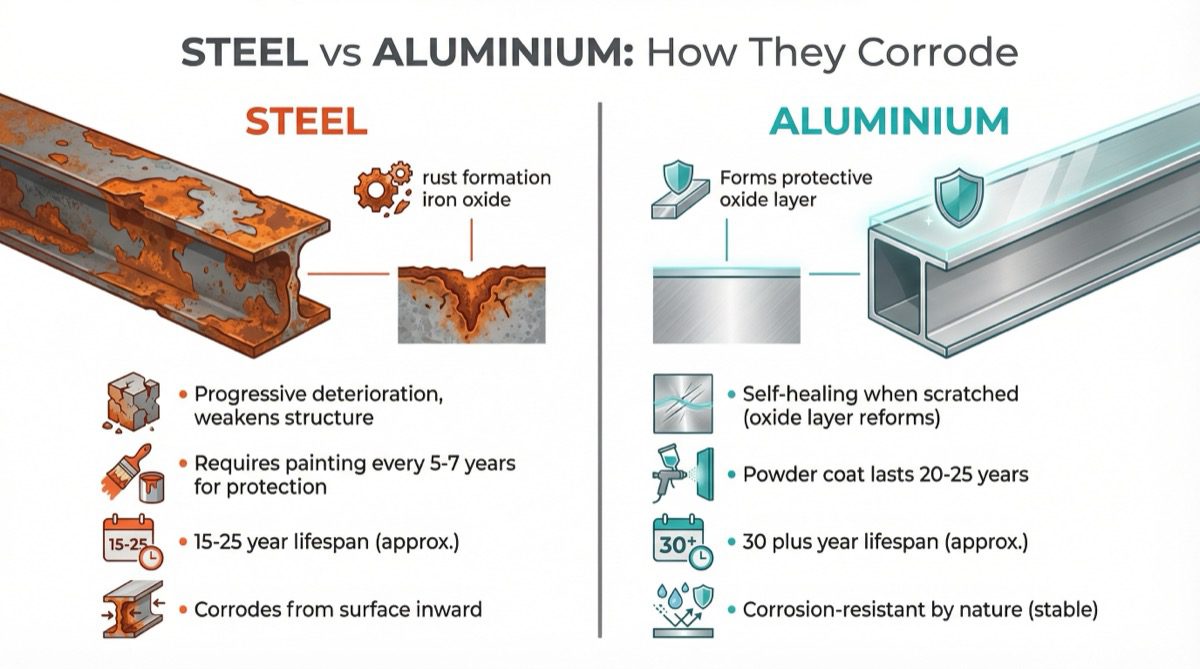
The critical point for shop front owners: rust does not protect the metal underneath. Unlike the oxide layers that form on some metals, iron oxide is porous, permeable to both air and water, and physically bulky — occupying roughly six times the volume of the original iron. That expansion is what causes paint to bubble and flake off rusted steel. As each layer of rust crumbles away, fresh metal is exposed, and the process accelerates. It is self-perpetuating.
Several factors speed this up dramatically on a typical UK high street:
- Salt and chlorides act as electrolytes, massively increasing the rate of the electrochemical reaction.
- Sulphur dioxide from vehicle exhaust and industrial pollution dissolves in moisture to form sulphuric acid on the metal surface.
- Scratches or chips in protective coatings expose bare steel directly to the elements.
- Trapped moisture in joints, behind signage, or under seals creates persistent wet conditions that never fully dry.
- Temperature cycling causes condensation — metal surfaces cool faster than the surrounding air, drawing moisture directly onto the steel.
Aluminium Does Not Rust (But It Can Corrode Differently)
This is worth stating plainly: aluminium cannot rust. Rust is iron oxide, and aluminium contains no iron. However, aluminium does corrode — through a fundamentally different mechanism that is far less destructive.
When aluminium is exposed to air, it instantly forms a microscopically thin layer of aluminium oxide (Al2O3) across the entire surface. This layer is only 5-10 nanometres thick, but it is extraordinarily effective as a barrier. It scores 9 on the Mohs hardness scale (compared to 6.5 for steel). It bonds firmly to the surface rather than flaking off. It is impermeable to oxygen and moisture. And if you scratch it, a new oxide layer forms almost immediately — it is self-healing.
This is the fundamental reason aluminium shop fronts outlast steel by decades. The oxide layer works with you, not against you.
Aluminium can still corrode in specific circumstances — pitting corrosion from chloride exposure in coastal areas, filiform corrosion under damaged coatings in humid conditions, and galvanic corrosion when in contact with dissimilar metals. But these are localised and manageable problems, not the progressive, structural degradation that rust inflicts on steel.
Galvanic Corrosion: The Hidden Danger in Shop Front Construction
Of all the corrosion issues we see on commercial shop fronts, galvanic corrosion is the one that catches the most people off guard. It is rarely discussed by shop front companies, yet it is responsible for a significant proportion of premature failures.
Galvanic corrosion occurs when two different metals are in direct contact in the presence of an electrolyte — which, in the UK, simply means moisture or rainwater. When this happens, one metal becomes the “sacrificial anode” and corrodes far faster than it would in isolation, while the other metal is protected.
How It Happens in Shop Fronts
It is surprisingly common. Steel fixings or brackets used in aluminium frames. Copper or brass hardware mounted on steel or aluminium sections. Stainless steel screws driven into aluminium profiles. Steel lintels sitting in direct contact with aluminium framing. Every one of these is a potential galvanic corrosion site.
The metals relevant to shop front construction sit on a scale called the galvanic series. From most reactive to least reactive: zinc, aluminium, mild steel, stainless steel, copper, and brass. When two metals from this series touch each other in the presence of moisture, the more reactive one corrodes preferentially. The further apart they are on the series, the worse the corrosion.
So when a mild steel bracket is bolted directly to an aluminium frame and both are exposed to rainwater, you get accelerated corrosion at the contact point. The resulting damage often appears as white powdery deposits around aluminium contact points, or concentrated rust bleeding from steel fixings — even when the rest of the frame looks fine.
Prevention
Galvanic corrosion is entirely preventable with proper design. The solution is isolation — preventing direct metal-to-metal contact between dissimilar materials:
- Plastic or nylon washers between dissimilar metal fixings.
- Rubber gaskets or insulating tape at contact surfaces.
- Plastic sleeves around bolts that pass through different metals.
- Powder coating or painting all contact surfaces before assembly.
- Specifying compatible metals throughout (e.g. stainless steel fixings with aluminium frames, always with appropriate isolation).
If your existing shop front shows localised corrosion concentrated around fixings or where different materials meet, galvanic corrosion is the most likely cause. It will not stop on its own — the fix is either isolating the metals or replacing the incompatible component.
UK Environmental Factors That Accelerate Shop Front Corrosion
The UK is not a kind environment for unprotected metal. Our maritime climate delivers high humidity year-round — average relative humidity sits between 70% and 90% across most of the country — and that persistent moisture is the enabler for every corrosion process.
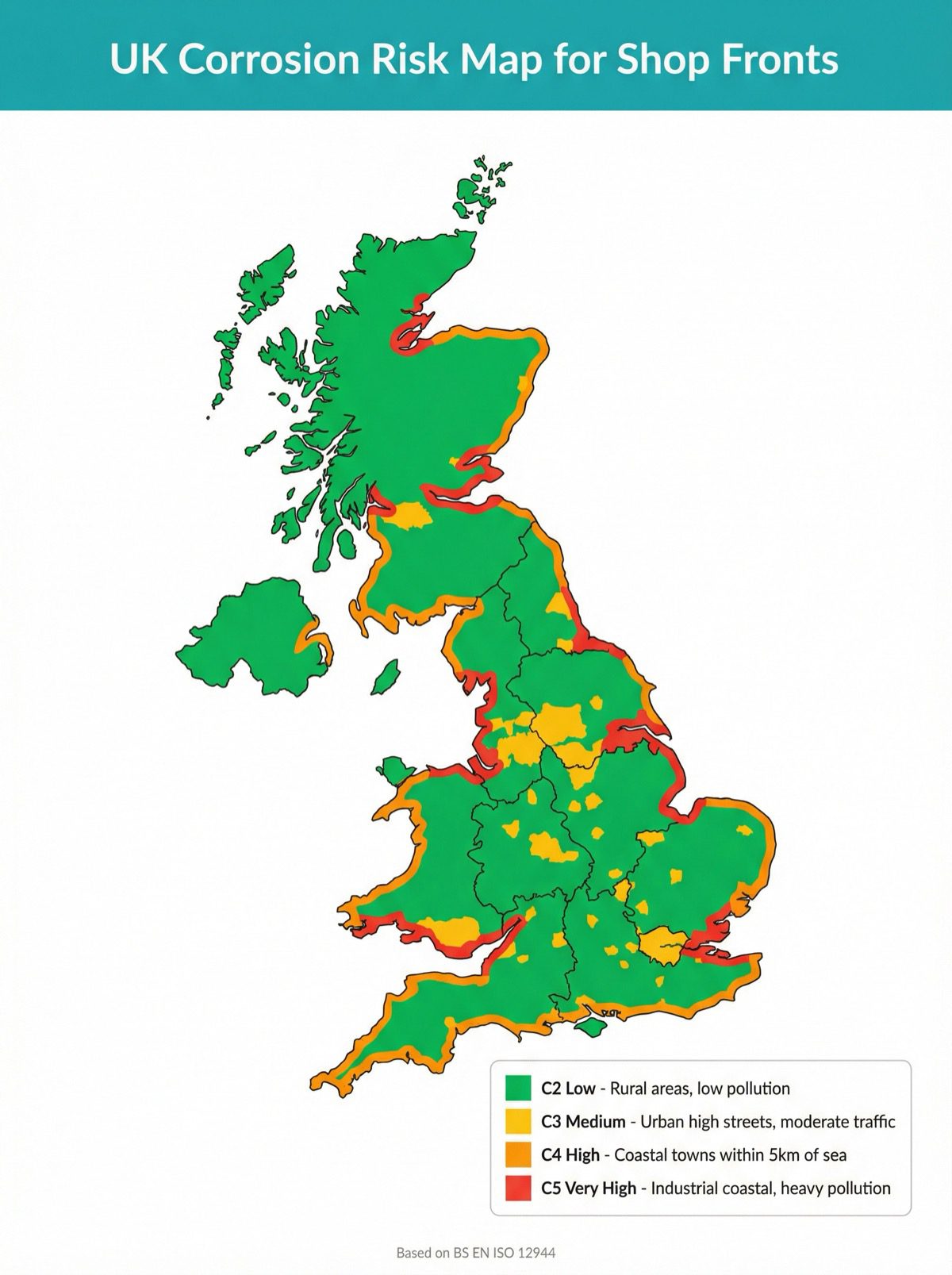
Understanding Corrosion Categories (BS EN ISO 12944)
The international standard BS EN ISO 12944 classifies environments into corrosion categories from C1 (very low) to C5 (very high), based on how aggressively the atmosphere attacks unprotected steel. For shop front owners, knowing which category your location falls into tells you how much protection your frontage needs.
| Location Type | Corrosion Category | Annual Steel Loss | UK Examples |
|---|---|---|---|
| Rural inland | C2 (Low) | 1.3 – 25 µm/year | Village high streets, rural market towns |
| Urban inland | C3 (Medium) | 25 – 50 µm/year | Most UK town and city high streets |
| Industrial urban | C3-C4 (Medium-High) | 25 – 80 µm/year | City centres near industry (Birmingham, Manchester, Liverpool) |
| Coastal (>2 km from sea) | C3 (Medium) | 25 – 50 µm/year | Coastal towns set back from the seafront |
| Coastal (<2 km from sea) | C4 (High) | 50 – 80 µm/year | Seafront high streets, harbour businesses |
| Seafront (<0.5 km from sea) | C4-C5 (High-Very High) | 50 – 200 µm/year | Promenade shops, pier-adjacent businesses |
To put those numbers into practical terms: a typical steel shop front section is 1.5-3 mm thick. In an urban inland location (C3), untreated steel loses 25-50 microns per year. In a seafront location (C5), that jumps to 50-200 microns per year. A seafront steel shop front could suffer structural compromise within 10-15 years even with basic maintenance.
Research by the Galvanizers Association UK found that steel samples positioned 24 metres from the coastline corroded 12 times faster than identical samples 243 metres from shore. Coastal corrosion can be 400-500 times more aggressive than dry inland environments.
The broader economic impact is staggering. Corrosion and wear cost the UK economy an estimated £80 billion per year, according to research from the University of Edinburgh. Globally, the figure reaches $2.5 trillion annually — roughly 3.4% of world GDP. Between 15% and 35% of that is considered preventable through better material selection, coating systems, and maintenance practices. For individual shop front owners, the lesson is clear: the right prevention strategy pays for itself many times over.
The Four Key Aggressors
Salt air is the primary corrosion accelerator in the UK. Sodium chloride carried on coastal winds acts as an electrolyte, dramatically increasing the rate of the electrochemical reaction that produces rust. The C5 (very high) corrosion category applies exclusively within approximately 2 km of the coastline, with corrosion rates peaking within 500 metres of the sea.
Urban pollution remains a factor despite improvements since the Clean Air Acts. Vehicle exhaust and industrial emissions release sulphur dioxide, which dissolves in surface moisture to form sulphuric acid. Industrial cities like Liverpool, Manchester, and Birmingham experience higher corrosion rates due to the combined effect of pollution and humidity.
Acid rain is less severe than it was in the 1970s and 1980s, but acid deposition still occurs. Rainfall pH in industrial and urban areas can drop to 4.0-4.5, compared to normal rain at approximately 5.6. This accelerates both steel rusting and aluminium pitting.
Humidity and condensation provide the persistent moisture that all corrosion processes require. Morning dew and overnight condensation on metal surfaces create daily wet-dry cycles that are particularly aggressive. South-facing shop fronts experience greater temperature cycling and tend to corrode faster around seal lines and joints.
The Five Stages of Shop Front Corrosion
Corrosion does not happen overnight. It follows a predictable progression, and understanding where your shop front sits on that progression determines whether treatment is viable or replacement is the smarter investment. Here are the five stages, with enough detail for you to assess your own frontage.
Stage 1: Coating Breakdown
The first sign is usually subtle. Paint begins to chalk, fade, or lose its gloss — particularly on south-facing elevations that take the brunt of UV exposure. Small chips appear around edges, screw heads, and areas subject to impact (door frames, kick plates). At this point, the base metal is not yet affected. This is the cheapest and easiest stage to address: touch up the coating, and corrosion never starts.
Stage 2: Surface Rust
Once the coating breaks down, bare steel is exposed to air and moisture. Orange-brown discolouration appears — sometimes just as staining that washes down the frontage in rain. Paint may start to bubble as rust forms underneath. At this stage, the structural integrity of the metal is not compromised. A professional can grind back the rust, apply a converter or zinc-rich primer, and recoat. Treatment is straightforward and cost-effective.
Stage 3: Scale Formation
This is the stage where most shop owners first notice the problem. Rust is now visible and spreading. Paint is flaking in sheets. If you tap the surface, you may hear hollow sounds where rust has expanded beneath the coating. The surface feels rough and uneven. Rust staining is now present on surrounding masonry and the pavement below. Professional treatment is still possible at this stage, but it requires thorough mechanical preparation — wire brushing, sanding back to bright metal — and a full multi-coat system.
Stage 4: Pitting and Deep Corrosion
Corrosion has now penetrated well into the metal. Pits are forming — localised craters where the steel has been eaten away. The surface is heavily textured and rough. In some areas you may be able to push a screwdriver into the metal. Structural sections are losing thickness. This is the tipping point: treatment becomes unreliable because the metal itself is compromised. Even if you treat the surface, the weakened sections remain. Professional assessment is essential.
Stage 5: Structural Failure
Perforation has occurred — you can see daylight through the metal in places. Frames may be visibly bowed, sagging, or distorted as weakened sections can no longer carry their load. Glazing seals are failing because frame movement has broken the bond. Water is entering the building. Rust debris is falling onto the pavement. This is a health and safety hazard. Replacement is the only option, and it needs to happen urgently.
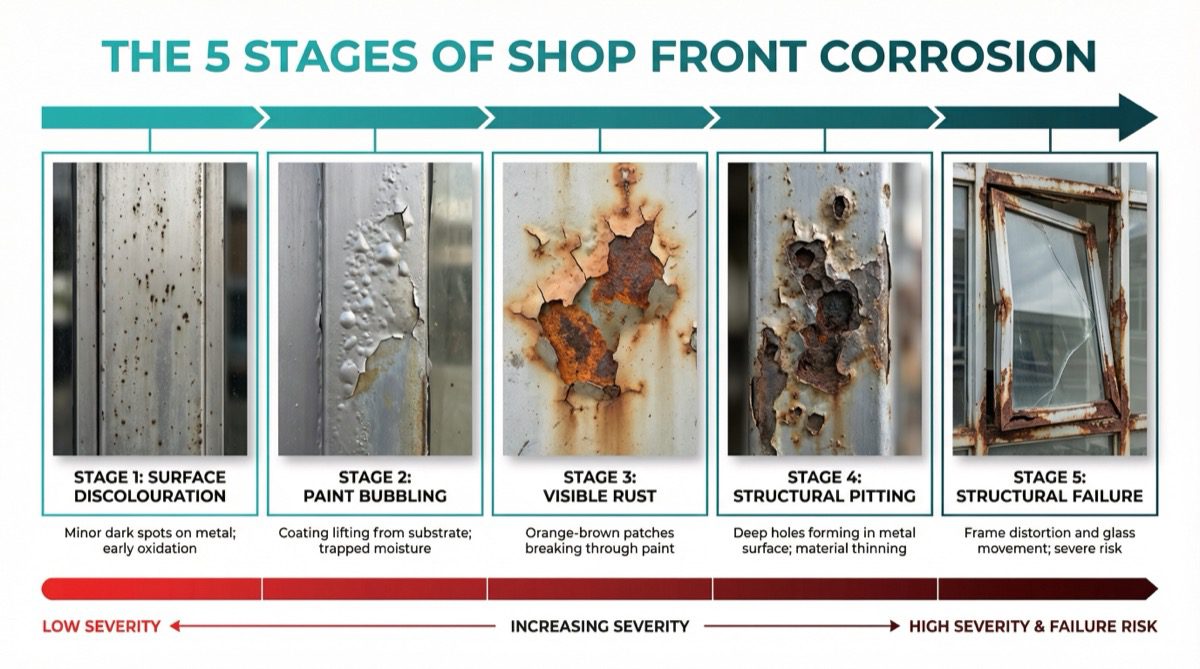
A simple rule of thumb: Stages 1-2 are treatable. Stage 3 needs professional assessment. Stages 4-5 almost always mean replacement.
How to Prevent Shop Front Corrosion
Prevention is always cheaper than cure. The right material choice, coating system, and maintenance routine can push your shop front’s lifespan from 15 years to 40+ years. Here are the proven methods, referenced against the British Standards that govern them.
Choose the Right Material
The single most effective corrosion prevention decision is material selection. Powder-coated aluminium is inherently resistant to rust because it contains no iron. Its self-healing oxide layer provides passive protection from day one. For new installations or replacements, aluminium eliminates the rust problem entirely. For businesses that prefer a traditional look, timber shop fronts avoid metal corrosion altogether, though they introduce different maintenance needs.
Hot-Dip Galvanising (BS EN ISO 1461)
If steel must be used, hot-dip galvanising is the gold standard for corrosion protection. The steel is immersed in molten zinc at approximately 450°C, forming a metallurgically bonded zinc-iron alloy layer topped by pure zinc.
Galvanising protects steel in two ways. The zinc coating acts as a physical barrier against moisture and oxygen. But more importantly, if the coating is scratched or damaged, the surrounding zinc corrodes preferentially — sacrificing itself to protect the exposed steel. This cathodic protection is effective for scratch widths up to approximately 5 mm, giving galvanised steel a self-healing quality that paint systems lack entirely.
Under BS EN ISO 1461:2022, minimum coating thickness depends on the steel section thickness — ranging from 45 µm for steel under 1.5 mm to 85 µm for steel over 6 mm. According to the Galvanizers Association UK, hot-dip galvanising delivers a life expectancy of 50+ years in typical UK conditions, and 20-30 years even in aggressive coastal environments.
Powder Coating (BS EN 12206-1)
Powder coating is the standard protective finish for modern shop fronts. Dry polyester powder is electrostatically applied and then oven-cured at 180-200°C, forming a continuous, hard film that is more uniform, durable, and UV-resistant than wet paint.
BS EN 12206-1:2021 specifies a minimum coating thickness of 40-50 microns, with an optimum of 60-80 microns for architectural applications. The Qualicoat quality label — an international third-party certification — grades powder coating into classes from standard (Class 1) through to a dedicated Seaside Class for coastal installations, which requires deeper acid etching and a full conversion layer seal.
A quality powder-coated finish lasts 15-25 years in exterior applications. It is available in the full RAL colour range — over 200 standard colours plus metallic, matt, satin, gloss, and textured finishes. When applied to aluminium, powder coating adds cosmetic versatility on top of the metal’s inherent corrosion resistance.
Marine-Grade Coatings for Coastal Properties
If your shop front is within 5-10 km of the coast, marine-grade coatings are worth the investment. Marine-grade epoxy-polyester powder coatings are specifically engineered to resist salt spray, UV radiation, humidity, and wind erosion. Testing involves 72 hours of neutral salt spray exposure per cycle across 25 cycles — over 4,200 hours of accelerated corrosion testing.
For maximum protection in C4-C5 environments, a duplex system combines a zinc primer base layer with a marine-grade topcoat. This provides both sacrificial protection and barrier protection — a belt-and-braces approach that is well suited to seafront and harbour-adjacent businesses.
Anodising (Aluminium Only)
Anodising thickens aluminium’s natural oxide layer from nanometres to 5-25 microns through a controlled electrochemical process. The result is a surface that is extraordinarily hard, abrasion-resistant, and durable. Inspections of anodised aluminium buildings over 30 years old show the anodic layer retaining its original appearance with minimal degradation.
Anodised aluminium does not chip, peel, or flake. It requires less maintenance than powder coating. And the metal remains 100% recyclable, with nothing added to its composition. The trade-off is a more limited colour range — natural silver, bronze, black, gold, and champagne — compared to the full RAL spectrum available with powder coating.
Treating a Rusted Shop Front: What Works and What Does Not
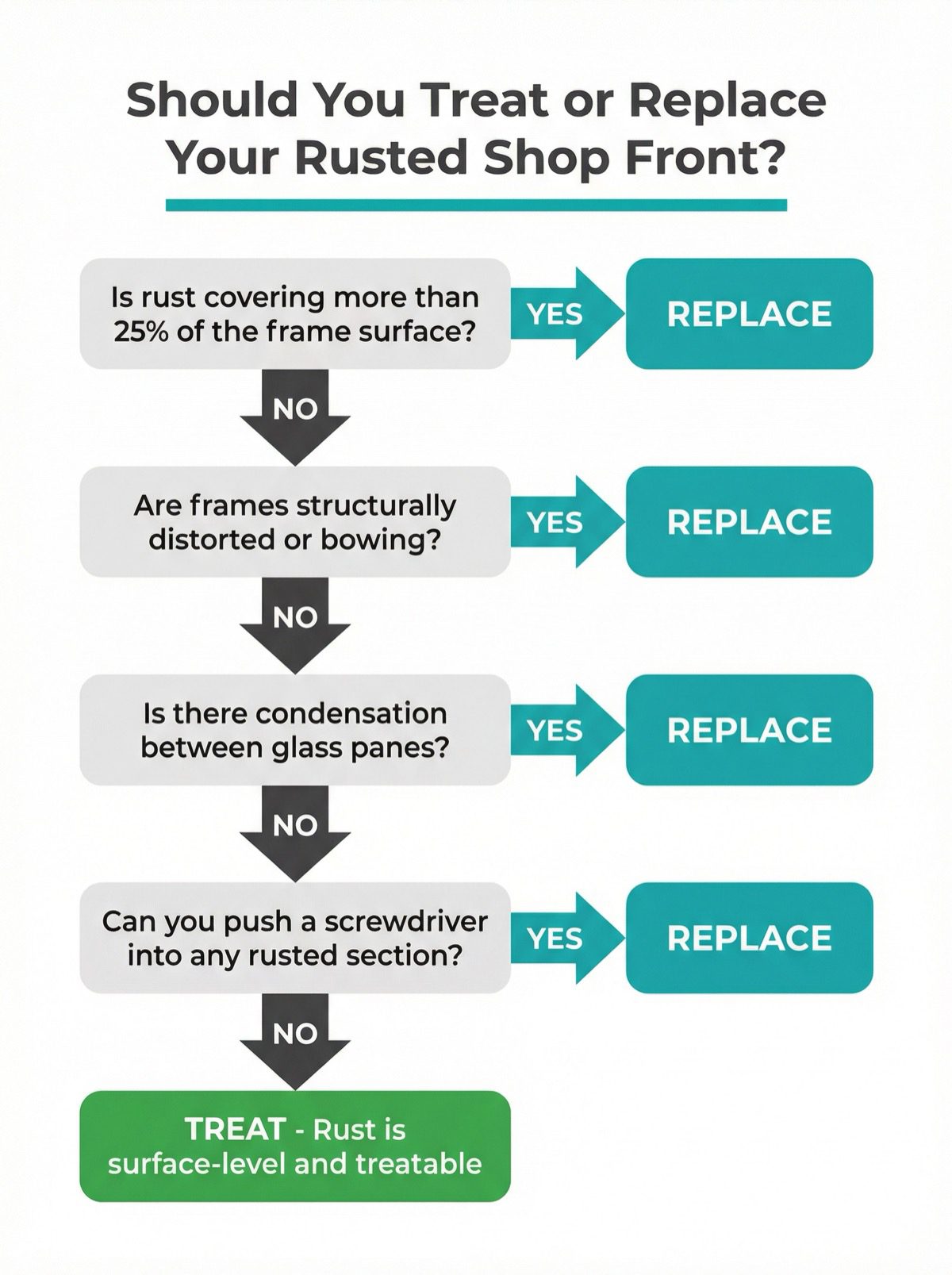
If your shop front is at Stage 1-3 on the corrosion scale, treatment is likely viable. The key is thorough preparation — cutting corners on prep is the single most common reason treatments fail within a year or two.
Surface Preparation
All loose rust and flaking paint must be removed before any treatment is applied. Wire brushing — manual for small areas, power-driven for larger surfaces — removes the worst of it. Follow with sanding, starting at 40-60 grit to strip rust back to bright metal and working up to 120-240 grit for a smooth finish ready for priming.
There is a critical rule: bare metal must be primed within 24 hours of surface preparation. Freshly exposed steel begins to oxidise almost immediately in UK humidity. Leaving prepared metal overnight without primer means the rust is already re-forming by morning.
Chemical Rust Converters
Rust converters are a practical solution for adherent rust that cannot easily be removed mechanically. Products containing tannic acid convert reddish iron oxides into bluish-black ferric tannate — a stable compound that bonds tightly to the base metal. Phosphoric acid-based converters produce a layer of inert ferric phosphate. Both types include an organic polymer that dries into a protective primer coat, creating a sound surface for topcoating.
UK products such as Neutrarust 661, Jenolite Rust Converter, and Bilt Hamber Deox C are widely available. However, converters have limitations: they only work on existing rust (not bare metal), heavy loose rust must be removed first, and they are not a substitute for mechanical preparation on heavily corroded surfaces.
Primers and Topcoats
For treated steel shop fronts, a zinc-rich primer is the best performing option. These primers contain 85-95% zinc dust in the dry film, providing both barrier protection and cathodic (sacrificial) protection. They are the industry standard for severe corrosion environments and the recommended choice for coastal locations.
Zinc phosphate primers are a good all-round alternative with solid barrier and chemical inhibition properties. Traditional red oxide primers are cheaper but are generally being superseded by zinc-based systems for performance.
For more detail on shop front painting systems, including wet paint versus spray application, our dedicated guide covers the full process.
The Treatment Viability Rule
Treatment is viable when:
- Surface rust only — no pitting deeper than 1 mm.
- Less than 10-15% of the shop front surface area is affected.
- Structural sections remain at full thickness.
- Rust is confined to cosmetic surfaces, not load-bearing joints.
- The underlying frame is otherwise in good condition.
Treatment becomes unreliable — and replacement becomes the better investment — when more than 25% of the surface shows active corrosion, pitting exceeds 1 mm depth in structural sections, the frame is visibly distorted, or previous treatments have failed within 1-2 years.
When Replacement Is the Only Answer
There comes a point where continued treatment is throwing money at a problem that cannot be solved. Recognising that point early saves you from the worst outcome: spending thousands on treatment and still needing to replace the shop front a year later.
Clear Signs Replacement Is Needed
- Perforation: Holes through the metal. If you can see daylight through any part of the frame, treatment is not an option.
- Structural distortion: Visible bowing, sagging, or twisting of frame members. This indicates the steel has lost enough cross-section to compromise its load-bearing capacity.
- Glass seal failure: When frame corrosion causes movement, the bond between frame and toughened glass panels breaks. You will notice draughts, water ingress, or condensation between panes.
- Widespread surface coverage: More than 25% of the frontage showing active corrosion. At this level, the cost of proper treatment approaches or exceeds replacement — and the treated frame will still be old steel in a hostile environment.
- Repeated treatment failure: If rust returns within 1-2 years of professional treatment, the underlying metal is too compromised to hold a coating system.
- Age: A steel shop front over 20 years old with active corrosion is at the end of its economic life. The metal has been through two decades of thermal cycling, moisture exposure, and atmospheric attack.
Why Aluminium Is the Smart Replacement Choice
When a rusted steel shop front is replaced, the replacement material matters enormously — and it is also the ideal time to rethink the overall design of your shop front. Installing another steel frame simply resets the clock on the same problem. Aluminium shop fronts eliminate rust permanently, deliver a 40+ year lifespan with basic maintenance, and require no repainting or re-treatment throughout their service life.
From an emergency repair perspective, aluminium frames also hold their glazing seals more reliably over time — meaning fewer call-outs for water ingress, draughts, or loose panels caused by frame movement. Aluminium weighs approximately one-third as much as steel for the same profile dimensions, which places less stress on the surrounding structure and simplifies installation. And because powder coating is applied in a factory-controlled environment — not sprayed on site — the finish quality and consistency are markedly better than anything achievable through on-site repainting of treated steel.
For businesses in the commercial glazing sector or those with large frontages, aluminium’s strength-to-weight ratio also allows for slimmer frame profiles and larger glass areas — improving natural light, street visibility, and the overall impression of the premises. Choosing between double glazing and single glazing at this stage is also worth considering, since a new frame gives you the opportunity to upgrade your glass specification at the same time.
Steel vs Aluminium: The Full Corrosion Comparison
This comparison matters because it is the core decision facing any shop owner dealing with a corroding frontage. Replace like-for-like with steel, or switch to aluminium? The data points strongly in one direction.
| Factor | Steel Shop Front | Aluminium Shop Front |
|---|---|---|
| Rust risk | High — iron oxide forms readily in UK climate | None — contains no iron |
| Corrosion mechanism | Iron oxide (porous, flaking, self-perpetuating) | Aluminium oxide (hard, bonded, self-healing) |
| Oxide volume expansion | 6x the original metal — causes coating failure | Negligible — oxide layer is nanometres thick |
| Untreated lifespan | 10-15 years | 25-30 years (before recoating needed) |
| Well-maintained lifespan | 25-30 years | 40+ years |
| Coastal durability (C4-C5) | Poor — accelerated corrosion within 10 years | Good — with marine-grade coating, 30+ years |
| Maintenance frequency | Annual inspection, repaint every 5-7 years | Annual wash, no repainting required |
| Weight | Heavier — more load on structure | Approximately one-third the weight of steel |
| Recyclability | Recyclable but often contaminated by corrosion products | 100% recyclable with no loss of quality |
| Colour options | Wet paint or spray — limited by repainting quality | Full RAL colour chart via factory powder coating |
Cost Analysis: Treatment vs Replacement Over 10 Years
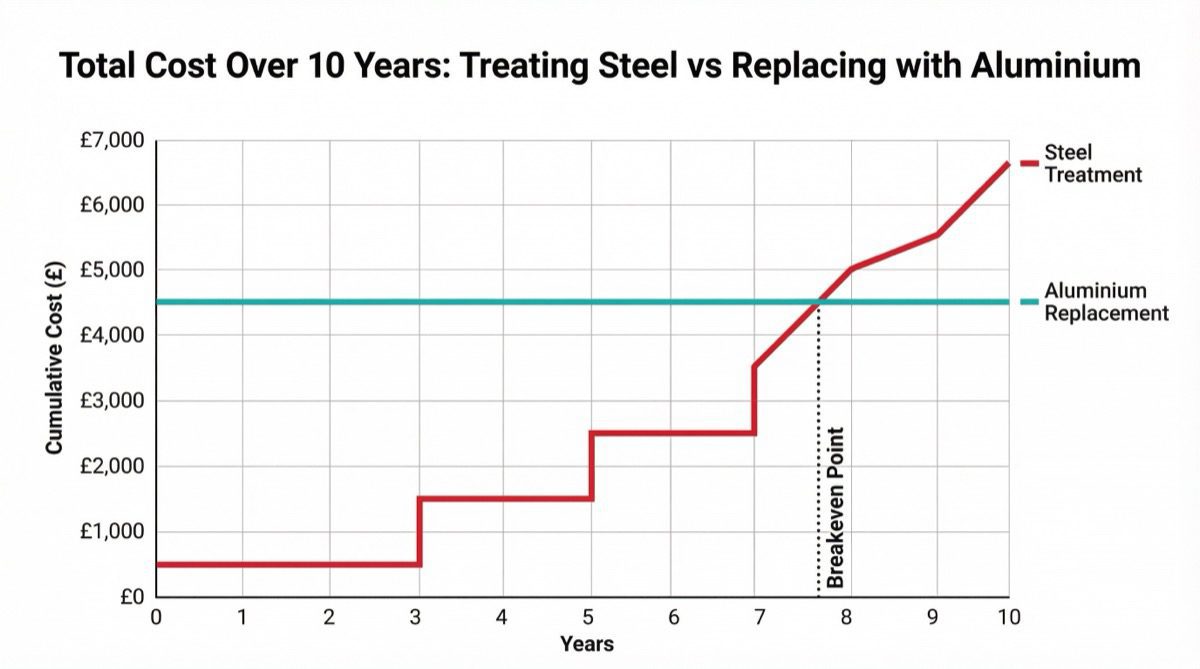
This is where the numbers tell a story that surprises most business owners. The upfront cost of treating rust is lower than replacement — but the total cost over a decade almost always favours replacing a rusted steel frontage with aluminium.
Treatment Costs (UK 2026 Estimates)
| Treatment | Estimated Cost | Notes |
|---|---|---|
| Small area DIY touch-up | £50 – £150 | Materials only (converter, primer, paint) |
| Professional localised treatment | £300 – £800 | Per affected area, includes prep and recoating |
| Full shop front treatment and repaint | £1,500 – £3,500 | Complete preparation, treatment, multi-coat system |
| Repeat treatment (within 5 years) | £1,000 – £2,500 | Likely needed for steel in C3+ environments |
Replacement Costs (UK 2026 Estimates)
| Option | Estimated Cost | Notes |
|---|---|---|
| Standard aluminium shop front (single unit) | £3,500 – £5,000 + VAT | Basic configuration, standard size |
| Full removal and new installation | £4,000 – £8,000 + VAT | Typical range for a standard retail unit |
| Premium specification (larger unit) | £8,000 – £15,000+ | Larger units, premium hardware, automation |
| Per square metre (supply and install) | ~£350/m² | Useful for budgeting non-standard sizes |
For detailed pricing breakdowns and a budget calculator, see our full shop front cost guide and shop front cost calculator.
The 10-Year Comparison
| Year | Steel (Treat & Maintain) | Aluminium (Replace) |
|---|---|---|
| Year 0 | £2,000 (initial treatment) | £5,000 (replacement) |
| Year 3 | £500 (maintenance/touch-up) | £0 |
| Year 5 | £2,000 (re-treatment) | £0 |
| Year 7 | £500 (maintenance/touch-up) | £0 |
| Year 10 | £1,500 (likely needs replacing) | £100 (annual wash) |
| 10-Year Total | £6,500 | £5,100 |
The crossover point occurs around year 7. After that, every pound spent maintaining a corroding steel frame is money that would have been better invested in aluminium from day one. And at year 10, the aluminium shop front is barely into its service life — while the treated steel frame is almost certainly due for full replacement anyway.
There is also an opportunity cost that does not appear in any table. A rusted, deteriorating shop front deters customers. Research consistently shows that frontage quality directly affects footfall and perceived brand credibility. A business losing even 5% of passing trade to a tired-looking exterior is losing far more over a decade than the cost difference between treatment and replacement. Pairing a new frontage with integrated lighting and properly planned signage compounds the return even further.
For more on the economics of repair versus replacement, our guide on when to replace your shop front covers the full decision-making framework.
Health, Safety, and Legal Obligations
A rusted shop front is not just an eyesore. It creates genuine legal and safety liabilities that business owners and landlords need to take seriously.
Safety Hazards
Severely rusted shop fronts present multiple hazards to the public and to building occupants:
- Falling debris: Corroded sections can detach and fall onto the pavement, posing an injury risk to pedestrians.
- Sharp edges: Corroded metal develops rough, jagged edges capable of causing cuts and lacerations.
- Glass retention failure: If the frame holding glazing panels corrodes, sealed units can become loose. A sheet of toughened glass falling from a shop front is a serious danger.
- Structural collapse: Advanced corrosion weakens structural members, risking partial or total shop front collapse.
- Water ingress: Corroded frames allow water into the building, potentially causing electrical hazards, mould growth, and further structural damage.
- Slip hazard: Rust-stained run-off on pavements can create slippery surfaces when wet.
Who Is Responsible?
In commercial property, the answer depends entirely on the lease. Under a Full Repairing and Insuring (FRI) lease — the most common type for retail premises — tenants are responsible for keeping the property in good condition, including the shop front. This means the cost of treating or replacing a corroded frontage typically falls on the tenant.
In commercial leases, windows, plate glass, and shop fronts are frequently stated to be the tenant’s responsibility, even where they form part of the building’s external structure. There is no statute that dictates who must insure these elements — it is a matter of contract, as outlined in the RICS Code for Leasing Business Premises.
At lease end, dilapidations claims can include the full cost of restoring a corroded shop front to its original condition. If you have let corrosion progress unchecked throughout your tenancy, you may face a substantial bill.
Insurance Implications
A deteriorating shop front could potentially invalidate building insurance if the insurer deems the damage to be the result of negligent maintenance rather than an insurable event. Insurance policies typically exclude damage arising from wear and tear or lack of maintenance. If a corroded frame fails and causes injury or property damage, and the insurer can demonstrate that the corrosion was obvious and unaddressed, the claim may be rejected.
Consider also the security dimension. A corroded, weakened shop front is easier to break into — and if your premises sits empty for any period, the risk increases further, as outlined in our guide to vacant property security. Insurers may increase premiums or add exclusions if the frontage is visibly deteriorated. For businesses with high-value stock, pairing a robust frontage with roller shutters provides both security and corrosion protection for vulnerable areas.
Relevant UK Legislation
- Health and Safety at Work Act 1974: Imposes a duty of care on employers and building occupiers towards employees, visitors, and the public.
- Occupiers’ Liability Act 1957 & 1984: Creates a duty of care towards lawful visitors and, to a lesser extent, trespassers.
- Building Regulations: Apply to structural integrity requirements if replacement work is carried out.
- CDM Regulations 2015: Apply if shop front replacement involves construction work, imposing duties on clients, designers, and contractors.
Shop Front Maintenance Schedule to Prevent Corrosion
Prevention costs a fraction of cure. The following maintenance schedule applies to both steel and aluminium shop fronts, though the intensity and cost differ significantly — one of the reasons aluminium is the preferred material for business owners who want to minimise ongoing expenditure.
| Frequency | Action | Applies To |
|---|---|---|
| Monthly | Visual inspection for chips, scratches, or early rust/corrosion spots | Steel and aluminium |
| Quarterly | Clean with mild detergent and water; rinse salt deposits in coastal areas | Steel and aluminium |
| Every 6 months | Detailed inspection of joints, seals, and fixings; treat any corrosion spots immediately | Steel (aluminium annually) |
| Annually | Full condition assessment; touch up any coating damage on steel; wash and inspect aluminium | Steel and aluminium |
| Every 3-5 years | Professional deep clean and coating assessment; consider recoating if chalking or fading visible | Steel (aluminium at 5-7 years) |
| Every 5-7 years | Full exterior repaint for painted steel surfaces | Steel only |
| Every 10-15 years | Major refurbishment assessment; full recoating if powder coated; structural survey if steel | Both (aluminium recoating rarely needed before 15 years) |
Coastal properties should double the inspection frequency listed above. A quarterly wash to remove salt deposits is essential — salt that sits on a surface for months causes far more damage than salt that is rinsed off within weeks.
South-facing frontages experience greater UV exposure and thermal cycling. Pay particular attention to seal lines, bottom rails, and any horizontal surfaces where water can pool. Installing a shop front canopy can also help shield vulnerable areas from direct rain and UV exposure.
Frequently Asked Questions
Why do shop fronts rust?
Steel shop fronts rust when their protective coating (paint or powder coating) breaks down, exposing bare iron to moisture and oxygen. The resulting electrochemical reaction produces iron oxide — rust — which is porous and self-perpetuating. UK conditions accelerate this process: high humidity, urban pollution, and coastal salt air all increase corrosion rates. Even a small chip in the coating can become a major rust problem within 2-3 years if left untreated.
Does aluminium rust?
No. Aluminium cannot rust because it contains no iron, and rust is specifically iron oxide. Aluminium does form its own oxide layer when exposed to air, but unlike rust, aluminium oxide is extremely hard, firmly bonded to the surface, impermeable to moisture, and self-healing if scratched. This is why aluminium shop fronts last 40+ years without the progressive structural degradation that affects steel.
Can you treat rust on a shop front without replacing it?
Yes, if the corrosion is caught early. Surface rust affecting less than 10-15% of the frontage, with no pitting deeper than 1 mm and no structural compromise, can be treated by removing loose rust, applying a chemical converter or zinc-rich primer, and recoating. Professional treatment costs £300-£3,500 depending on severity. However, once more than 25% of the surface is affected or structural sections are weakened, replacement is more cost-effective.
How much does it cost to replace a rusted shop front in the UK?
A standard aluminium replacement shop front for a single retail unit costs £3,500-£5,000 + VAT, including removal of the old frame and installation. Larger or premium specifications range from £8,000-£15,000+. As a rough guide, budget approximately £350 per square metre for supply and installation. See our detailed cost guide for full pricing breakdowns.
Is it cheaper to repair or replace a rusted shop front?
In the short term, treatment is cheaper — typically £1,500-£3,500 versus £4,000-£8,000 for replacement. Over 10 years, however, the maths reverses. Repeated treatment and maintenance of a corroding steel frame totals approximately £6,500, while a one-time aluminium replacement totals around £5,100 including minimal upkeep. Replacement also eliminates the risk of future rust entirely.
What is galvanic corrosion and how does it affect shop fronts?
Galvanic corrosion occurs when two different metals (e.g. steel fixings in an aluminium frame) are in direct contact in the presence of moisture. The more reactive metal corrodes far faster than it would alone. This is a common cause of premature shop front failure and is prevented by isolating dissimilar metals with plastic washers, rubber gaskets, or insulating sleeves.
How long does a steel shop front last compared to aluminium?
An untreated steel shop front typically lasts 10-15 years before corrosion becomes a significant problem. With regular maintenance and repainting every 5-7 years, that extends to 25-30 years. A powder-coated aluminium shop front lasts 40+ years with only basic cleaning — no repainting, no rust treatment, no structural degradation from corrosion.
Who is responsible for a rusted shop front — landlord or tenant?
It depends on the lease. Under a Full Repairing and Insuring (FRI) lease, the most common type for UK retail premises, the tenant is responsible for maintaining the shop front in good condition. Shop fronts, windows, and plate glass are frequently specified as the tenant’s obligation even when they form part of the external structure. At lease end, unaddressed corrosion can result in a dilapidations claim.
Is a rusted shop front a health and safety hazard?
Yes. Advanced corrosion can cause falling debris, sharp edges, glass retention failure, structural weakness, water ingress, and slip hazards from rust-stained pavements. Building occupiers have duties under the Health and Safety at Work Act 1974 and the Occupiers’ Liability Acts. If a corroded shop front causes injury, the occupier or owner may be held liable.
What is the best coating to prevent shop front rust?
For steel, hot-dip galvanising to BS EN ISO 1461 provides the longest-lasting protection — 50+ years in typical UK conditions. For aluminium, factory-applied powder coating to BS EN 12206-1 at 60-80 microns is the standard, with marine-grade coatings recommended for coastal locations. The most effective system for severe environments is a duplex coating: galvanised steel or marine-grade primer, topped with a high-quality powder coat or polyester topcoat.
How do I know what corrosion category my shop front location falls under?
BS EN ISO 12944 classifies UK environments from C1 (very low) to C5 (very high). Most urban high streets are C3 (medium). If you are within 2 km of the coast, your location is likely C4 (high). Within 500 metres of the sea, expect C4-C5 (high to very high). Rural inland locations are typically C2 (low). Your coating system and maintenance schedule should match your corrosion category.
Does salt air affect shop fronts?
Salt air is the single biggest accelerator of shop front corrosion in the UK. Sodium chloride carried on coastal winds acts as an electrolyte, dramatically speeding up rust formation on steel. Steel samples 24 metres from the coastline corrode 12 times faster than those at 243 metres. For coastal shop fronts, marine-grade coatings, more frequent cleaning (quarterly minimum), and ideally aluminium construction are strongly recommended.
Protect Your Shop Front — Or Replace It Before It Costs You More
Corrosion does not wait, and it does not slow down. Every month that a damaged coating or early rust spot goes unaddressed, the problem grows — and the cost of fixing it grows with it. The businesses that spend the least on corrosion over the lifetime of their premises are the ones that either invest in the right materials upfront or act quickly when the first warning signs appear.
If your shop front is showing signs of rust, the first step is a professional assessment. We can tell you whether treatment is viable or whether replacement is the smarter long-term investment — honestly, with no obligation, based on what we see and what the numbers say.
With over 20 years of experience installing commercial shop fronts across the UK, FENSA registration, CHAS accreditation, and Constructionline approval, Huxley & Co provides free, no-obligation assessments and quotes for shop front replacement. Call us on 020 7112 4849, email info@huxleyandco.co.uk, or request a callback online.