
Key Takeaways:
- A well-designed commercial shop front can increase foot traffic by up to 30% and directly impacts how customers perceive your business before they step inside.
- Aluminium, toughened glass and timber are the three primary material choices, starting from around £350/m², £450/m² and £520/m² respectively.
- Planning permission is typically required for structural changes, and listed building consent applies in conservation areas across England and Wales.
- Colour, signage, lighting, window displays and accessibility all need to work together as a unified design rather than afterthoughts.
- Working with a FENSA-registered installer ensures your shop front meets Building Regulations and is properly certified from day one.
A restaurant owner in Shoreditch recently told us that swapping her tired timber fascia for a sleek aluminium-and-glass frontage doubled her walk-in covers within three months. She hadn’t changed the menu, the prices or the interior. The only thing that changed was what people saw from the pavement.
That story isn’t unusual. Your shop front is doing a job 24 hours a day, seven days a week, whether the lights are on or not. It tells passers-by what kind of business you run, how much you care about quality, and whether they’d feel comfortable walking through the door. Get it right and you have a silent salesperson working around the clock. Get it wrong and potential customers drift past without a second glance.
This guide pulls together everything we’ve learned across more than 20 years of designing and installing commercial shop fronts across London and the South East. We’ll cover design principles, materials, colour choices, signage, lighting, security, accessibility, costs and the full installation process — so you can make confident decisions whether you’re fitting out a brand-new unit or breathing life into a tired frontage.

What Makes a Great Shop Front? Core Design Principles
Before you pick materials or colours, it helps to step back and think about what a shop front actually needs to achieve. After installing hundreds of commercial frontages, we’ve found that the strongest designs share four qualities: they’re memorable, recognisable, legible and inviting.
Memorable: Your frontage competes with every other business on the street. It doesn’t have to be loud — it just needs a distinctive element that sticks. That could be an unusual material pairing, a bold colour from the RAL colour chart, or an architectural detail like a curved glass corner panel.
Recognisable: Consistency between your shop front and your wider brand matters more than most people realise. If your logo uses clean sans-serif type and a teal palette, a frontage with ornate gold lettering sends a confusing signal. Every element — fascia, signage, door furniture — should reinforce who you are.
Legible: Can someone read your shop name from across the road? We regularly see frontages where the business name is too small, the font too decorative, or the colour contrast too weak. Picking the right sign type and lettering is one of the most important decisions you will make. If people can’t tell what you do at a glance, they won’t stop.
Inviting: Large areas of glass let people see products and activity. A clean, well-lit entrance with a clear pathway says “come in.” Cluttered displays, dirty frames or a dark interior do the opposite.
Shop Front Design Styles: Modern, Traditional and Everything Between
Your design style should reflect both your brand identity and the character of the street you’re on. Here are the main approaches we see working well across different commercial settings.

Contemporary and Minimalist
Clean lines, slim aluminium frames and large expanses of glass define the modern commercial frontage. This style works well for restaurants, salons, estate agents and tech-focused businesses. Frameless toughened glass shop fronts create a near-invisible barrier between the street and the interior. Add a set of bi-folding doors that open the entire frontage on warm days and a minimal design becomes genuinely striking.
Traditional and Heritage
If your business sits in a conservation area or period building, a traditional design is often both a planning requirement and a commercial advantage. Panelled stallrisers, corbel brackets and multi-paned windows signal craftsmanship and quality. Timber shop fronts are the natural choice — hardwood frames painted in heritage colours can replicate Victorian or Georgian proportions while meeting current Building Regulations.
Industrial and Urban
Exposed steelwork, Crittall-style glazing bars, dark powder-coated frames and raw materials suit converted warehouses, railway arches and regeneration areas. Popular with craft breweries, co-working spaces and independent coffee shops.
Blending Old and New
Some of our most successful installations combine modern materials with traditional proportions. An aluminium shop front can be powder-coated to look like painted timber and detailed with traditional moulding profiles, giving you heritage aesthetics with minimal maintenance.
Choosing the Right Materials for Your Shop Front
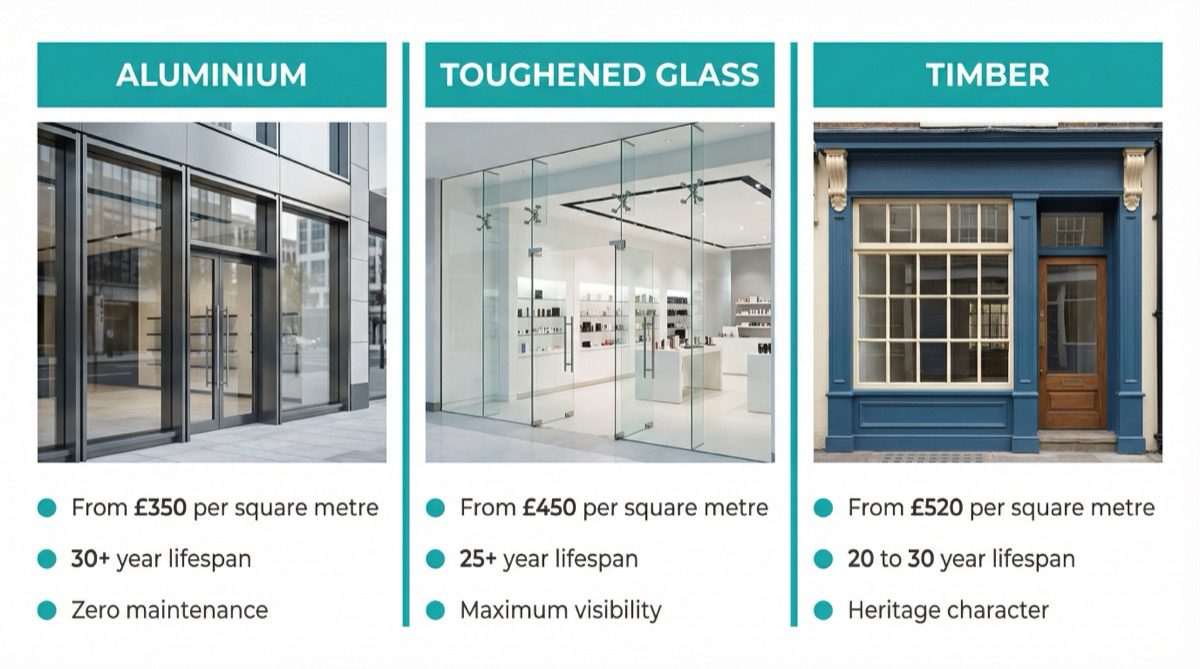
Material choice affects appearance, performance, maintenance, lifespan and cost. Here’s an honest comparison based on what we install day in, day out.
Aluminium
Aluminium shop fronts account for the majority of our installations. The material is lightweight, corrosion-resistant and strong for its weight, allowing slimmer frame profiles and larger glazed areas. Powder coating gives you access to virtually any colour on the RAL colour chart, and the finish won’t peel, crack or fade for decades. For most commercial premises, aluminium is the default recommendation.
Toughened Glass
Toughened glass shop fronts maximise transparency and light. Structural glass systems can create near-frameless facades supported by minimal fixings. Toughened glass is four to five times stronger than standard float glass and shatters into safe granular pieces rather than dangerous shards. Laminated options add further security and hold together even when broken.
Timber
Timber shop fronts offer warmth and character that no other material matches. Hardwoods like meranti, sapele and accoya combine dimensional stability with natural durability. Timber does require more upkeep — expect to repaint every five to eight years — but for heritage applications, conservation areas and premium brands, that trade-off is worthwhile.
Curtain Walling and Composite Systems
For larger frontages, commercial glazing and curtain walling systems combine aluminium framing with large glazed panels. Common in showrooms, gyms and larger retail units where you want floor-to-ceiling glass spanning multiple bays.
Material Comparison at a Glance
| Factor | Aluminium | Toughened Glass | Timber |
|---|---|---|---|
| Starting cost (per m²) | From £350 | From £450 | From £520 |
| Maintenance | Very low | Low | Moderate (repaint every 5–8 years) |
| Lifespan | 30–45 years | 25–40 years | 25–40 years (with maintenance) |
| Colour options | Any RAL colour | Clear, tinted, frosted | Any paint or stain colour |
| Best for | Most commercial uses | Maximum visibility and light | Heritage, conservation, premium brand |
| Planning suitability | Modern and mixed settings | Contemporary settings | Conservation areas and listed buildings |
For a detailed breakdown of costs including installation, hardware and finishing, see our full shop front cost guide or try the shop front cost calculator for a quick estimate based on your dimensions.
Colour Selection: More Than Just Picking a Favourite
Colour affects visibility, brand perception and even how large your frontage appears. Start with your brand palette — if you have established colours, use them on the fascia and signage. If you’re starting fresh, think about colour psychology: deep blues and greens convey trust, bold reds create energy, black suggests premium quality.
Whatever background colour you choose, signage needs strong contrast. White lettering on a dark fascia is one of the most legible combinations from a distance. Also consider your neighbours — a forest green frontage next to another green shop disappears, but the same green next to cream and red brick pops.
We offer the full RAL colour chart for powder-coated aluminium and can colour-match to Pantone or existing brand specifications.
Signage That Works Day and Night
Your signage needs to communicate your business name and be readable in daylight, at dusk and after dark. Flat fascia signs are clean and cost-effective. Projecting signs catch the eye of pedestrians walking along the pavement. Individual 3D letters fixed to the fascia give a premium architectural finish.
For businesses trading into the evening, illuminated signage is worth the investment. Halo-lit letters create a sophisticated effect, front-lit channel letters offer maximum visibility, and internally illuminated light boxes are the most affordable after-dark option.
Keep the fascia depth proportionate — no more than about one-fifth of the total shop front height. An oversized fascia overwhelms the glazing and makes the whole frontage feel squat. And if your building has architectural features above the shop — decorative stonework, a cornice line — work with them, not against them.
Window Displays That Pull People Inside
Your window display bridges the gap between the street and the till. It needs to grab attention, communicate what you sell, and create enough curiosity to pull people through the door.
Sell an experience. Instead of simply placing items in the window, create a scene. A cookware shop might stage a dinner party. A clothing boutique could build a “weekend away” vignette. Lifestyle merchandising outperforms static product displays across almost every retail sector.
Let people see inside. If your business involves visible activity — a barista making coffee, a florist arranging blooms, a baker pulling bread from the oven — let people see it. Activity attracts attention and breaks down the barrier between browsing and buying.
Refresh regularly. A display that hasn’t changed in months signals stagnation. Seasonal updates, tie-ins with local events, or even just swapping props keeps your frontage feeling alive.
Don’t overcrowd. Select a small number of hero products and give them space to breathe. If you try to show everything, you end up showing nothing.
Lighting: The Element That Works Overtime
Good lighting transforms a shop front from invisible after 4pm in winter to a glowing beacon on the high street.
Display lighting: LED spotlights or track lighting highlight products and create depth. Warm white (around 3000K) suits hospitality, food and fashion. Cooler temperatures (4000K+) work for tech and clinical settings.
Fascia and sign lighting: Trough lights or gooseneck lamps aimed at the fascia keep your name visible after dark. Halo-illuminated lettering achieves the same result with a cleaner look.
Architectural lighting: Recessed downlights in a canopy wash light down the frontage and create a welcoming pool of illumination at the entrance.
LED technology means a full lighting scheme for a typical shop front costs just a few pounds a month in electricity. Timers and photocell sensors automate everything.
Security Without Compromising Design
Security doesn’t have to ruin your carefully designed frontage. The best measures are the ones people barely notice.
Roller shutters remain the most popular solution. Perforated shutters allow displays to stay visible when you’re closed — better for natural surveillance and aesthetics than solid shutters that blank out your frontage. Powder-coat them to match your fascia and conceal the shutter box behind the fascia board for a clean finish.
Security glazing — laminated or anti-bandit glass — provides smash-and-grab protection with no visible difference from standard glass. Automatic doors fitted with maglocks and access control give you full entry-point management outside trading hours.
Accessibility: Legal Requirement and Good Business
The Equality Act 2010 requires reasonable adjustments so disabled people aren’t placed at a substantial disadvantage. For a shop front, that means thinking carefully about the entrance.
Level or ramped access is essential — steps exclude wheelchair users, parents with pushchairs and anyone with limited mobility. Where a level threshold isn’t possible, a ramp at a gradient no steeper than 1:12 should be provided. Door width of at least 800mm (preferably 1000mm) is the minimum for wheelchair access. Automatic doors remove the need for manual effort entirely. Visual contrast around door frames and manifestation markings on glass panels are Building Regulations requirements that also help customers with visual impairments.
A shop that’s easy for everyone to enter is a shop that gets more customers.
The Design-to-Installation Process
Never had a shop front installed before? Here’s what to expect.
1. Site survey: We visit your premises to take precise measurements, assess the existing structure, check services and discuss your design brief. We also identify planning constraints early.
2. Design and quotation: You receive detailed drawings and a fully itemised quotation. We adjust the design as many times as needed until you’re happy.
3. Planning and building control: We advise on planning permission, provide technical drawings and handle Building Regulations submissions. As a FENSA-registered company, our glazing installations are self-certified — saving you the cost of separate local authority inspections.
4. Manufacture: Frames are fabricated off-site to precise specifications, powder-coated and quality-checked. Glass is cut, toughened and laminated to order. Off-site fabrication means tighter tolerances and faster on-site work.
5. Installation: A typical single-unit shop front takes one to three days. We coordinate removal and installation to minimise disruption, and where possible you can continue trading throughout.
6. Handover: We walk you through operation and maintenance, hand over certificates and warranties, and make sure you’re satisfied. See completed projects in our project gallery.
Planning Permission and Regulations
Changing the appearance of a commercial shop front usually requires planning permission. Here’s a quick summary:
- Planning permission — required for changes to the external appearance of most commercial buildings, covering new frames, altered openings and fascia changes.
- Advertisement consent — required for new illuminated, projecting or large fascia signs. Some signs benefit from deemed consent, but always check.
- Listed building consent — required for any works affecting the character of a listed building, separate from planning permission.
- Building Regulations — apply to structural alterations, glazing thermal performance, means of escape and access. We self-certify glazing as a FENSA-registered installer.
- Conservation area guidance — local authorities often have specific shop front design requirements covering materials, colours and proportions. Check early to avoid rejected applications.
We regularly work with planning departments and can advise on the consents needed for your specific project.
How Much Does a Shop Front Cost?
Cost depends on materials, size, glazing specification, hardware (doors, locks, closers), finishing, signage and the complexity of the installation. Here are guide prices to help you budget.
| Material | Starting Price (per m²) | Typical Total for a Standard 4m Frontage |
|---|---|---|
| Aluminium | From £350/m² | £4,000 – £8,000 |
| Toughened glass | From £450/m² | £5,500 – £12,000 |
| Timber | From £520/m² | £6,500 – £14,000 |
These prices include supply and installation but exclude signage, roller shutters, automatic doors and any structural works. VAT applies at the standard rate.
For a more precise estimate based on your exact requirements, use our shop front cost calculator or call us on 020 7112 4849 for a no-obligation quotation.
Tips From the Workshop Floor
After more than two decades of installing shop fronts, here are a few things we wish every business owner knew before starting.
Don’t choose materials in isolation. Materials, colour, signage and lighting should work as a unified package. A beautiful frame in the wrong colour underperforms a more modest design where everything is coordinated.
Invest in good glass. Low-iron glass (clearer, less green) and high-performance double-glazed units make a noticeable difference to both appearance and thermal comfort.
Plan for maintenance from day one. Even aluminium benefits from periodic cleaning. Timber needs repainting on a schedule. Build it into your plan rather than waiting for deterioration — left unchecked, steel frames in particular are vulnerable to rust and corrosion that can turn a cosmetic issue into a structural problem.
Get the entrance right. The door is where the experience begins. A stiff, rattling door undermines everything else you’ve done with the design.
Frequently Asked Questions
Do I need planning permission to change my shop front?
In most cases, yes. Any change to the external appearance of a commercial building typically requires planning permission from your local authority. If your building is listed or in a conservation area, additional consents may be needed. We can advise on the specific requirements for your project.
How long does a shop front installation take?
A standard single-unit installation usually takes one to three days on site. The overall timeline from initial enquiry to completion — including survey, design, planning (if needed), manufacture and installation — is typically six to ten weeks.
Which material is best for a commercial shop front?
Aluminium is the most popular choice for commercial premises because it combines strength, slim profiles, low maintenance and a wide range of colour options. Timber is preferred for heritage or conservation area settings, and toughened glass suits businesses that want maximum transparency.
How much does a new shop front cost in the UK?
Prices start from around £350 per square metre for aluminium, £450/m² for toughened glass, and £520/m² for timber. A typical 4-metre-wide frontage ranges from roughly £4,000 to £14,000 depending on materials and specification. Use our cost calculator for a quick estimate or visit our full shop front cost guide.
Can I replace my shop front without closing my business?
In most cases, yes. Our guide on when to replace your shop front covers the full decision-making process. We schedule installations to minimise disruption and can often complete the swap in a single day for straightforward projects. Temporary hoarding can keep your premises secure and presentable while work is underway.
What is FENSA registration and why does it matter?
FENSA is a government-authorised scheme that allows registered installers to self-certify that glazing work complies with Building Regulations. Choosing a FENSA-registered installer like Huxley & Co means you receive a compliance certificate without the cost and delay of a separate local authority inspection.
How do I choose the right colour for my shop front?
Start with your brand colours. If you don’t have established brand colours, consider the impression you want to create and the colours of neighbouring buildings. We offer the full RAL colour chart for powder-coated aluminium and can colour-match to Pantone references or existing brand specifications.
What security options are available for shop fronts?
The main options are roller shutters (solid or perforated), laminated or anti-bandit glazing, multi-point locking systems, and automatic doors with access control. We recommend perforated roller shutters for most retail premises because they provide strong physical protection while keeping your window display visible.
Are there grants available for shop front improvements?
Some local authorities and Business Improvement Districts (BIDs) run shop front improvement grant schemes, particularly in regeneration areas or heritage zones. Grants typically cover a portion of the cost and come with design conditions. Check with your local council or BID for current availability in your area.
How do I maintain my shop front to keep it looking its best?
Aluminium frames need only periodic cleaning with warm soapy water. Timber should be inspected annually and repainted or re-stained every five to eight years. Glass should be cleaned regularly and checked for seal failures in double-glazed units. Hardware — hinges, locks, closers — should be serviced annually to keep doors operating smoothly.
Ready to Design Your New Shop Front?
Whether you have a clear vision or just a rough idea, we’re here to help you turn it into a frontage that works for your business. With over 20 years of experience, FENSA registration, CHAS accreditation and Constructionline approval, Huxley & Co handles everything from initial design through to final installation.
Get in touch for a free, no-obligation consultation and quotation:
- Call: 020 7112 4849
- Email: info@huxleyandco.co.uk
- Or fill in our contact form and we’ll get back to you within 24 hours.