
Key Takeaways:
- Curtain walling lets in up to 90% natural light, which has been shown to increase workplace productivity by 18% and reduce artificial lighting costs by up to 40%.
- High-performance curtain wall systems achieve U-values of 0.8–1.5 W/m²K, comfortably meeting Part L 2021 requirements and cutting heating energy loss through the facade by up to 60%.
- Installed costs range from £300 to £900 per m² — two to three times more than traditional cladding — but the 40–60 year lifespan and lower whole-life costs often justify the premium.
- Post-Grenfell fire safety regulations make specification more complex for buildings above 18 metres, requiring BS 8414 testing, non-combustible cavity barriers, and detailed fire-stopping at every floor junction.
- For ground-floor retail and single-storey commercial units, aluminium shop front systems typically deliver better value than curtain walling, with faster installation and lower overall project costs.
A developer we worked with last year had a clear vision for his new four-storey office building in Croydon: floor-to-ceiling glass on every elevation, maximum daylight, and a facade that would look as sharp in twenty years as it did on completion day. His architect had specified a curtain wall system, but the project quantity surveyor had flagged costs that were nearly double the original cladding budget. The question came to us: is curtain walling actually worth it?
It is a question we hear regularly, and the honest answer is that it depends. Curtain walling can transform a commercial building — dramatically improving energy performance, natural light, and long-term value. But it also comes with genuine drawbacks that need to be weighed carefully before committing to the expense.
This guide gives you both sides with real numbers, UK-specific regulations, and practical advice drawn from over 20 years of commercial glazing work. No sales pitch — just the facts you need to make the right decision for your project.

What Is Curtain Walling?
A curtain wall is a non-structural external facade, typically made from aluminium framing and glass, that hangs from the building’s structural frame like a curtain. Unlike load-bearing walls, it carries only its own weight and transfers wind loads back to the primary structure at each floor level.
Because curtain walls are non-structural, the facade can be almost entirely glass. The two main system types — stick systems (assembled piece by piece on site) and unitised systems (factory-assembled panels craned into position) — each suit different building heights, programmes, and budgets.
For a deeper look at system types, specifications, and UK standards, see our complete guide to aluminium curtain wall design.
Advantages of Curtain Walling
Natural Light and Occupant Wellbeing
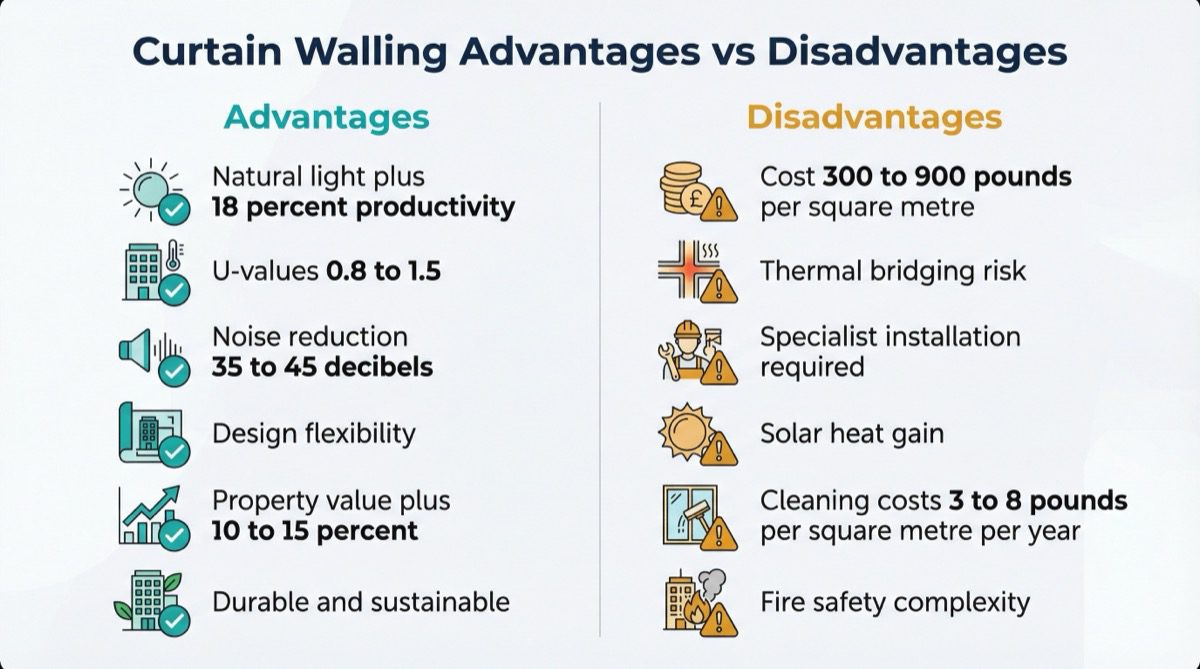
The most immediately noticeable benefit of curtain walling is daylight. A well-designed curtain wall facade can transmit up to 90% of visible light into the building, compared to 20–30% for a conventional masonry wall with punched windows.
That is not just an aesthetic preference. Research by the World Green Building Council found that workers in offices with optimised natural lighting reported an 18% increase in productivity and a 6.5% reduction in absenteeism. For a commercial landlord, those figures translate directly into tenant satisfaction and retention.
Maximising daylight also reduces dependence on artificial lighting by up to 40%. In a typical 2,000 m² office, that saving alone can knock £8,000–£12,000 off annual energy bills. It also earns credits under BREEAM and the WELL Building Standard, both increasingly demanded by corporate tenants.
Energy Efficiency and Part L Compliance
Modern curtain wall systems with thermally broken aluminium profiles and high-performance double or triple glazing achieve U-values between 0.8 and 1.5 W/m²K. That comfortably meets the requirements of Part L 2021 (Conservation of Fuel and Power), which sets maximum elemental U-values for new non-domestic buildings.
To put those figures in context, a solid brick wall achieves around 1.5–2.0 W/m²K, while older single-glazed curtain walls from the 1980s and 1990s sit at 4.0–5.5 W/m²K. A modern system with argon-filled triple glazing and a warm-edge spacer can reduce heat loss through the facade by up to 60% compared to those older installations.
The thermal break — a polyamide or polyurethane strip separating the inner and outer aluminium profiles — is the critical component. Without it, the aluminium frame acts as a thermal highway and U-value performance collapses. Reputable UK suppliers include thermal breaks as standard, but it is worth verifying the break depth (24 mm minimum) when reviewing specifications.
Lightweight Construction and Structural Savings
Aluminium weighs roughly a third of steel and a fraction of masonry. A typical curtain wall system weighs 25–50 kg/m², compared to 200–400 kg/m² for a brick-and-block cavity wall with windows. That weight reduction means smaller structural columns, less reinforcement, and potentially shallower foundations — savings that can partially offset the higher facade cost. On constrained sites with poor ground conditions, the structural saving alone can be substantial.
Design Flexibility and Aesthetic Impact
Curtain walling offers almost limitless design freedom. Aluminium profiles can be powder-coated to any RAL or BS colour, anodised in a range of metallic finishes, or clad with timber, stone, or composite panels. Profiles can be shaped into curves, facets, and angles that would be impractical with conventional construction.
Concealed vent systems maintain clean sightlines while providing natural ventilation, and spandrel panels can be colour-matched or patterned to create visual rhythm across the facade. For property developers, this visual impact has measurable commercial value — studies by the Royal Institution of Chartered Surveyors indicate that buildings with high-quality glazed facades command 10–15% higher rental values and sale prices compared to equivalent buildings with conventional cladding.
Noise Reduction
Standard curtain walling with sealed double-glazed units provides noise reduction of 30–35 dB. Upgraded systems with acoustic laminated glass and wider cavities push that to 35–45 dB, comparable to a solid masonry wall.
For offices near busy roads, railway lines, or flight paths, acoustic curtain walling can be the difference between a productive workspace and a constant distraction. The key is specifying the right glass make-up at design stage, because retrofitting acoustic performance later is expensive and often impractical.
Durability and Sustainability
Aluminium does not rust. A properly specified and installed curtain wall system has a working lifespan of 40–60 years, with polyester powder-coated finishes lasting 25–30 years before recoating is needed. Gaskets, seals, and drainage components are replaceable without dismantling the system.
Aluminium is also 100% recyclable with no loss of quality, and recycling uses just 5% of the energy needed to produce primary aluminium — a genuine advantage for projects targeting BREEAM Excellent or subject to whole-life carbon assessments.
Disadvantages of Curtain Walling
Higher Upfront Cost
There is no getting around this one. Curtain walling typically costs £300–£900 per m² fully installed, depending on system type, glass specification, and building height. By comparison, traditional rainscreen cladding with punched windows sits at £150–£300/m², and standard aluminium shop front systems at £150–£450/m².
For a medium-sized office building with 1,500 m² of facade, the difference could be £200,000–£500,000. That premium needs to be justified by energy savings, rental uplift, or design requirements — and in some cases, it simply is not. Understanding how project costs break down helps put these figures in perspective.
Thermal Bridging Risk
Every curtain wall system relies on brackets to connect the aluminium frame to the building’s structural steel or concrete. These brackets are potential thermal bridges — points where heat bypasses the insulated facade and escapes directly to the outside.
If the thermal break design is inadequate, or if brackets are not fitted with isolating pads, the real-world thermal performance of the wall can be significantly worse than the laboratory-tested U-value suggests. Thermal imaging surveys of completed curtain wall buildings regularly reveal cold spots at bracket locations, floor slab edges, and transom connections.
The solution is competent design and installation, which brings us to the next disadvantage.
Specialist Installation
Curtain walling requires specialist installers with experience in setting out, sealing, and commissioning glazed facade systems. Stick systems must be assembled on site in the correct sequence with each mullion and transom aligned to tight tolerances, while unitised systems need crane access and careful coordination with the main contractor’s programme. Silicone sealing cannot be carried out in rain or below 5°C, so on an exposed site in a British winter, programme delays are a real possibility.
Solar Heat Gain and Glare
Large areas of glass let in light, but they also let in heat. On south and west-facing elevations, uncontrolled solar heat gain through curtain walling can push internal temperatures well above comfortable levels during summer, forcing the air conditioning system to work harder and increasing energy costs.
Solar control coatings, tinted glass, external louvres, and fritted glass can all mitigate this, but every one of them reduces the daylight transmittance that made curtain walling attractive in the first place. Getting the balance right requires careful facade engineering at design stage. For buildings where glazing specification is critical, this trade-off deserves serious attention early in the project.
Cleaning and Maintenance Costs
Glass gets dirty. On a low-rise shop front, that means a bucket, a squeegee, and twenty minutes of someone’s time. On a multi-storey curtain wall building, it means cradle access systems, specialist cleaning contractors, and an annual bill that typically runs to £3–£8 per m².
Beyond the glass, gaskets and seals need inspection and replacement (typically every 15–20 years), and drainage channels need clearing. These are manageable costs, but they need to be budgeted for from the outset.
Fire Safety Complexity Post-Grenfell
The Building Safety Act 2022, introduced following the Grenfell Tower tragedy, has changed the fire safety requirements for glazed facades on buildings above 18 metres (roughly seven storeys). The requirements now include:
- Non-combustible materials — all components within the facade build-up must achieve A1 or A2 classification under BS EN 13501-1.
- Fire stopping — every junction between the curtain wall and the floor slab must be sealed with tested, certified fire-stopping systems to prevent vertical fire spread through the cavity.
- BS 8414 testing — large-scale fire performance testing may be required to demonstrate that the complete facade system meets the criteria in BR 135.
- Gateway process — for buildings falling under the Building Safety Act, facade designs are subject to review at Gateway 2 (before construction) and Gateway 3 (before occupation).
None of this makes curtain walling unsafe — properly specified systems perform well in fire. But the regulatory burden, testing costs, and documentation requirements add time and expense to the project programme. A curtain wall that was straightforward to specify in 2015 now requires considerably more design input and compliance evidence.
When Is Curtain Walling the Right Choice?
Curtain walling makes the strongest case for itself on:
- Multi-storey commercial buildings where maximising natural light, rental value, and energy performance across large facade areas justifies the investment.
- Prestige developments where architectural impact and a high-quality facade are central to the project’s commercial strategy.
- Buildings targeting BREEAM Excellent or Outstanding where the daylighting, energy, and material credits from curtain walling contribute to the overall rating.
- Tight-programme projects where unitised curtain walling (manufactured off-site while the structure is still going up) can accelerate the facade installation.
When Are Shop Front Systems a Better Fit?
Curtain walling is not always the answer. For many projects, a well-specified aluminium shop front delivers what is needed at a fraction of the cost.
- Ground-floor retail units — shop front systems are purpose-designed for single-storey applications with doors, signage zones, and stallriser panels. They cost less, install faster, and are easier to modify if tenants change.
- Single and two-storey commercial buildings — the structural and thermal advantages of curtain walling are less pronounced at lower heights, so the cost premium is harder to justify.
- Budget-constrained projects — when the facade budget is tight, shop front systems with high-performance commercial glazing can achieve good thermal and acoustic performance without the curtain wall price tag.
- Buildings in conservation areas — where planning officers may resist the modern aesthetic of full-height curtain walling, a more traditional shop front design (with the right shop front lighting) could gain approval more easily.
Frequently Asked Questions
What are the main disadvantages of curtain walling?
The main disadvantages are higher upfront cost (£300–£900/m² vs £150–£300 for traditional cladding), thermal bridging risk at bracket connections, solar heat gain on south-facing elevations, specialist installation requirements, ongoing glass cleaning costs, and increased fire safety complexity for buildings above 18 metres under post-Grenfell regulations.
Is curtain walling energy efficient?
Yes. Modern curtain wall systems with thermally broken aluminium frames and high-performance glazing achieve U-values of 0.8–1.5 W/m²K, meeting UK Part L 2021 requirements. They also reduce artificial lighting costs by up to 40% through increased daylight. However, poor specification — particularly inadequate thermal breaks or missing insulating pads at bracket connections — can reduce real-world performance considerably.
How much does curtain walling cost per square metre in the UK?
Curtain walling costs £300–£900 per m² fully installed, depending on system type (stick or unitised), glass specification, building height, and access requirements. Stick systems are cheaper for low to mid-rise buildings. Unitised systems cost more per m² but offer faster installation on taller projects.
Are curtain walls safe in a fire?
When properly specified and installed, yes. Fire-stopping at every floor-to-wall junction prevents vertical fire spread, and non-combustible materials are mandatory above 18 metres under the Building Safety Act 2022. Correct specification of cavity barriers, fire-rated spandrel panels, and tested fire-stopping systems compliant with BS 8414 and BR 135 is essential.
How long does a curtain wall system last?
A properly installed aluminium curtain wall has a working lifespan of 40–60 years. Powder-coated finishes last 25–30 years before recoating. Gaskets and seals typically need replacement every 15–20 years. Aluminium does not rust, so the framework can outlast the building itself with proper maintenance.
What is the difference between curtain walling and a shop front?
Curtain walling is a non-structural facade system for multi-storey buildings, spanning floor to floor and hanging from the structural frame. Shop front systems are ground-floor glazing solutions with doors, signage zones, and stallriser panels, designed for retail and commercial units up to two storeys. Curtain walling costs £300–£900/m² versus £150–£450/m² for shop fronts.
Does curtain walling reduce noise?
Standard curtain walling with sealed double-glazed units reduces external noise by 30–35 dB. Upgraded systems with acoustic laminated glass and wider cavities achieve 35–45 dB, comparable to a solid masonry wall. Acoustic glass specification should be addressed at design stage, as retro-fitting acoustic performance into an existing curtain wall is expensive.
Can curtain walling increase property value?
Yes. Research by RICS indicates that buildings with high-quality glazed facades command 10–15% higher rental values and sale prices compared to equivalent buildings with conventional cladding. The combination of natural light, energy efficiency, and visual impact makes curtain-walled buildings more attractive to commercial tenants and investors.
Get Expert Advice on Your Curtain Walling Project
Whether curtain walling is right for your building comes down to balancing performance, aesthetics, budget, and regulatory requirements. At Huxley & Co, we have been designing and installing curtain wall systems and commercial glazing across the UK for over 20 years, backed by FENSA registration, CHAS accreditation, and Constructionline certification.
Whether you need a full curtain wall facade or a high-performance shop front, we can survey your property, talk through the options, and provide a transparent quote.
Contact Huxley & Co on 020 7112 4849 or request a free consultation through our website.
Last updated: March 2026