

Key Takeaways:
- Over 170,000 commercial properties in the UK currently sit vacant, with 750,000 vandalised each year.
- Standard commercial insurance typically becomes void after 30-60 days of vacancy without documented security.
- Roller shutters cost more upfront (£500-£2,000+ per opening) but save thousands over repeated boarding.
- Squatting in commercial property is legal in England and Wales — physical barriers are the only reliable prevention.
- A combined approach of emergency boarding now, followed by permanent roller shutters, offers the strongest protection.
A landlord in Birmingham left a high street retail unit empty for six months after the tenant moved out. No shutters. No boarding. Just a locked front door and an alarm that nobody monitored. Within eight weeks, the glazing was smashed, copper piping had been stripped from the walls, and squatters had established themselves in the back rooms. The eviction cost £3,200 through the county court. The repair bill came to over £14,000 — and ultimately the landlord had to replace the entire shop front. The property sat unlettable for another four months while the work was completed.
It is a scenario that plays out thousands of times a year across the UK. With over 170,000 commercial properties standing empty and shop vacancy rates stuck around 10.8%, the question facing property owners and landlords is not whether a vacant property will attract trouble — it is when. And the answer, almost always, is sooner than you expect.
This guide covers everything you need to know about securing vacant commercial premises: the risks you face, the insurance obligations you need to meet, and why roller shutters and professional shop front boarding remain the most effective frontline defences available.
The Growing Problem of Vacant Commercial Property in the UK
Britain’s high streets are struggling. According to data from the Centre for Cities, roughly one in ten shops now stands empty nationwide. In some towns — Newport, Wigan, Middlesbrough — the figure climbs to one in seven. And these are not short-term gaps between tenants. Half of all vacant commercial units have been empty for three years or more.
The numbers tell a stark story:
- 170,000+ commercial properties sit vacant across the UK
- 10.8% average shop vacancy rate nationally
- 34 retail businesses collapsed in 2024 alone, closing 7,537 stores
- 50% of vacant units have been empty for three years or longer
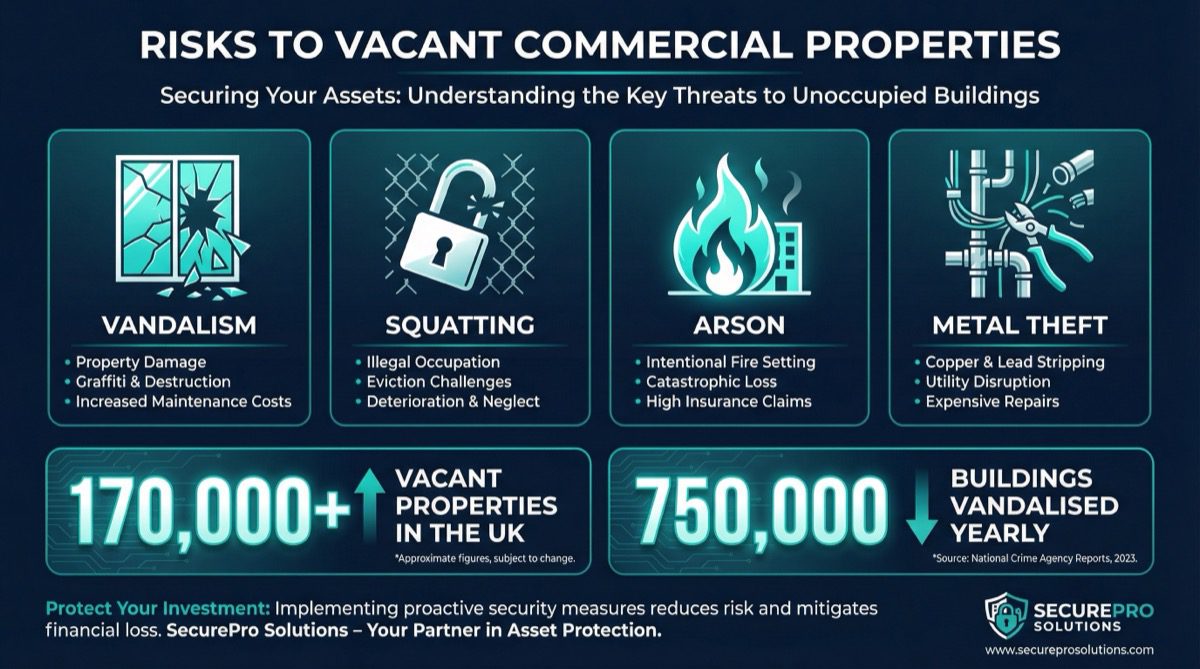
For property owners and managing agents, each empty unit represents an ongoing liability. There is no rental income to offset costs, but every risk — vandalism, squatting, arson, insurance complications — continues to accumulate. And the longer a property sits unprotected, the worse it gets. A building that looks abandoned attracts more trouble than one that looks secured. It is a cycle that feeds on itself.
The first 30 days after a property becomes vacant are the most important. That is when insurers expect you to act, when criminals start noticing, and when the cost of prevention is a fraction of the cost of repair.
Security Risks Facing Empty Shops and Commercial Premises
A vacant commercial property is not just sitting there quietly waiting for a new tenant. It is an active target. Without occupants, without regular foot traffic, and often without visible security, empty premises face a catalogue of threats that get worse with time.
Break-Ins and Theft
Metal theft has become one of the most persistent crimes targeting vacant buildings. Copper piping, lead roof flashings, aluminium window frames, boilers, wiring — materials that rust and corrode when left exposed — anything with scrap value gets stripped. A single break-in can cause £5,000 to £20,000 in damage, and that is before you factor in the lost rental income while repairs are carried out.
The scale is staggering. Office for National Statistics data shows that approximately 750,000 vacant buildings are vandalised every year in the UK. Empty retail premises with unprotected glazing or standard locks are among the easiest targets. A shop front with nothing more than a Yale lock and a plate glass window is not a barrier — it is an invitation. Upgrading to laminated glass adds a physical interlayer that holds the pane together even when struck, but for vacant premises, shutters or boarding are still the first line of defence.
Vandalism and Anti-Social Behaviour
Graffiti, smashed windows, fly-posting, and general criminal damage are almost guaranteed for unprotected vacant properties in urban areas. The damage itself is often relatively cheap to repair in isolation — a broken window here, spray paint removal there. But it adds up quickly, and the real cost is what it does to the property’s letting prospects.
A visibly damaged, neglected shopfront tells prospective tenants that the area is declining and the landlord is not engaged. Research shows that kerb appeal directly affects footfall, and damage accelerates that decline. Every week a property sits looking derelict, its potential rental value drops. Agents report that properties showing signs of vandalism take 40-60% longer to let than those maintained in good condition.
Squatters in Commercial Property
Here is the fact that catches most property owners off guard: squatting in a commercial property is not a criminal offence in England and Wales.
The Legal Aid, Sentencing and Punishment of Offenders Act 2012 criminalised squatting in residential buildings, but commercial premises were deliberately excluded. If someone gains entry to your empty shop or office without causing criminal damage during entry, removing them requires a civil court order — not a call to the police.
That process typically costs between £1,000 and £5,000 in legal fees and can take several weeks. During that time, squatters may cause significant internal damage, and you cannot lawfully remove them yourself. In the most extreme cases, continuous occupation of a property for 10 to 12 years can even lead to an adverse possession claim through the Land Registry.
The Ministry of Justice estimates around 20,000 individuals are squatting in unoccupied properties across the UK at any given time. Physical barriers — roller shutters, steel screens, professional boarding — are the only guaranteed method of preventing entry in the first place. Once someone is inside, you are already facing a legal process and a bill.
Fire and Arson
Home Office statistics paint a grim picture: roughly 60 fires occur daily in or beside empty buildings across the UK. Some are deliberate arson. Others start from rough sleepers, accumulated rubbish, or faulty electrics left live in abandoned premises.
A fire in a vacant building does not just damage that property. It threatens neighbouring businesses, can injure emergency responders, and creates liability exposure for the owner. If an insurer can demonstrate that you failed to take reasonable security precautions, a fire claim can be disputed or denied entirely.
Fly-Tipping and Environmental Damage
Vacant commercial properties with unsecured access points quickly become dumping grounds. Mattresses, construction waste, household rubbish, and sometimes hazardous materials get left on site. Clearance costs range from a few hundred pounds for light dumping up to £1,000 or more for serious accumulations. And as the property owner, you are responsible for the clean-up — not the fly-tippers, who are rarely caught.
Local councils can and do issue enforcement notices to property owners, adding fines on top of clearance costs. A property that has become a known dumping spot will attract repeat offenders unless access is physically blocked.
Insurance Requirements for Vacant Commercial Property
Your insurance policy almost certainly has a vacancy clause. Most property owners do not read it until they need to make a claim — and by then, it is too late.
Here is how it typically works:
The 30-60 day threshold. Standard commercial property insurance policies require you to notify your insurer when a property becomes vacant. Most policies impose altered terms after 30 to 60 days of unoccupancy. Fail to notify, and your cover may be void from the date the property became empty — not from the date you forgot to ring them.
Reduced cover (FLEA only). Once a property is classed as vacant, insurers typically strip cover back to what the industry calls FLEA: fire, lightning, earthquake, and aircraft impact. That means no cover for theft, vandalism, water damage, or most of the risks that vacant properties actually face. Some specialist vacant property policies offer broader cover, but they come at significantly higher premiums.
Physical security requirements. Virtually all insurers require documented physical security measures to maintain even basic cover on a vacant building. The standard expectations include:
- All ground-floor windows and doors boarded, shuttered, or fitted with steel screens
- Functioning intruder alarm system
- Documented weekly or fortnightly inspections with photographic evidence
- All access points locked with appropriate security hardware
- Utilities isolated where the insurer requires it
Why this matters for roller shutters. Installing roller shutters on a vacant commercial property satisfies the physical security requirement in a way that most insurers consider superior to boarding. Shutters are permanent, tamper-resistant, and can be inspected from the outside without requiring internal access. Several insurers have told us that properties with roller shutters attract more favourable terms than those relying on boarding alone.
Keep records of everything: the installation date, photographs before and after, the installer’s details, and your inspection log. If you ever need to make a claim, this paperwork is what stands between you and a rejection.
Roller Shutters: The Long-Term Security Solution for Vacant Properties
Every competitor in the vacant property security space talks about guards, cameras, and alarm monitoring. All of those have their place. But none of them physically prevent someone from walking through your front door.
A roller shutter does.
Why Roller Shutters Are the Strongest Defence for Empty Shop Fronts
Roller shutters work on a simple principle: create a physical steel or aluminium barrier across every access point that cannot be cut, pried, or kicked through. Unlike plywood boarding, which a determined intruder can breach in under two minutes with a crowbar, interlocking steel slats resist forced entry by design.
But the physical barrier is only half the story. A solid roller shutter on a vacant shop front sends a clear visual message: this property is actively protected. Opportunistic criminals — the ones responsible for most vacant property crime — move on to easier targets. They are looking for broken windows and rotting plywood, not steel shutters.
Types of Roller Shutters for Vacant Property Security
Not every vacant property needs the same type of shutter. The right choice depends on the security level required, the duration of vacancy, and whether you want visibility into the premises.
Solid steel or aluminium shutters offer maximum security. The interlocking slats form an unbroken barrier with no visibility through, making them ideal for properties at high risk of break-in or in areas with significant anti-social behaviour. They are the go-to choice for long-term vacant properties where security is the overriding priority.
Perforated roller shutters balance security with visibility. Small holes punched into the steel slats allow you to see into the premises from outside without entering, which is useful for conducting visual inspections and checking for water damage, squatters, or internal issues. They are also preferred by some councils and landlords because they look less imposing than solid shutters while still providing strong physical security.
Polycarbonate shutters use transparent panels between aluminium slats to maintain full visibility. They are more common on retail premises where the landlord wants to keep the shop front visible for marketing or re-letting purposes. A well-presented frontage with a strong design behind the polycarbonate makes a far better impression on prospective tenants. While they offer less physical protection than solid steel, they are still vastly superior to boarding and effectively prevent casual break-ins.
Manual vs. electric operation. For vacant properties, manual operation is often the practical choice. There is no dependency on a power supply that may be disconnected, and there are fewer moving parts to maintain. Electric shutters make sense where the property still has live power and where ease of access for inspections is a priority.
How Roller Shutters Help You Meet Insurance Requirements
Installing shutters on a vacant property does more than just keep people out. It creates a documented compliance trail that satisfies insurer requirements:
- Physical barrier evidence: Installation certificates and photographs prove that all access points are secured to a standard above the minimum boarding requirement.
- External inspection capability: Perforated shutters allow weekly inspections to be conducted from outside, reducing the time and cost of compliance.
- Premium benefits: Some insurers offer reduced premiums for properties with roller shutters compared to those secured with boarding only, recognising the lower risk profile.
- Long-term durability: Unlike boarding, which degrades and requires replacement, shutters maintain their security rating for 15-25+ years with minimal maintenance.
Emergency Boarding: Fast Protection When You Need It Now
Sometimes you do not have the luxury of planning ahead. A window gets smashed overnight. A break-in leaves the shop front wide open. Storm damage takes out a panel of glazing. In those situations, you need the property secured within hours, not days.
That is where emergency boarding comes in.
When Boarding Up Is the Right Choice
Boarding is the right response when speed matters more than permanence:
- Immediate aftermath of a break-in or vandalism — the property needs securing today, not next week
- Short-term vacancy — if a new tenant is confirmed within a few weeks, boarding bridges the gap
- Emergency weather damage — storms, floods, or impacts that leave openings exposed
- Insurance compliance — your insurer requires immediate action and boarding can be done same-day
Huxley & Co provides 24/7 emergency repair and boarding services across London and the wider UK, with same-day response for urgent situations.
Materials and Methods for Effective Boarding
Not all boarding is created equal. A few sheets of plywood nailed to a timber frame will last weeks at best and offers minimal resistance to a determined intruder.
Professional boarding uses 18mm OSB or marine-grade plywood secured with coach bolts or security fixings that cannot be easily removed from outside. For higher-risk properties, steel security screens provide a more robust alternative to timber boarding — though at a higher cost.
The difference between a professional boarding job and a DIY attempt is significant. Professionally installed boards sit flush, use tamper-resistant fixings, and cover the full opening without gaps. DIY boarding frequently leaves gaps at edges, uses screws that can be backed out with a drill, and looks obviously amateur — which, again, signals vulnerability rather than security.
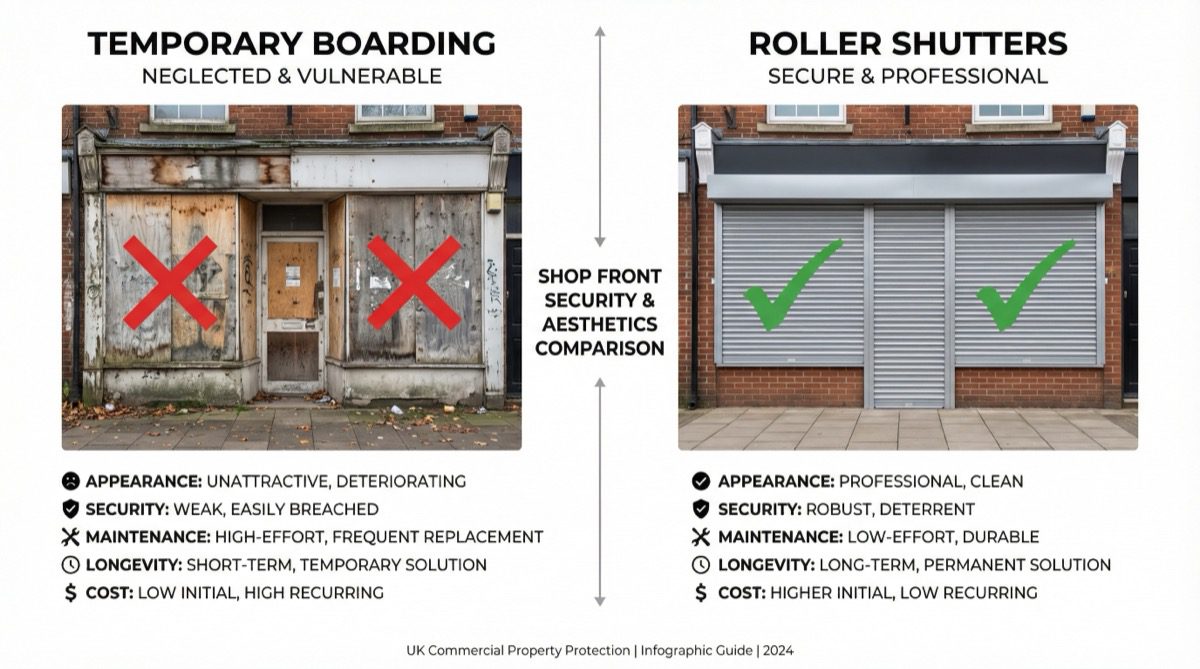
Roller Shutters vs. Boarding Up vs. Security Guards vs. CCTV: Which Is Right?
Property owners are often told to “layer” their security. That is sound advice, but it begs a question: where should you spend your money first? Here is how the four most common vacant property security measures compare.
| Factor | Roller Shutters | Boarding Up | Security Guards | CCTV |
|---|---|---|---|---|
| Security Level | High — interlocking steel/aluminium slats resist forced entry | Medium — plywood can be cut or pried within minutes | High — but only while on-site | Low — records crime but does not prevent it |
| Physical Prevention | Yes — blocks entry entirely | Partial — deters casual attempts only | Yes — while present | No — observation only |
| Durability | 15-25+ years | Weeks to months before degradation | Ongoing staffing required | Equipment lasts 3-5 years |
| Upfront Cost | £500-£2,000+ per opening | £200-£500 per opening | £10-£20 per hour | £1,500-£5,000+ for installation |
| Ongoing Cost | Minimal maintenance | Repeated replacement needed | £3,000-£7,000+ per month | £50-£200/month monitoring |
| 12-Month Total Cost* | £500-£2,000 per opening | £1,000-£2,500+ per opening | £36,000-£84,000+ | £2,100-£7,400+ |
| Insurance Compliance | Preferred by most insurers | Meets minimum requirements | Supplementary only | Supplementary only |
| Property Appearance | Professional, maintained | Signals abandonment | Neutral | Neutral |
| Squatter Deterrence | High — robust physical barrier | Medium — can be removed over time | High — while present | Low — no physical prevention |
| Reusability | Fully reusable when property re-lets | Single use, discarded after | N/A | Partially reusable |
*12-month estimates based on a single standard shop front opening. Security guard costs assume 12-hour night cover only. Actual costs vary by location, specification, and provider.
The comparison makes the economics clear. Boarding looks cheaper on day one, but over any vacancy lasting more than a few months, roller shutters are the more cost-effective option. Security guards and monitored CCTV serve important roles, but they are supplementary measures — they work best alongside a physical barrier that prevents entry in the first place.
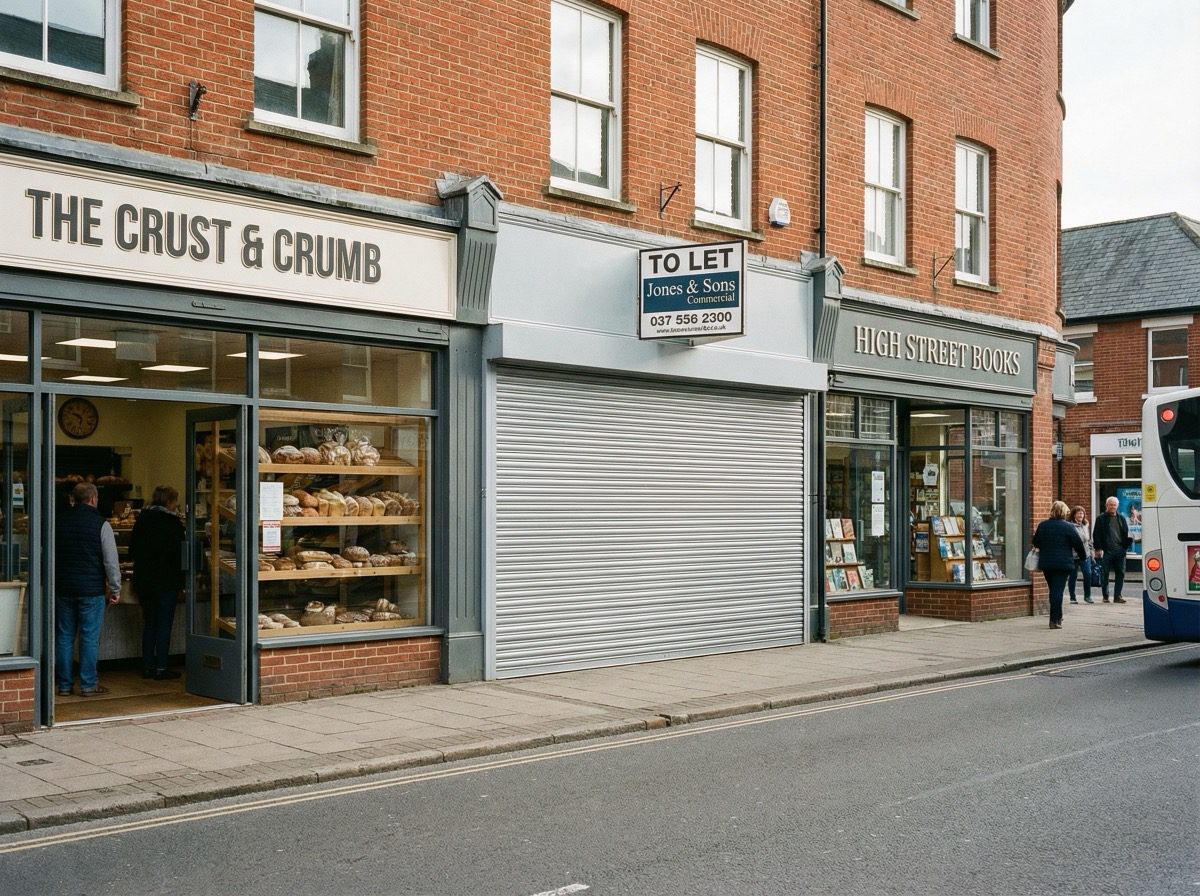
The Real Cost: Repeated Boarding vs. One-Off Roller Shutter Installation
Let us run the numbers on a scenario we see regularly: a standard high street retail unit with a single shop front opening, vacant for 12 months.
Scenario A: Boarding only
- Initial boarding: £350
- First replacement after vandalism (month 3): £350
- Second replacement after storm damage (month 7): £350
- Third replacement after attempted break-in (month 10): £400 (upgraded fixings)
- Total over 12 months: £1,450
- Plus: property looks derelict throughout, potentially delaying re-letting by months
Scenario B: Emergency boarding + roller shutter
- Emergency boarding on day one: £350
- Roller shutter installation (week two): £1,200
- Boarding removed once shutter is fitted: included
- Total over 12 months: £1,550
- Plus: property looks maintained, shutter remains as an asset for future use
The cost difference is marginal — around £100 in this example. But Scenario B leaves you with a permanent security asset that protects the property for the next 15-25 years, maintains its appearance for re-letting, and satisfies insurers to a higher standard. Scenario A leaves you with nothing but receipts for discarded plywood.
And that is assuming nothing serious happens. A single break-in where copper piping is stripped can easily cost £5,000-£20,000 in damage and repair. A squatter eviction through the courts adds £1,000-£5,000. A fire caused by unauthorised access can result in total loss. Against those figures, the cost of a roller shutter is trivial.
How to Secure Your Vacant Shop Front: A Step-by-Step Guide
Whether you are a landlord dealing with your first void property or a managing agent handling a portfolio, the process should follow the same sequence. Speed matters. Every day a vacant property sits unsecured increases the risk.
- Notify your insurer immediately. Do this within the first 30 days — ideally on day one. Ask specifically what security measures they require and get it in writing. Do not assume your existing policy covers you.
- Arrange emergency boarding of all ground-floor openings. Every window, door, and accessible opening needs to be secured. Use a professional service — Huxley & Co’s emergency boarding team can respond same-day across London and the UK.
- Commission a roller shutter survey and installation. Contact a specialist roller shutter installer to survey the property and quote for permanent shutters. Our guide on how to choose a shop front installer explains what to look for. Installation typically takes 5-10 working days from survey to completion.
- Set up a documented weekly inspection schedule. Your insurer will almost certainly require regular inspections. Photograph the exterior and interior at each visit, record the date and time, and store everything securely. A missed inspection can void your cover.
- Consider supplementary security measures. Depending on the location and risk level, you may also want to install an intruder alarm, external CCTV, perimeter lighting, or motion-activated deterrents. These work alongside — not instead of — physical barriers.
- Display clear signage. “Property Protected” or “24hr CCTV in Operation” signs are cheap but effective deterrents. They signal that the property is monitored and that criminal activity will be detected.
- Isolate utilities where required. Your insurer may require gas and water supplies to be turned off and drained to prevent leaks. Check their specific requirements — some also require electricity to remain live for alarm systems.
- Maintain photographic records. Before and after photographs of the property’s condition, every security installation, and each weekly inspection. If you ever need to make a claim, this evidence is essential.
Why Property Owners Choose Huxley & Co for Vacant Property Security
Most security companies sell one thing: guards, cameras, or alarms. Huxley & Co is different because we install the physical barriers that actually stop people getting in.
With over 20 years of experience installing roller shutters, shop fronts, and commercial glazing across London and the UK, we understand the specific vulnerabilities of commercial shopfronts. We have secured hundreds of vacant retail units, offices, and commercial premises — from single shops to multi-unit portfolios.
Here is what you get when you work with us:
- 24/7 emergency boarding: Same-day response when you need a property secured immediately. Call us any time — day, night, weekends, bank holidays. Our emergency repair team carries boarding materials on every van.
- Custom roller shutter solutions: We install solid, perforated, and polycarbonate roller shutters in any configuration, for any shop front size. Every installation is surveyed, specified, and fitted by our own team — no subcontractors.
- End-to-end service: From initial consultation and site survey through to installation, commissioning, and ongoing maintenance. We handle the full process so you have one point of contact.
- Insurance documentation: We provide installation certificates, photographs, and specification documents that satisfy insurer requirements for vacant property security compliance.
- Nationwide coverage: Based in London, working across the UK. We have secured vacant properties from central London high streets to retail parks in the Midlands and beyond.
Frequently Asked Questions
How do you secure a vacant commercial property?
Notify your insurer within 30 days of vacancy. Board up all ground-floor openings immediately using professional boarding services. Install roller shutters for long-term protection. Set up documented weekly inspections, consider supplementary CCTV and alarm systems, display security signage, isolate utilities as required, and maintain photographic records of the property’s condition throughout the vacancy.
Is it illegal to squat in a commercial property in the UK?
No. Squatting in commercial property is not a criminal offence in England and Wales. The 2012 legislation that criminalised squatting applies only to residential buildings. Removing squatters from commercial premises requires a civil court order, typically costing £1,000-£5,000 and taking several weeks. Physical prevention — through roller shutters and boarding — is the only reliable way to stop squatters gaining entry in the first place.
What happens to insurance when a commercial property becomes vacant?
Standard commercial property insurance typically becomes void or is severely restricted after 30-60 days of vacancy. Cover is usually reduced to FLEA only (fire, lightning, earthquake, aircraft impact), meaning no cover for theft, vandalism, or water damage. Insurers require documented physical security — boarding, shutters, or steel screens — along with functioning alarms and regular inspections. Failing to meet these requirements can void your policy entirely.
Are roller shutters effective for security?
Roller shutters are among the most effective physical security barriers for commercial premises. Steel and aluminium interlocking slats resist cutting, prying, and forced entry far more effectively than plywood boarding. They serve as both a physical barrier and a visible deterrent — a shuttered property signals active protection, causing opportunistic criminals to look elsewhere. Many insurers prefer roller shutters over boarding for vacant property compliance.
How much does it cost to board up a shop front?
Professional boarding of a standard shop front opening typically costs £200-£500 using plywood or OSB board. However, boarding degrades within weeks to months and often needs replacing after vandalism or weather damage. Over a 12-month vacancy, repeated boarding can cost £1,000-£2,500+ per opening. By comparison, roller shutters cost £500-£2,000+ per opening as a one-off installation with minimal ongoing maintenance.
What is the difference between boarding up and installing roller shutters?
Boarding is a temporary measure using plywood or OSB panels. It can be installed same-day but degrades quickly, can be breached relatively easily, and makes a property look derelict — which attracts further crime. Roller shutters are a permanent installation using interlocking steel or aluminium slats. They last 15-25+ years, resist forced entry far more effectively, maintain the property’s professional appearance, and are preferred by many insurers. For most vacant properties, the best approach is emergency boarding followed by permanent shutter installation.
Do insurers require vacant properties to be boarded up?
Most UK commercial property insurers require physical security measures for vacant premises, and boarding is typically the minimum acceptable standard. Many policies specifically require all ground-floor openings to be secured with boarding, shutters, or steel screens. Roller shutters generally receive more favourable treatment from insurers than boarding because they provide stronger, longer-lasting protection. Failing to secure your property as required will almost certainly void your cover.
Can roller shutters be fitted to any shop front?
Roller shutters can be fitted to virtually any commercial shop front configuration. They can be face-fixed to the exterior wall, recessed within the shop front frame, or installed behind an existing fascia. A professional installer will survey the property to determine the best mounting method based on the building structure, opening dimensions, and required security level. Both manual and electric operation options are available.
Are empty properties more likely to be targeted by arsonists?
Yes. Home Office data shows that approximately 60 fires occur daily in or beside empty buildings in the UK. Vacant properties face elevated arson risk because there are no occupants to detect fires early, combustible materials are often left behind by previous tenants, and unsecured premises attract rough sleepers and anti-social behaviour that increase ignition risk. Physical barriers like solid roller shutters reduce arson risk by preventing unauthorised access entirely.
How quickly can Huxley & Co secure a vacant property?
Our emergency boarding service operates 24/7 with same-day response for urgent situations including break-ins, vandalism, and storm damage. For roller shutter installation, we typically complete a site survey within 48 hours and carry out installation within 5-10 working days, depending on scope and specification. Where both immediate and long-term security are needed, we install boarding on day one while manufacturing and fitting shutters in the days that follow.
Protect Your Vacant Property Today
Every day an empty commercial property sits unsecured is a day closer to a break-in, a squatter, an insurance dispute, or worse. Whether you need emergency boarding right now or permanent roller shutters for long-term protection, Huxley & Co can help.
We offer free site assessments and no-obligation quotes for all vacant property security projects. Our team operates 24/7 for emergency boarding and can typically begin roller shutter installation within days.
Call us now: 020 7112 4849
Request a quote: Contact Huxley & Co