

Key Takeaways:
- Commercial electric roller shutters cost between £1,500 and £10,000+ installed, depending on size, motor type, and security rating.
- LPS 1175 security-rated shutters (SR1 to SR5) are recognised by UK insurers and can cut commercial premiums by 10-30% annually.
- Three motor types serve different needs: tubular for shopfronts, direct drive for industrial units, and central systems for multi-shutter complexes.
- Fire-rated shutters must comply with BS EN 16034, with E60, E120, and E240 classifications for 1, 2, and 4 hours of fire resistance.
- Annual servicing is a legal obligation under the Health and Safety at Work Act 1974, with maintenance contracts typically running £150-£400 per unit per year.
A warehouse manager in Croydon found out the hard way what happens when you cut corners on commercial security. The manual shutter on the loading bay had been sticking for months. Staff propped it open during shifts to avoid the hassle. One Friday evening, someone forgot to pull it down. By Monday morning, £40,000 worth of stock had walked out the door.
Commercial premises without adequate physical security are three to four times more likely to suffer a break-in than those with rated shutters and proper access control. And it is not just theft — fire compartmentalisation failures, Health and Safety prosecutions, voided insurance policies. The consequences of getting commercial shutters wrong go well beyond a broken lock.
This guide covers what UK businesses need to know about electric roller shutters for commercial premises: motor technologies, security and fire ratings, real costs, and your legal obligations.
Motor Types for Commercial Electric Shutters
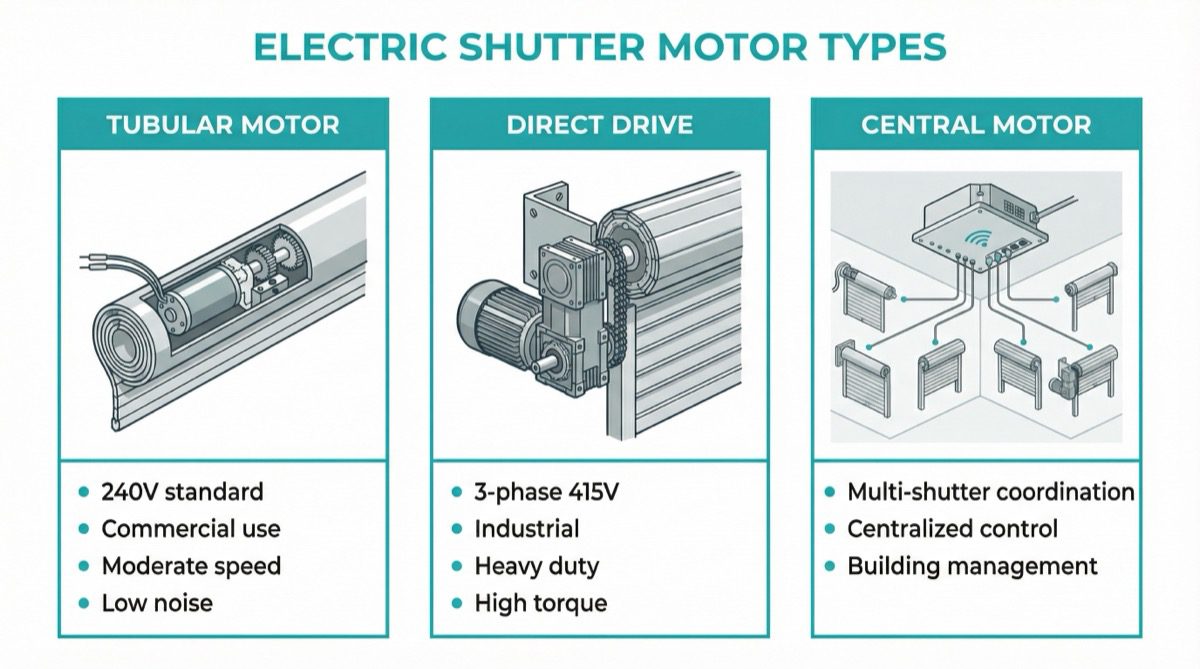
The motor determines how your shutter performs, how long it lasts, and what it costs to run. Commercial installations use three types, each suited to different applications.
Tubular motors sit inside the roller barrel, running on standard single-phase 240V supply. They are compact, cost-effective, and simple to install — the standard choice for high street shopfronts, offices, and premises that open and close once or twice a day. The limitation is that they are not built for very large openings, heavy curtains, or frequent cycling.
Direct drive motors mount externally to the roller tube. Available in single-phase (240V) and three-phase (415V), they handle heavier curtains and bigger openings. Three-phase motors deliver higher torque and greater efficiency, which translates to lower running costs over thousands of cycles. For warehouses, loading bays, and any shutter cycling dozens of times daily, direct drive is the go-to specification. They are also easier to service — accessible without removing the curtain.
Central motor systems coordinate multiple shutters simultaneously. Shopping centres and large commercial complexes use them to synchronise operation and incorporate safety interlocking across fire compartments.
| Motor Type | Power Supply | Best For | Key Advantage |
|---|---|---|---|
| Tubular | Single phase (240V) | Shopfronts, offices, low-frequency use | Compact, lower cost, simple installation |
| Direct drive (single phase) | Single phase (240V) | Medium commercial, moderate frequency | Easier maintenance, handles larger openings |
| Direct drive (3-phase) | Three phase (415V) | Warehouses, loading bays, industrial | Higher torque, lower running costs |
| Central system | Three phase (415V) | Shopping centres, multi-shutter complexes | Synchronised control, safety interlocking |
Control and Operation Methods
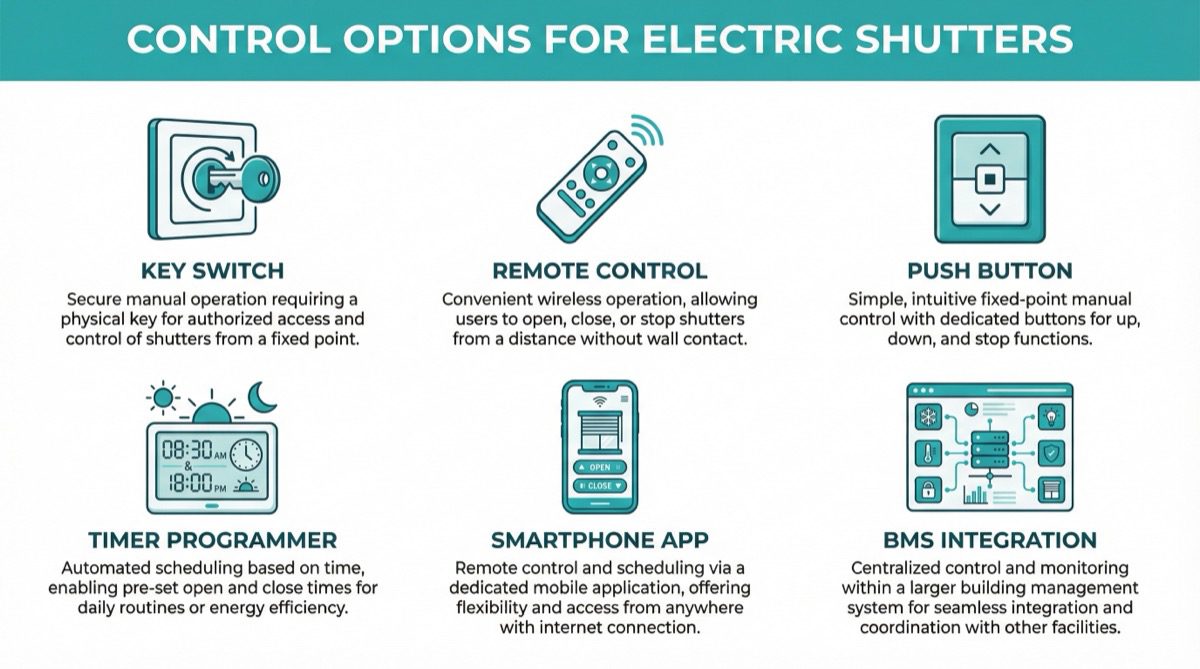
The right control system depends on who needs access, how often the shutter operates, and whether it needs to tie into your building’s wider security setup.
| Control Type | Best For | Notes |
|---|---|---|
| Key switch | Standard shopfronts | Physical key required; most common for retail |
| Rocker switch | Internal staff operation | Simple up/down wall switch inside premises |
| Remote control | Convenience, multiple operators | Wireless; 15-30m range; typically 2 handsets |
| Keypad / pin code | Shared access, tenant buildings | Eliminates lost key issues |
| Timer | Scheduled retail operation | Auto open/close at set times |
| BMS integration | Large facilities, multi-shutter | Building management system control |
| Smartphone app | Remote monitoring, multi-site | Audit trail of every opening/closing |
| Induction loops / PIR | Vehicle access, loading bays | Auto-detect approaching vehicles |
For most shops, a key switch or remote control will do. Multi-site operators and facilities managers benefit from app-based or BMS control. Loading bays and vehicle access points work best with sensor-activated systems, removing the need for drivers to leave the cab. If you are having issues with an existing setup, our guide to common roller shutter problems covers the most frequent control faults.
Types of Commercial Electric Roller Shutters
Different curtain designs prioritise different things — security, visibility, fire protection, insulation, or speed. Here is how the main types break down.
Solid roller shutters — interlocking galvanised steel or aluminium slats forming a continuous barrier. Strongest physical security. Standard for warehouses and industrial units. Zero visibility when closed.
Perforated roller shutters — small perforations punched into the slats allow passers-by to see window displays and interior lighting. The go-to choice for retail where you want security without turning the frontage into a fortress.
Polycarbonate shutters — transparent panels giving near-complete visibility. Popular with retailers who treat the after-hours window display as a marketing asset. Lower security than steel.
Rolling grille shutters — lattice of interlocking tubes. Maximum airflow and visibility. Common in shopping centres and indoor malls where the building perimeter provides the primary security.
Insulated shutters — foam-filled slats for thermal efficiency. Essential for cold stores, food processing, and temperature-controlled warehouses. Thermal values as low as 0.69 W/m2K.
Fire-rated shutters — purpose-built for fire compartmentalisation. Activate through the fire alarm and must comply with BS EN 16034. Covered in detail below.
High-speed shutters — operating at 1.0 to 2.3 m/s, ten times faster than standard. Built for busy loading bays, cold storage, and clean rooms where every second the opening is exposed costs money.
Security Ratings: LPS 1175, STS 202, and Secured by Design
The difference between a basic unrated shutter and a tested, certified product can determine whether your insurance claim is accepted or rejected. Understanding the rating system matters.
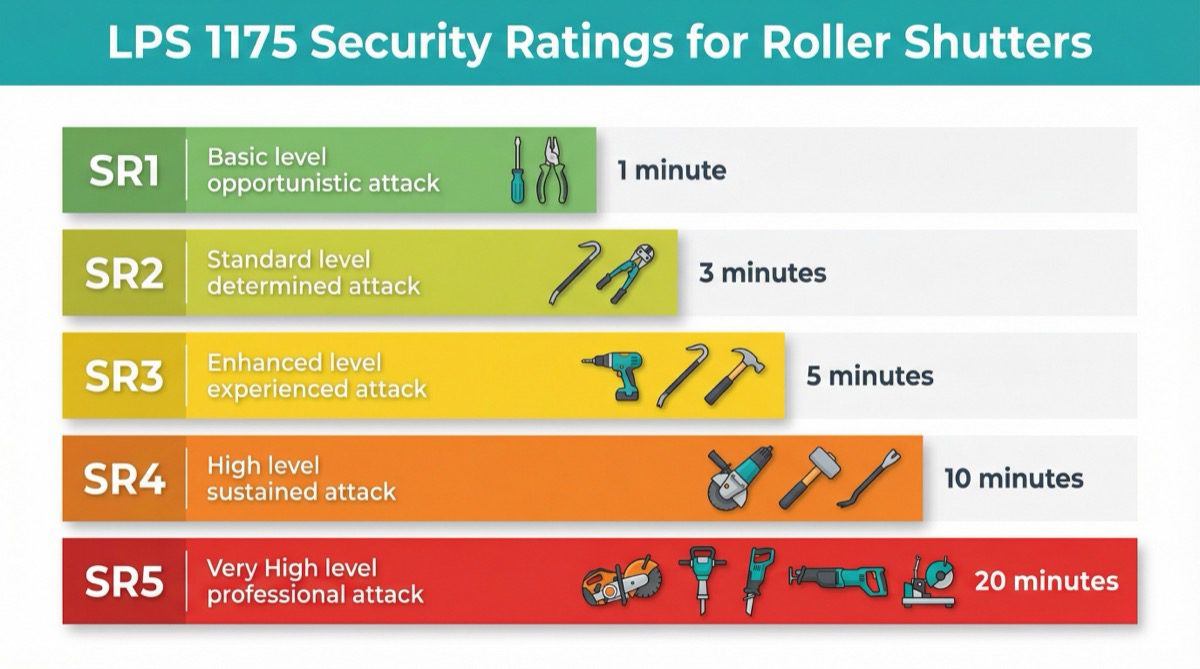
LPS 1175 is the UK’s primary security standard, administered by the Building Research Establishment. Shutters are physically attacked under controlled conditions and rated SR1 to SR5 based on their resistance.
| Rating | Attack Level | Suited To |
|---|---|---|
| SR1 | Casual/opportunist (hand tools) | Low-risk retail, offices |
| SR2 | Determined opportunist (powered tools) | Standard retail shops, commercial units |
| SR3 | Deliberate forced entry (heavy tools) | High-value retail, warehouses, distribution |
| SR4 | Experienced intruder (industrial cutting) | High-risk facilities, valuable stock |
| SR5 | Maximum security | Critical infrastructure, high-value assets |
LPS 1175 is recognised by the Association of British Insurers (ABI) and UK police. STS 202 is an alternative standard (ratings BR1-BR6) administered by Warringtonfire — less common in the UK market but accepted by some insurers.
Secured by Design (SBD) is the police-backed accreditation for crime prevention products. Properties with SBD-accredited shutters experience approximately 75% fewer burglary incidents. That figure carries serious weight with underwriters and is the benchmark to aim for if you want maximum insurance premium reduction.
Most high street shops and offices need SR1 or SR2. Warehouses and distribution centres should consider SR2 or SR3. High-value, high-risk premises push into SR3 to SR5. If your premises are currently unoccupied, vacant property security should be addressed urgently — empty buildings without rated shutters are among the highest-risk targets. Always confirm your insurer’s minimum requirement before specifying.
Fire Safety Compliance
Since November 2019, all new fire shutters must comply with BS EN 16034:2014 alongside BS EN 13241-1. CE marking is required (transitioning to UKCA), and installing a fire shutter without proper certification is a compliance failure with serious legal consequences.
Fire resistance classifications:
- E60 (1 hour) — standard for retail, offices, warehouse divisions
- E120 (2 hours) — larger commercial, manufacturing, mixed-use
- E240 (4 hours) — high-risk industrial, chemical, pharmaceutical
Fire shutters connect to the building’s fire alarm system. When triggered, a solenoid release initiates controlled descent. They also incorporate a gravity failsafe — if power fails during a fire, the shutter closes under its own weight. There is no scenario where a properly installed fire shutter remains open during an alarm.
The Regulatory Reform (Fire Safety) Order 2005 makes the building owner or managing agent responsible for fire shutter maintenance. Failure to maintain documented inspection records is a criminal offence. Our guide on vacant property security covers why fire protection is especially critical for unoccupied premises.
Speed Specifications
A standard shutter opening at 0.15 m/s takes roughly 20 seconds to clear a typical shopfront. Fine for a retail unit. Not fine for a loading bay handling 50 deliveries a day.
| Type | Opening Speed | Closing Speed | Best For |
|---|---|---|---|
| Standard commercial | 0.1 – 0.2 m/s | 0.1 – 0.15 m/s | Shops, offices, low frequency |
| Industrial | 0.2 – 0.5 m/s | 0.15 – 0.3 m/s | Warehouses, factories |
| High-speed | 1.0 – 2.3 m/s | ~0.5 m/s | Loading bays, cold storage, clean rooms |
High-speed shutters use frequency-regulated motors for smooth operation, and top models handle wind loads up to Beaufort force 13. In cold storage and food processing, minimising open time directly reduces energy waste.
Matching Shutters to Your Premises
A shutter that works for a Soho boutique would be wrong for a distribution centre in Tilbury. Here is what the right specification looks like across common commercial applications.
| Application | Shutter Type | Motor | Security |
|---|---|---|---|
| High street shops | Solid or perforated aluminium | Tubular | SR1-SR2 |
| Shopping centres | Polycarbonate or grille | Tubular / direct drive | SR1-SR3 |
| Warehouses | Solid steel, insulated | Direct drive (3-phase) | SR2-SR4 |
| Loading bays | High-speed, insulated | Direct drive (3-phase) | Standard-SR2 |
| Car parks | Solid or perforated steel | Direct drive | SR1-SR2 |
| Offices | Aluminium, insulated | Tubular | SR1-SR2 |
| Banks / high security | Solid steel, security rated | Direct drive | SR3-SR5 |
| Schools / healthcare | Fire-rated + security rated | Tubular / direct drive | SR1-SR2 + fire |
Consider how the shutter affects your frontage. If you are concerned about visual impact on your shop front, perforated and polycarbonate options keep the premises looking active after hours. Pairing shutters with good shop front lighting also helps maintain a welcoming appearance when closed.
How Much Do Commercial Electric Roller Shutters Cost?
Pricing depends on opening size, curtain material, motor type, security rating, fire compliance, control system, and finish. Here are realistic ranges based on current UK market pricing for supply and installation.
| Shutter Type | Supply + Install | Notes |
|---|---|---|
| Standard shopfront | £1,500 – £4,000+ | Tubular motor, aluminium curtain |
| Industrial | £2,500 – £8,000+ | Direct drive motor, heavy-duty steel |
| Security rated (LPS 1175) | £2,500 – £10,000+ | Insurance approved, certified |
| Fire rated (E60-E240) | £2,000 – £6,000+ | BS EN 16034 compliant |
| High-speed | £3,900 – £7,995+ | Frequency-regulated motors |
| Insulated | £2,276 – £5,000+ | Foam-filled aluminium or steel |
Additional costs to factor in: electrical work (£400-£2,500), powder coating and customisation (adds 10-30%), and access equipment hire (£450-£1,000) for above-ground installations.
Insurance Premium Savings
Security-rated shutters reduce commercial insurance premiums by 10 to 30 per cent annually. For a business paying £5,000 a year in premises insurance, that is £500 to £1,500 saved every year. Many commercial insurers now require physical security for ground-floor premises in high-risk areas — some refuse cover without it.
Factoring in insurance savings, the typical payback period is 3 to 7 years. After that, the premium reduction is pure saving for the remaining 10-20 years of service life.
UK Regulations and Legal Requirements
Commercial electric shutters sit at the intersection of several pieces of legislation. Business owners are responsible for compliance, and ignorance is not a defence.
- BS EN 13241-1:2003 — product safety standard for powered industrial doors. CE/UKCA marking mandatory.
- Health and Safety at Work Act 1974 — general duty to ensure equipment is safe.
- Workplace Regulations 1992 — powered doors must be maintained in efficient working order.
- Supply of Machinery (Safety) Regulations 2008 — powered doors classified as machinery.
- Fire Safety Order 2005 — fire shutter maintenance and inspection obligations.
Every commercial electric shutter must have: anti-fall-back devices on all powered shutters over doorways, obstruction detection where the switch is out of sight, an accessible manual override, and documented regular servicing. That last point catches more businesses out than any other — an annual service is a legal obligation, not a suggestion.
Maintenance and Servicing
Regular maintenance separates a shutter that lasts 25 years from one that fails after 8. Annual servicing covers curtain and guide inspection, motor testing, safety device checks, control system testing, and structural fixings. Cost: £150-£500 per unit per year.
Planned maintenance contracts (£150-£400/unit/year) include scheduled visits plus priority call-out response — many waive emergency call-out fees for contract customers.
Common repair costs:
- Motor replacement: £400-£500 + VAT
- Remote control replacement: £180 + VAT
- Key switch replacement: £140 + VAT
- Emergency call-out: £100-£250
- Fire shutter compliance inspection: £200-£500 annually
For maintenance best practices, see our guide to effective roller shutter maintenance. If your shutter is already showing faults, our roller shutter repairs guide covers the most common problems. And watch for corrosion on older installations — if your shop front is showing signs of rust, the shutter guides and fixings may be affected too.
Why Choose Huxley & Co for Commercial Electric Roller Shutters
Huxley & Co has been installing, maintaining, and repairing commercial roller shutters across London and the South East for over 20 years. We hold FENSA, CHAS, and Constructionline accreditations, and every installation is carried out by our own directly employed engineers.
We handle the full lifecycle — survey, specify, supply, install, maintain, and repair. If your shutter develops a fault, you call the same team that fitted it. We already know the specification, the motor type, and the access requirements.
We work with the full range: solid security shutters, perforated retail shutters, polycarbonate vision shutters, rolling grilles, fire-rated systems, and high-speed industrial doors. Every project starts with a free site survey.
Call us on 020 7112 4849 or request a free quote online.
Frequently Asked Questions
How much do commercial electric roller shutters cost?
Commercial electric roller shutters typically cost between £1,500 and £10,000+ fully installed, depending on size, material, security rating, and motor type. A standard aluminium shopfront shutter with a tubular motor runs from £1,500 to £4,000. Security-rated shutters certified to LPS 1175 start at around £2,500, while fire-rated and high-speed industrial shutters can exceed £8,000.
What happens to electric roller shutters in a power cut?
All commercial electric roller shutters installed to BS EN 13241 must include a manual override — typically a hand crank or chain hoist. Fire-rated shutters close automatically on power failure through a gravity failsafe, ensuring the building stays protected.
How often do electric roller shutters need servicing?
Annual servicing is the legal minimum under the Health and Safety at Work Act 1974. Shutters in high-frequency use should be serviced every six months. Fire-rated shutters require documented inspections under the Regulatory Reform (Fire Safety) Order 2005. See our full guide to roller shutter maintenance for practical steps.
Do electric roller shutters reduce insurance premiums?
Yes. Security-rated shutters can reduce commercial premiums by 10-30% annually. LPS 1175 is recognised by the Association of British Insurers, and Secured by Design shutters are associated with a 75% reduction in burglary incidents. Many policies require physical security as a condition of cover.
Can electric roller shutters connect to a fire alarm?
Yes. Fire-rated shutters integrate with building fire alarm systems through a solenoid release that triggers controlled descent. They comply with BS EN 16034 and include failsafe mechanisms ensuring closure even during power failure.
What is the difference between single-phase and 3-phase motors?
Single-phase motors (240V) suit most shopfronts and small-to-medium openings. Three-phase motors (415V) deliver higher torque and efficiency for heavy-duty applications — warehouses, loading bays, and large industrial doors where the curtain is heavy and cycling is frequent.
Do roller shutters need planning permission?
Usually not — commercial shutter installation typically falls under permitted development. However, listed buildings, conservation areas, and significant external alterations may require consent. Some councils prefer perforated or polycarbonate designs on high street frontages.
How long do electric roller shutters last?
With proper maintenance, 15 to 25 years or more. The motor is typically the first component needing replacement, usually after 7-15 years depending on usage. Regular servicing and prompt minor repairs are the keys to maximising lifespan.
What security rating do I need?
SR1 or SR2 covers most retail and offices. SR3 suits warehouses, distribution centres, and high-value premises. SR4 and SR5 are for critical infrastructure. Always confirm your insurer’s minimum requirement.
Are electric roller shutters worth the investment?
For most commercial premises, they pay for themselves within 3-7 years through insurance savings alone. Electric operation eliminates daily physical effort, reduces mechanical wear, and allows integration with timers, BMS, and remote controls. Get a free quote to see what electric shutters would cost for your premises.