
Key Takeaways:
- Toughened glass (BS EN 12150) is the most common shop front glass in the UK, but laminated or toughened laminated glass offers far better security against break-ins.
- UK Building Regulations require safety glass in critical locations — Approved Documents K, L, and Q each impose different requirements for safety, energy, and security.
- Glass supply costs range from £35/m² for 6mm toughened up to £260+/m² for fire-rated panels, with fully installed shop fronts typically running £300–£700/m².
- Seven glass types serve different purposes — toughened, laminated, toughened laminated, low-E/IGU, acoustic, self-cleaning, and fire-rated — and choosing the wrong one costs money or fails compliance.
- Glass thickness depends on application: 10mm toughened suits standard display windows, but jewellers and phone shops should specify 17.5mm+ toughened laminated at P6B security rating.
Walk down any busy UK high street and you will pass dozens of shop fronts with different glass. Some are crystal clear. Some have a slight green tint. And a depressing number have plywood boards nailed across them because someone put a brick through the wrong type of glass at two in the morning.
The glass you choose affects security, energy bills, noise levels, merchandise fading, insurance premiums, and Building Regulations compliance. Yet most business owners spend weeks on the frame colour and five minutes on the glass.
This guide covers seven types of shop front glass with real UK costs, British Standards, a thickness guide by application, and practical recommendations for every business type. Every recommendation comes from fitting commercial glazing across the UK for over 20 years.
Why the Right Glass Matters
Safety: Under Approved Document K, all glazing in critical locations must be safety glass — within 800mm of floor level in windows, 1,500mm in doors, and 300mm of door edges. Standard annealed glass is not compliant.
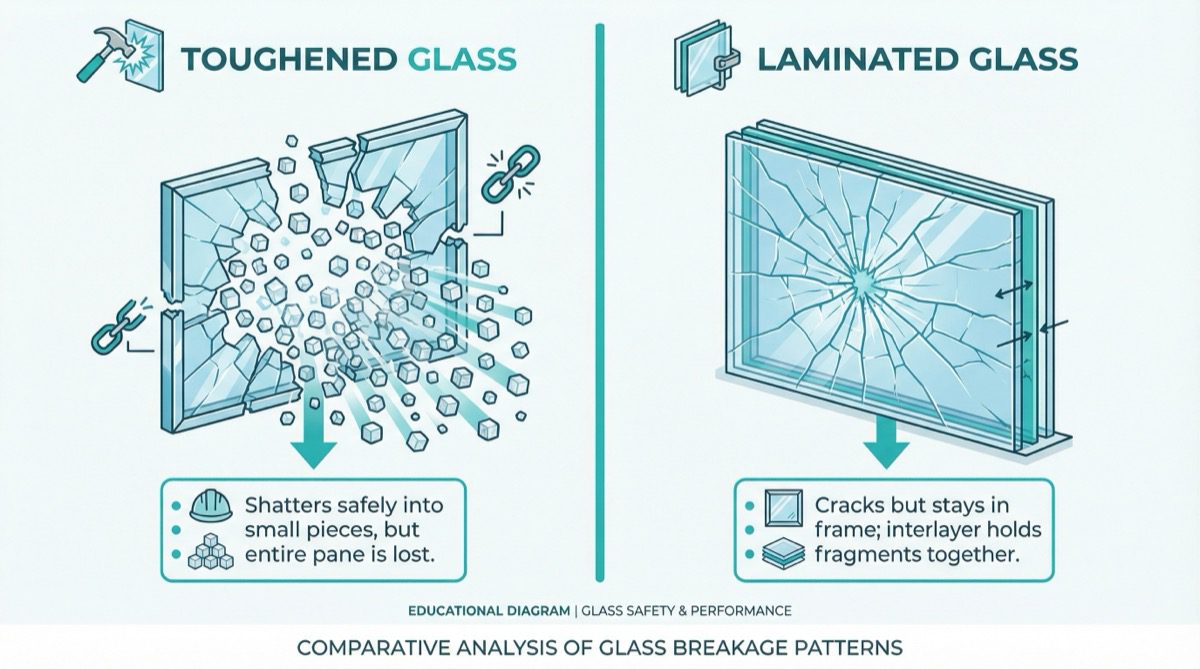
Security: Approved Document Q requires minimum P1A laminated glass (BS EN 356) adjacent to door locks in new-build ground floor premises. A 10mm toughened panel shatters entirely on impact. A 10.8mm laminated panel cracks but stays in the frame, potentially stopping a break-in.
Energy: Approved Document L (2022) requires new commercial glazing to achieve U-values below 1.6 W/m²K, which rules out single glazing for new installations. A low-E double glazed unit achieves 1.1–1.4 W/m²K — roughly 75% less heat loss.
The 7 Types of Shop Front Glass
1. Toughened (Tempered) Glass
Heated to 620°C and rapidly cooled, toughened glass is four to five times stronger than annealed glass. When it breaks, it shatters into small blunt pieces rather than dangerous shards. This is the baseline for toughened glass shop fronts and meets BS EN 12150.
The drawback: the entire panel collapses on breakage, leaving your premises wide open. It also blocks only about 25% of UV, so displayed stock will fade. Cost: £35–£90/m². Best for: Internal partitions, upper-floor glazing, frameless glass doors where security risk is low.
2. Laminated Glass
Two or more panes bonded with a PVB interlayer. If struck, it cracks in a spider-web pattern but stays in the frame — like a car windscreen. That means a physical barrier remains after impact, no emergency boarding is needed (saving £200–£400 in callout fees), and it blocks up to 99% of UV radiation. Manufactured to BS EN 14449.
Read our full guide to laminated glass advantages. Cost: £42–£110/m². Best for: Ground-floor retail, premises with displayed stock, south-facing shop fronts.
3. Toughened Laminated Glass
The premium option — toughened panes bonded with a laminated interlayer. You get the impact strength of tempering plus the retention of lamination. For jewellers, phone shops, and high-value retail, we recommend this at minimum P6B rating (BS EN 356), which withstands 31–50 hammer-and-axe blows. Cost: £95–£160/m².
4. Low-E Glass and Double Glazed Units (IGUs)
Low-emissivity glass has a thin metallic coating that reflects heat inward. In an IGU (two panes with an argon-filled cavity), it achieves U-values of 1.1–1.4 W/m²K — meeting Approved Document L. Standard commercial spec: 6mm outer toughened + 20mm argon cavity + 6.4mm laminated inner with low-E coating (BS EN 1279). Effectively mandatory for new installations. Cost: £80–£150/m².
5. Acoustic Glass
Uses a specially formulated PVB interlayer that dampens sound far more than standard laminated glass. A 10.8mm acoustic laminated panel achieves 41 dB noise reduction versus 29–31 dB for standard toughened. Worth knowing: standard double glazing can actually perform worse than single glazing at certain frequencies due to resonance — acoustic laminated glass avoids this. Cost: £90–£180/m². Best for: Busy roads, hair salons, restaurants, cafes.
6. Self-Cleaning Glass
Products like Pilkington Activ have a titanium dioxide coating that breaks down organic dirt (photocatalysis) and allows rainwater to sheet off evenly (hydrophilicity). It does not eliminate cleaning entirely but reduces frequency significantly. The coating is permanent. Cost: £70–£130/m². Best for: Large display windows, overhead canopies, high-pollution areas.
7. Fire-Rated Glass
Classified under BS EN 13501-1 as integrity-only (E-rated) or integrity plus insulation (EI-rated). E30 maintains a fire barrier for 30 minutes; EI60 maintains barrier and insulation for 60 minutes. Required for boundary-condition shop fronts and mixed-use buildings with flats above. Cost: £120–£260+/m².
Shop Front Glass Comparison Table
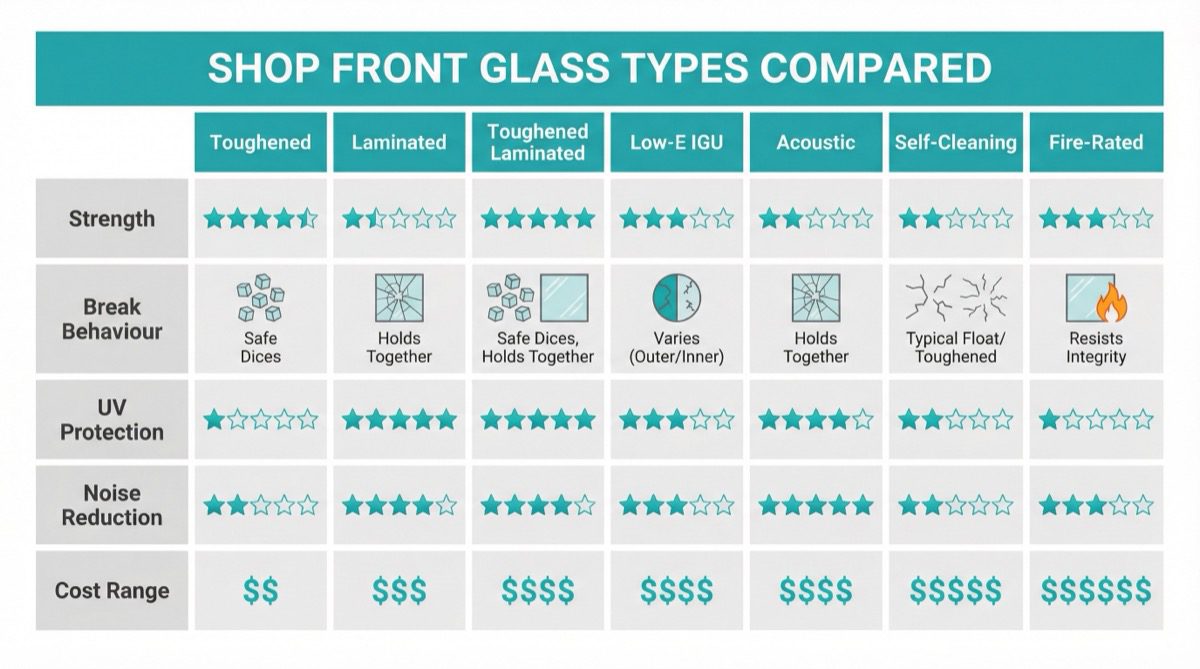
| Glass Type | Strength vs Annealed | Break Behaviour | UV Blocked | Noise Reduction | UK Standard | Cost/m² |
|---|---|---|---|---|---|---|
| Toughened | 4–5x stronger | Shatters; panel collapses | ~25% | 29–31 dB | BS EN 12150 | £28–£80 |
| Laminated | Same per pane | Cracks; stays in frame | Up to 99% | 33–42 dB | BS EN 14449 | £42–£120 |
| Toughened Laminated | 4–5x + retention | Cracks; stays intact | Up to 99% | 33–42 dB | BS EN 12150 + 14449 | £65–£160 |
| Low-E (IGU) | As per base glass | As per base glass | 60–75% | 36+ dB | BS EN 1279 | £80–£150 |
| Acoustic Laminated | Same as laminated | Cracks; stays in frame | Up to 99% | 37–54 dB | BS EN 14449 | £90–£180 |
| Self-Cleaning | As per base glass | As per base glass | As per base | As per base | Pilkington Activ | £70–£130 |
| Fire-Rated | Varies | Stays intact | Varies | Varies | BS EN 13501-1 | £120–£260+ |
What Thickness Glass Do You Need?
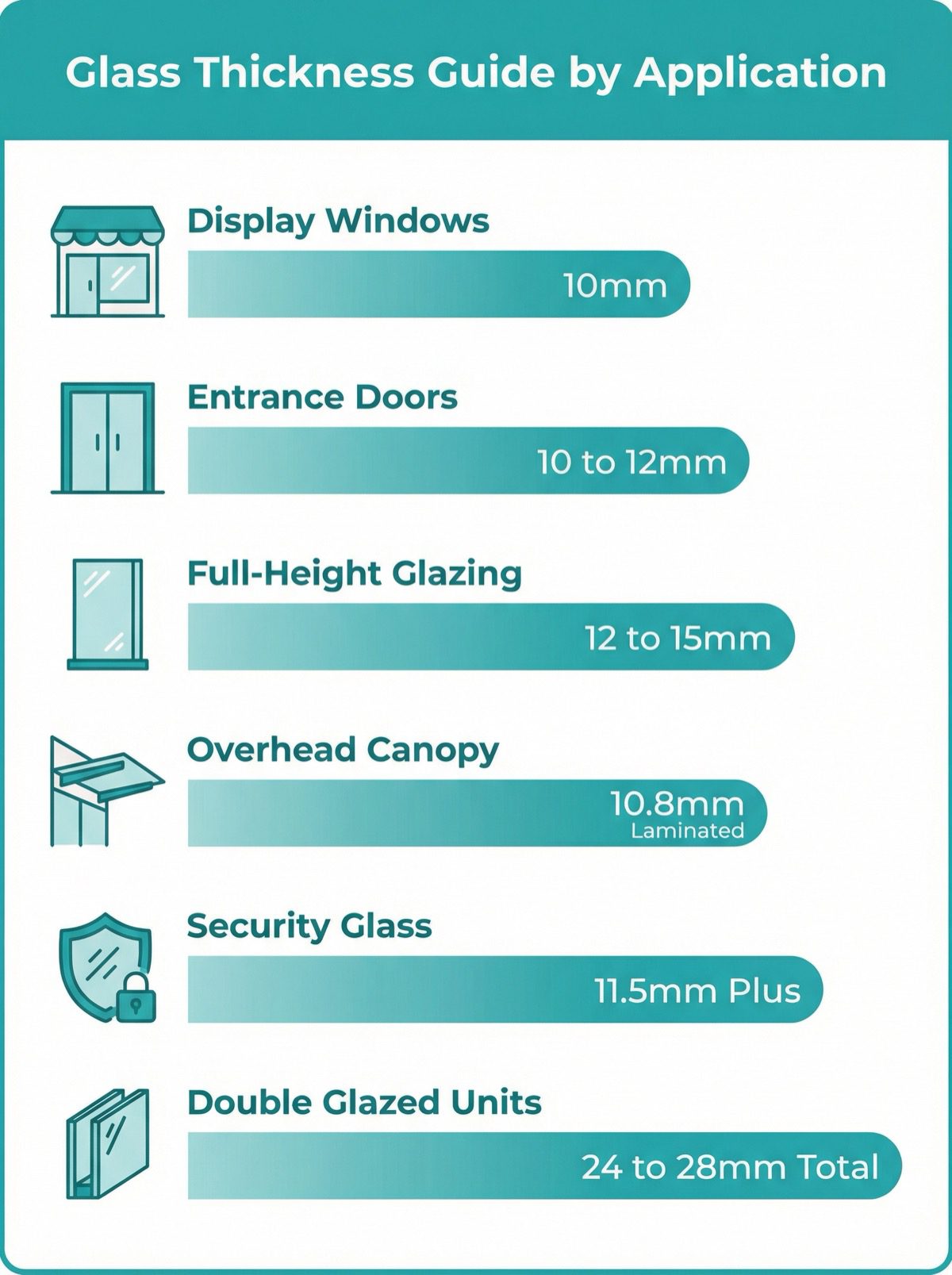
Thickness depends on pane size, building location, framing, and security risk. Here is a guide for standard UK commercial applications.
| Application | Minimum | Recommended | Notes |
|---|---|---|---|
| Standard display window | 6mm toughened | 10mm toughened or 6.4mm laminated | Safety glass required (Approved Document K) |
| Ground floor retail (security risk) | 6.4mm laminated | 11.5mm–13.5mm laminated | P1A min; P6B for high-value goods |
| Entrance doors | 10mm toughened | 12mm toughened or 10.8mm laminated | Heavy foot traffic, safety-critical |
| Overhead glazing / canopies | 6.4mm laminated inner | 8.8mm+ laminated inner | Laminated mandatory for inner pane |
| Frameless shop fronts | 10mm toughened | 12mm–19mm toughened | Edge-to-edge glass needs extra thickness |
| Jewellers / phone shops | 13.5mm laminated | 17.5mm+ toughened laminated (P6B+) | SGP interlayer recommended |
| Double glazed unit (IGU) | 4mm + 4mm | 6mm outer + 6.4mm laminated inner | Low-E on surface 2 or 3; argon fill |
For aluminium shop fronts, the framing typically accommodates 6mm up to 28mm IGU, but structural calculations depend on the specific profile. Always confirm thickness with your glazier before ordering.
UK Standards and Building Regulations
BS EN 12150 — The standard for thermally toughened safety glass. Toughened shop front glass must carry this kitemark, which covers the tempering process and fragmentation pattern.
BS EN 14449 — The equivalent for laminated glass, covering interlayer bonding and impact classification.
BS 6206 / BS EN 12600 — Impact performance standards. BS 6206 (Class A/B/C) has been largely superseded by BS EN 12600 (Class 1/2/3), which uses a pendulum test. You may see BS 6206 in older specifications.
Approved Document K — Mandates safety glass in critical locations: doors (within 1,500mm of floor), windows (within 800mm), side panels near doors (within 300mm, up to 1,500mm height), and overhead glazing (laminated inner pane mandatory).
Approved Document L (2022) — Requires new commercial glazing to achieve U-values below 1.6 W/m²K (target: 1.2 W/m²K). SBEM calculations required for non-domestic buildings.
BS EN 356 — Security classifications. P1A–P5A test resistance to thrown objects. P6B–P8B test resistance to sustained hammer-and-axe attack. P1A is the Document Q minimum for new builds; P6B is recommended for high-value retail.
How Much Does Shop Front Glass Cost?
Here are glass supply costs for the UK in 2025–2026. For full installed pricing including frames and fitting, see our shop front cost guide.
| Glass Type | Thickness | Cost/m² |
|---|---|---|
| Clear toughened | 6mm | £35–£45 |
| Clear toughened | 10mm | £55–£65 |
| Clear toughened | 12mm | £75–£90 |
| Laminated (PVB) | 6.4mm | £42–£55 |
| Laminated (PVB) | 10.8mm | £70–£90 |
| Laminated (PVB) | 13.5mm | £85–£110 |
| Toughened laminated | 13.5mm | £95–£130 |
| Toughened laminated | 17.5mm | £120–£160 |
| Acoustic laminated | 6.8mm | £90–£120 |
| Low-E double glazed unit | 28mm | £80–£130 |
| Self-cleaning | 6mm | £70–£100 |
| Fire-rated (E30) | 7mm | £120–£180 |
| Fire-rated (EI60) | 15mm+ | £180–£260+ |
Fully installed shop fronts (glass + aluminium or timber framing + fitting) typically run £300–£700/m², rising above £1,000/m² for frameless or specialist glazing.
Worth considering: cheaper glass can cost more long term. A toughened panel broken in a burglary needs emergency boarding (£200–£400), a replacement, and potentially lost stock. Laminated glass that stays in the frame often just needs a scheduled replacement at your convenience.
Which Glass Should You Choose?
High street retail: Low-E IGU with laminated inner pane. Meets Part L, provides security, UV protection, and noise reduction in one unit.
Restaurants and cafes: DGU with acoustic laminated inner pane for noise reduction. Especially valuable on busy roads where traffic noise at 70+ dB would otherwise dominate the interior.
Jewellers and high-value goods: 17.5mm+ toughened laminated at P6B minimum (BS EN 356). SGP interlayer rather than standard PVB for additional rigidity and attack resistance.
Noise-sensitive locations: Acoustic laminated glass. A DGU with 6.8mm acoustic laminated inner achieves 40+ dB reduction. For extreme environments near railway lines, triple glazing can reach 50–54 dB.
Listed or conservation areas: Laminated glass in a slim-profile IGU within timber framing. Meets aesthetic requirements and practical needs for security and thermal performance. If existing frames show corrosion, address that at the same time.
Frequently Asked Questions
Is toughened or laminated glass better for a shop front?
They serve different purposes. Toughened is stronger against impact and costs less. Laminated provides far better security (stays in frame when broken), blocks 99% of UV, and reduces noise. For ground-floor retail with displayed stock, laminated is the stronger choice. For low-risk internal glazing, toughened is more cost-effective. See our laminated glass advantages guide for a full comparison.
What thickness glass do I need for a shop front?
Standard display windows: 10mm toughened or 6.4mm laminated. Doors: 10–12mm toughened or 10.8mm laminated. High-security premises: 13.5–17.5mm+ toughened laminated. Frameless shop fronts: 12–19mm toughened. Always confirm with your glazier based on panel size and framing.
How much does shop front glass cost per square metre?
Supply costs range from £35–£45/m² for 6mm toughened up to £260+/m² for fire-rated glass. Common specifications (10mm toughened, 6.4mm laminated) fall in the £42–£65/m² range. Fully installed shop fronts run £300–£700/m². Full details in our shop front cost guide.
Is toughened glass a legal requirement for shop fronts?
Safety glass is required under Approved Document K in critical locations, but it does not have to be toughened. Laminated glass (BS EN 14449) is equally compliant. For new-build ground floor premises, Approved Document Q also requires minimum P1A laminated glass adjacent to locks.
What is the best security glass for a shop front?
Toughened laminated glass rated P6B or above under BS EN 356. At P6B, the glass withstands 31–50 hammer-and-axe blows before an opening can be created. Standard toughened glass provides minimal post-breakage security because the panel collapses entirely.
Can you get double glazed shop fronts?
Yes, and for new installations they are effectively mandatory under Approved Document L (2022). A typical spec: 6mm outer toughened + 16–20mm argon cavity + 6.4mm laminated inner with low-E coating, achieving U-values of 1.1–1.4 W/m²K. More detail in our double glazing vs single glazing guide.
What is anti-bandit glass?
Laminated or toughened laminated glass rated P6B or above under BS EN 356. The P6B test involves sustained hammer-and-axe attack — the glass must resist 31–50 blows before a 400mm x 400mm opening is created. Standard for jewellers, phone shops, and high-value commercial premises.
Does laminated glass reduce noise?
Yes. Standard 6.4mm laminated achieves 33–34 dB versus 29–31 dB for toughened glass. Acoustic laminated performs better still — 10.8mm acoustic laminated reaches 41 dB, and a DGU with acoustic laminated inner pane exceeds 40 dB.
What glass is required by UK Building Regulations?
Approved Document K requires safety glass (toughened or laminated) in critical locations. Approved Document L (2022) requires new installations to achieve U-values below 1.6 W/m²K, effectively mandating double glazing. Approved Document Q requires P1A laminated glass adjacent to locks in new-build ground floor premises.
Is low-E glass worth it for a shop front?
If you are doing a new installation or full replacement, you will almost certainly need it to meet Part L. Even for voluntary upgrades, low-E double glazing cuts window heat loss by roughly 75% compared to single glazing, with the energy savings typically paying back the extra cost within a few years.
Get the Right Glass for Your Shop Front
Choosing the right glass is about matching the specification to your actual needs. A clothing boutique on a quiet side street does not need P6B toughened laminated glass. A jeweller on a busy high street should not rely on basic toughened glass.
If you are planning a new commercial glazing project, replacing existing glass, or want to understand whether your current shop front is still fit for purpose, our team can assess your premises and recommend the right glass type and thickness for your situation.
Looking for design inspiration? Thinking about upgrading your shop front lighting at the same time? Wondering whether it is time for a full replacement?
Call us on 020 7112 4849 or email info@huxleyandco.co.uk for a free consultation. We are FENSA registered, CHAS accredited, and Constructionline certified.