

Key Takeaways:
- “Storefront” is the American term for what the UK industry calls a shop front glazing system — both describe ground-floor aluminium-framed facades that sit between structural openings.
- Shop front systems span a single storey (up to about 3 m) and are fixed within openings, while curtain walls hang from floor slabs and can rise the full height of a multi-storey building.
- Typical UK costs are £350–£520/m² for shop front glazing versus £300–£900/m² for curtain walling, with the wide curtain wall range reflecting different system types.
- Curtain walls are engineered for high wind loads, multi-directional movement, and individually drained panels — features that are unnecessary at ground level but critical above the first floor.
- Many commercial buildings combine both systems: shop front glazing at street level with curtain walling on the upper floors, giving the best balance of cost and performance.
A property developer we worked with last year had a mixed-use building in south-east London — retail on the ground floor, three storeys of offices above. His architect specified curtain walling from the ground up, and the glazing quote came back at over £185,000.
We switched the ground floor to a shop front glazing system and kept curtain walling only from the first floor upward. That saved him close to £40,000.
Shop front systems and curtain walls are both aluminium-framed, glass-filled facades that can look identical from the outside. But they are engineered for different jobs. Getting the distinction right saves money without compromising performance. Getting it wrong means overpaying — or under-specifying a facade that cannot handle the loads it will face.
A Note on Terminology: Storefront vs Shop Front
If you have been searching for “storefront vs curtain wall,” you will have noticed that most results come from American websites. “Storefront” is the US term for what the UK glazing industry calls a shop front system. The products are functionally the same — aluminium-framed glazing for ground-floor commercial premises. Throughout this article, we use “shop front” because it is the term UK architects and building owners actually use.
What Is a Shop Front Glazing System?
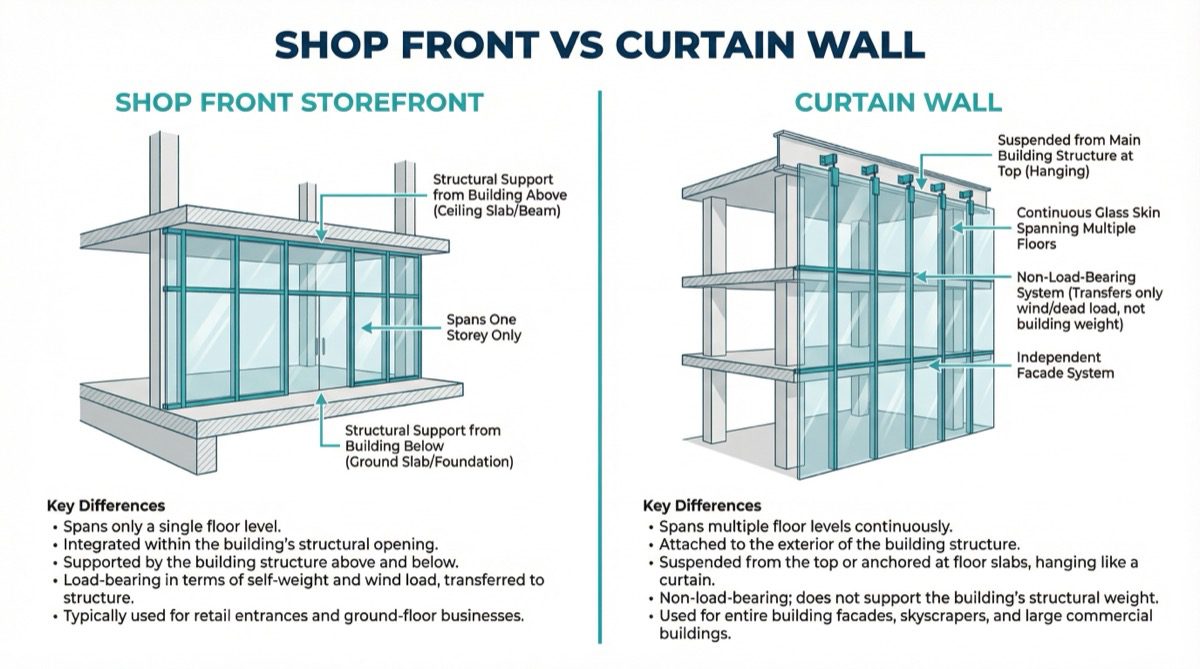
A shop front system is an aluminium-framed facade designed to fill the structural openings on a building’s ground floor. The frame sits between columns, walls, or steelwork that carry the building’s weight — the shop front itself carries no structural load beyond its own weight and ground-level wind load.
Typical applications include retail units, restaurants, showrooms, and ground-floor office entrances. Frame depths are usually 50–65 mm, and maximum heights sit around 3 m. If you are looking at aluminium shop fronts for a standard high-street unit, this is the system you need.
Shop fronts are manufactured under BS EN 14351-1, the standard covering windows and pedestrian doorsets. Water management is straightforward: rain that gets past the outer seals drains through the frame to weep holes at the sill.
What Is a Curtain Wall System?
A curtain wall is an aluminium-and-glass facade that hangs from a building’s structural frame rather than sitting within openings. It is fixed to floor slabs using brackets and anchors, spanning multiple storeys — sometimes the full height of the building.
Like a shop front, a curtain wall carries no structural load. The difference is that environmental loads are much greater at height: wind pressures increase with elevation, and the system must accommodate thermal expansion, building sway, and floor deflection. Curtain walls are covered by BS EN 13830, with more rigorous testing requirements. For a deeper look at system types, see our complete guide to aluminium curtain wall design.
Key Technical Differences
From the pavement, both systems look like aluminium frames filled with glass. The engineering underneath is where they diverge.
Structural Attachment and Height
A shop front is installed within a structural opening — between columns, between a floor slab and a lintel, or between masonry walls. That limits it to single-storey spans, typically up to about 3 m.
A curtain wall is hung from the structural frame using adjustable brackets fixed to floor slabs. It passes in front of the floor edges, hanging like a curtain. Each floor slab provides a new fixing point, so there is no practical height limit.
Wind Load and Movement
Shop fronts are tested for ground-level wind pressures. Curtain walls are engineered for site-specific loads calculated per BS EN 1991-1-4, accounting for height, terrain, and building shape — wind pressure on the tenth floor can be several times greater than at street level.
Curtain walls must also accommodate thermal expansion of 3–5 mm per storey, interstory drift of up to 76 mm, and floor deflection under load. None of these forces are significant at ground level, so shop fronts need minimal movement tolerance.
Water Management
Shop fronts drain all water to weep slots at the sill. Curtain walls use pressure-equalised zone drainage, with each panel individually drained at transom level. On a tall building, water that enters at the twentieth floor should not need to travel to the ground — zone drainage prevents that.
Thermal Performance
Both systems must meet Part L of the Building Regulations. Curtain walls generally deliver better U-values because deeper frames accommodate wider thermal breaks: 0.8–1.2 W/m²K for high-performance curtain walls versus 1.4–2.0 W/m²K for shop fronts. Specifying double glazing with argon fill and low-E coatings narrows the gap at ground level.
Shop Front vs Curtain Wall: Comparison at a Glance
| Feature | Shop Front (Storefront) | Curtain Wall |
|---|---|---|
| Typical height | Up to 3 m (single storey) | Multi-storey (no practical limit) |
| Frame depth | 50–65 mm | 50–200 mm+ |
| Structural role | Non-loadbearing; fixed within openings | Non-loadbearing; hung from floor slabs |
| Floor spanning | Single storey only | Spans multiple floors |
| Water management | Drains to sill weep slots | Individually drained at each panel |
| Wind load capacity | Ground-floor sheltered conditions | Engineered per BS EN 1991-1-4 |
| Thermal performance (U-value) | 1.4–2.0 W/m²K | 0.8–1.6 W/m²K |
| Movement tolerance | Minimal | 3–5 mm/storey + up to 76 mm drift |
| Installation | From ground level | Scaffolding, mast climbers, or crane |
| UK product standard | BS EN 14351-1 | BS EN 13830 |
| Cost (supply + install) | £350–£520/m² | £300–£900/m² |
| Best suited for | Retail, restaurants, showrooms | Multi-storey offices, high-rise, public buildings |
Cost Comparison: Shop Front vs Curtain Wall
Installed costs for a standard aluminium shop front in the UK typically fall between £350 and £520/m², depending on frame finish, glass specification, and door configuration. For a detailed breakdown, see our guide to shop front costs.
Curtain wall costs span £300–£900/m², from basic stick-built systems on straightforward mid-rises to structural glazing on complex high-rise projects. Curtain walling also requires scaffolding or mast climbers, adding £20–£50/m² in access costs.
The real savings come from specifying the right system for the right part of the building. Using curtain walling where a shop front would do the job means paying for engineering you do not need at ground level.
When to Choose a Shop Front System
A shop front system is the right choice when the glazing is ground-floor only (under 3 m), the facade sits within a structural opening, wind exposure is low, and budget matters. Common applications include high-street retail, restaurants, car showrooms, estate agents, and ground-floor office receptions. For design inspiration, see our guide to unique ideas for shop front designs.
When to Choose a Curtain Wall System
Choose a curtain wall when the glazing extends above the ground floor, the building is in an exposed location, the facade must accommodate significant movement, or a seamless floor-to-ceiling glass aesthetic is required. Typical applications include multi-storey offices, atriums, high-rise residential, and transport hubs.
Hybrid Solutions: Using Both Systems Together
On many projects, the answer is not one or the other — it is both.
A mixed-use building with retail at ground level and offices above is a textbook case. The ground floor gets a shop front system with display windows, accessible doors, and signage flexibility. From the first floor up, curtain walling provides the capacity the upper storeys demand.
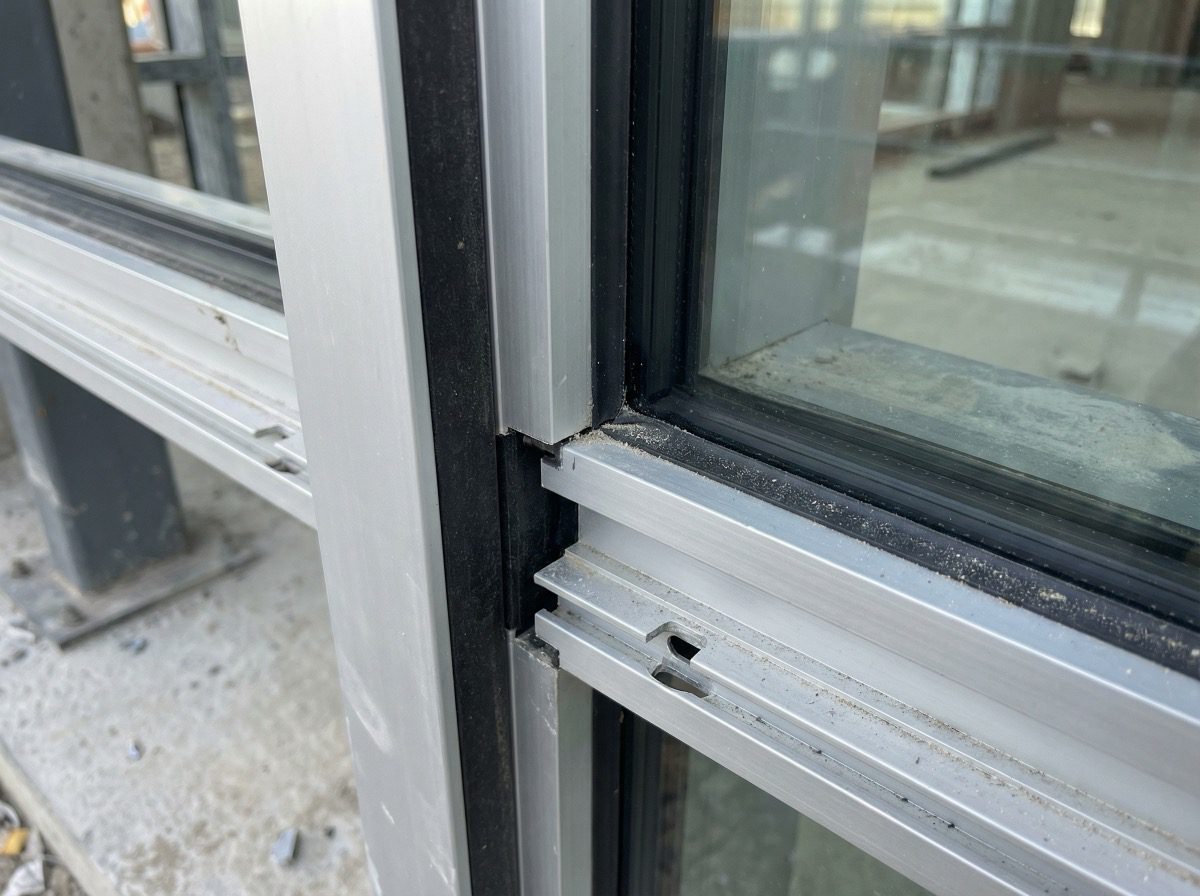
Done well, the transition is invisible from street level. Aluminium profiles are colour-matched, sightlines aligned, and the junction weathered and fire-stopped to full curtain wall standards. This approach is increasingly common across new UK commercial glazing projects.
Frequently Asked Questions
What is the difference between a storefront and a curtain wall?
A storefront (shop front) sits within structural openings at ground-floor level. A curtain wall hangs from floor slabs and spans multiple storeys. The key differences are height capability, wind load capacity, movement tolerance, water management, and cost.
Is a storefront the same as a shop front?
Yes. “Storefront” is the American term and “shop front” is the UK equivalent. Both describe aluminium-framed glazing systems for ground-floor commercial premises.
Can a shop front system be used above the ground floor?
Generally no. Shop fronts are designed for single-storey spans within structural openings and are not engineered for the wind loads, building movement, or water management demands above ground level.
Why is the curtain wall cost range so wide?
It spans £300–£900/m² because pricing depends on system type (stick-built vs unitised vs structural glazing), building height, glass specification, and site-specific engineering. Shop front pricing is narrower because the variables are fewer.
Which system has better thermal performance?
Curtain walls achieve U-values of 0.8–1.6 W/m²K versus 1.4–2.0 W/m²K for shop fronts, thanks to deeper frames and wider thermal breaks. But a well-specified shop front with double glazing comfortably meets Part L at ground level.
Do both systems need to comply with Building Regulations?
Yes. Both must meet Part L (energy efficiency), Part B (fire safety), and Part K (protection from falling). Shop fronts are tested to BS EN 14351-1; curtain walls to the more rigorous BS EN 13830.
What is a hybrid glazing system?
A hybrid uses shop front glazing at ground level and curtain walling on upper floors. It is common on mixed-use developments and gives the best balance of cost and performance.
How do I know which system my building needs?
The deciding factors are building height, structural configuration, wind exposure, thermal targets, and budget. Single-storey ground-floor units nearly always suit a shop front. Multi-storey facades need curtain walling. Mixed-use buildings often benefit from both. Call us on 020 7112 4849 or get in touch for project-specific advice.
Getting the Right System for Your Project
The right choice depends on what each part of the building demands. Specify a curtain wall where a shop front would do the job and you overspend. Specify a shop front where you need a curtain wall and you risk water ingress, seal failure, and remedial costs that dwarf the original saving.
Huxley & Co has been designing and installing both shop front systems and curtain wall facades across the UK for over 20 years, with FENSA, CHAS, and Constructionline accreditations. Not sure which system your project needs? Call 020 7112 4849 or request a free consultation.